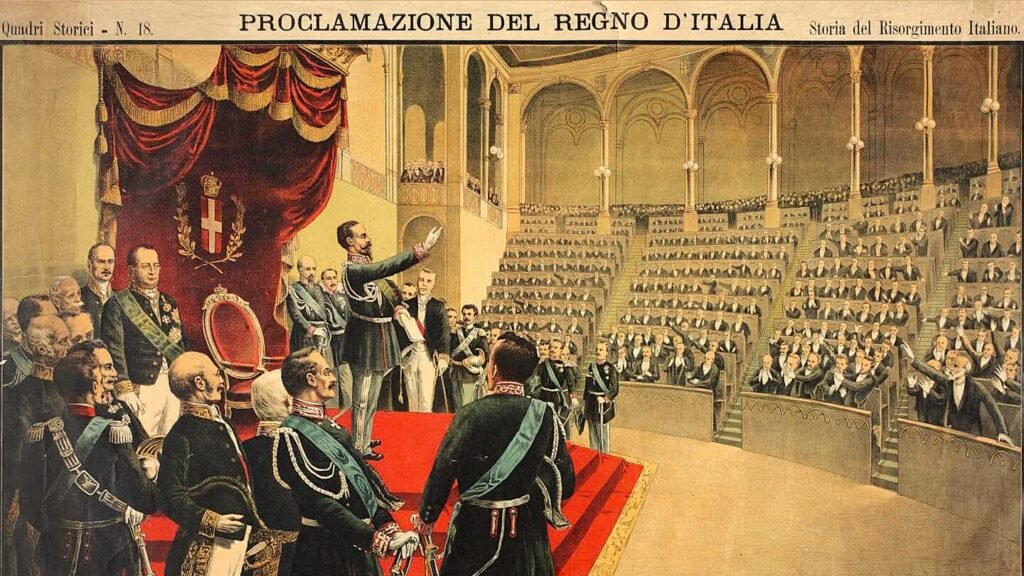
The unification of Italy, also called the Risorgimento, was the nineteenth-century political process that joined the separate states of the Italian peninsula into one kingdom. The Kingdom of Italy was proclaimed on 17 March 1861 under Victor Emmanuel II of Piedmont-Sardinia, and it later took in Venetia in 1866 and Rome in 1870.
Background to the unification of Italy
Italy had never been a single state in modern times. The Italian Encyclopedia Treccani notes that the idea of an Italian nation appeared in educated circles in the eighteenth century, and that the French occupation under Napoleon created a short-lived Italian Republic in 1802 and a Kingdom of Italy in 1805, both limited to parts of the north. The tricolor of green, white and red, born in 1797, later became the national flag.
The Congress of Vienna of 1814 and 1815 divided the peninsula again into many states under direct or indirect Austrian influence. The Austrian chancellor Metternich dismissed Italy as a mere geographical expression. Secret societies such as the Carbonari organized revolts in the 1820s and 1830s, but all were put down. In 1831 Giuseppe Mazzini founded Young Italy, which aimed at a free, united and republican nation, yet its uprisings also failed and did not win the support of the peasant majority.
A second current favored change through monarchs and diplomacy. The moderates looked to the House of Savoy, which ruled the Kingdom of Piedmont-Sardinia, as the one Italian dynasty strong enough to challenge Austria.
Course of events: the wars of independence
The revolutions of 1848 reached Italy. Venice rose on 17 March and Milan on 18 March, and after five days of fighting Austrian troops under Marshal Radetzky left Milan. On 23 March King Charles Albert of Piedmont declared war on Austria, which began the first war of independence. The campaign ended with Austrian victories at Custoza in July 1848 and at Novara in 1849. Charles Albert abdicated in favor of his son Victor Emmanuel II. In 1849 a republic was declared in Rome, with Mazzini as a leader and Giuseppe Garibaldi among its defenders, but French troops restored Pope Pius IX. Venice, the last republic to resist, surrendered on 24 August 1849 after a siege and a cholera epidemic.
The leading figure of the next decade was Camillo Benso, Count of Cavour, who headed the Piedmontese government from 1852. A liberal, Cavour believed Piedmont needed the help of France and Britain. At the Paris conference of 1856 he raised the Italian question before the great powers. In 1858, in secret talks at Plombières, he reached an agreement with Napoleon III under which France would fight alongside Piedmont if Austria attacked.
Austria declared war on 26 April 1859, which began the second war of independence. French and Piedmontese forces won at Magenta, San Martino and Solferino, but Napoleon III then signed the armistice of Villafranca, and only Lombardy passed to Piedmont. Cavour resigned in anger. He returned when Napoleon accepted the annexation of Tuscany and Emilia to Piedmont in exchange for Nice and Savoy going to France.
The south was won by a different route. Garibaldi sailed from Quarto near Genoa in the night of 5 to 6 May 1860 with about a thousand volunteers, the Expedition of the Thousand, and conquered Sicily in two months, proclaiming himself dictator in the name of Victor Emmanuel II. When he crossed to the mainland and advanced on Naples, Cavour feared the democrats would seize the initiative and arranged for the Piedmontese army to intervene. It defeated papal troops at Castelfidardo and annexed the Marche and Umbria, while Garibaldi defeated the Bourbon forces on the Volturno. At Teano, Garibaldi handed southern Italy to the king.
Proclamation of the Kingdom of Italy
The first national Parliament, meeting in Turin, proclaimed the Kingdom of Italy on 17 March 1861. The US Office of the Historian records that the United States accepted the credentials of Chevalier Joseph Bertinatti as minister of the Kingdom of Italy on 11 April 1861, which it treats as formal recognition.
The new state was not yet complete. Venetia joined after the third war of independence in 1866, and Rome was taken in 1870. The US legation moved from Turin to Florence in 1865 and to Rome in 1871, following the capital. The Office of the Historian states that by 1871 Italy had absorbed Venetia and the former Papal States, including Rome. Trento and Trieste remained under Austria until 1918.
Aftermath and significance of the unification
Unification created a state, but not yet a common national life. Treccani points out that before unification most people spoke only a local dialect, and that regional differences in culture and wealth were large. It quotes the statesman Massimo d’Azeglio, who is said to have remarked that now that Italy was made, Italians had to be made. Compulsory schooling and the army were important tools in this work, and shared hardship in the trenches of the First World War brought Italians from different regions closer together.
The role of the main figures is still debated. Moderates and democrats both contributed, according to Treccani, but the final result favored Cavour’s strategy of diplomacy and royal armies over the popular uprisings preferred by Mazzini. Garibaldi’s volunteers won a decisive victory in the south, yet the Piedmontese state took over the administration. The Statuto Albertino, granted by Charles Albert in 1848, became the constitution of unified Italy and stayed in force until 1946.
The Risorgimento is remembered as the foundation of modern Italy. It also left lasting questions about the relation between the north and south, the position of the Catholic Church after the loss of Rome, and the meaning of national identity for a population that had been divided for centuries.
Key facts
- The Kingdom of Italy was proclaimed by the Parliament in Turin on 17 March 1861.1
- The Expedition of the Thousand left Quarto near Genoa on the night of 5 to 6 May 1860 under Giuseppe Garibaldi.1
- Austria declared war on Piedmont on 26 April 1859, starting the second war of independence.1
- Venetia joined Italy after the war of 1866 and Rome in 1870, while Trento and Trieste stayed Austrian until 1918.1
- The United States recognized the Kingdom of Italy on 11 April 1861, and Italy had absorbed Venetia and the former Papal States by 1871.2
Related concepts
Quick checkWhen was the Kingdom of Italy proclaimed?Show answer
The Parliament meeting in Turin proclaimed the Kingdom of Italy on 17 March 1861 under Victor Emmanuel II. Venetia and Rome joined it later, in 1866 and 1870.
Sources
- Istituto della Enciclopedia Italiana Treccani, Risorgimento (Enciclopedia dei ragazzi, in Italian), https://www.treccani.it/enciclopedia/risorgimento_(Enciclopedia-dei-ragazzi)/
- Office of the Historian, US Department of State, Italy: Guide to Country Recognition and Relations, https://history.state.gov/countries/italy
Editorially reviewed by Specialty Digest Editorial TeamLast reviewed November 4, 2026Researched and drafted with AI assistanceReport an issue