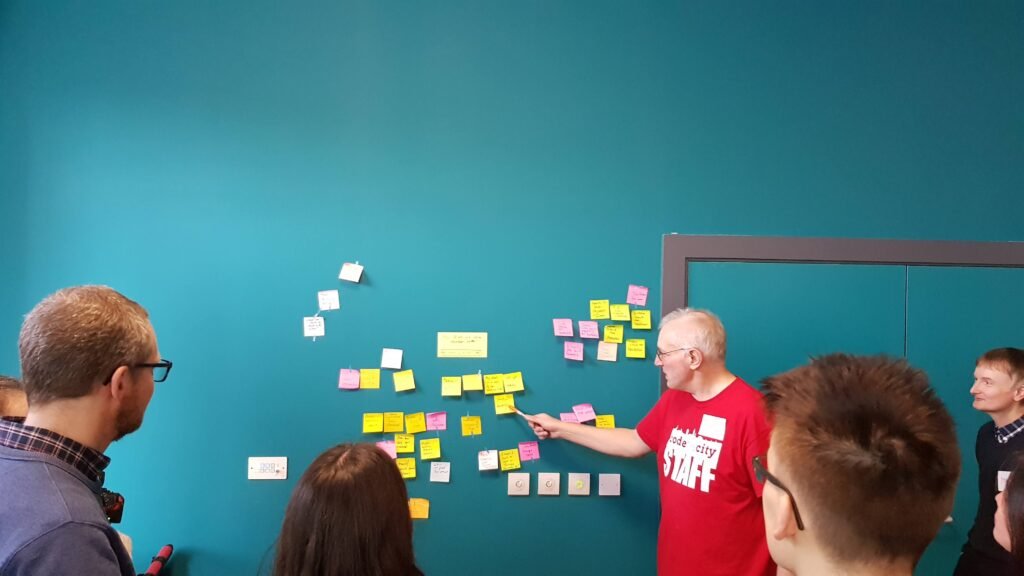
Design thinking is a problem-solving methodology that applies designers’ approaches, such as deep empathy with users, iterative experimentation, and tolerance for ambiguity, to challenges well beyond traditional product design, including business strategy, social problems, and organizational change. Rather than jumping directly to solutions, design thinking emphasizes thoroughly understanding a problem and the people affected by it before committing to any particular answer.
Popularized significantly by design consultancies and business schools beginning in the early 2000s, design thinking has since been adopted across industries ranging from healthcare to finance, reflecting a broader recognition that creative, human-centered problem-solving approaches can benefit contexts far removed from the industrial and graphic design fields where such methods originally developed.
Core Stages of the Design Thinking Process
Design thinking is commonly described through a sequence of stages, typically including empathizing with users to understand their needs, defining the problem clearly based on that understanding, ideating a wide range of potential solutions, prototyping promising ideas in tangible form, and testing those prototypes with real users to gather feedback.
While often presented as linear for teaching purposes, these stages are typically non-linear in actual practice, with teams frequently cycling back to earlier stages as testing reveals new information or ideation surfaces unexpected directions worth exploring further before settling on a final approach.
Empathy and Human-Centered Research
The empathize stage involves deeply understanding the people a solution is intended to serve, often through direct observation, interviews, and immersive research methods designed to surface needs and frustrations that people themselves might struggle to articulate directly if simply asked what they want.
This emphasis on empathy distinguishes design thinking from more purely analytical problem-solving approaches, since design thinking assumes that truly understanding a problem requires direct engagement with affected people’s lived experience rather than relying solely on data, assumptions, or expert judgment about what a solution should look like.
Reframing Problems Through Definition
The define stage involves synthesizing research findings into a clear, actionable problem statement, often reframing an initial assumed problem into a more precise or different formulation once genuine user needs and underlying causes become better understood through the empathy research conducted earlier.
This reframing step is considered critical, since teams that skip directly from a surface-level problem statement to solution generation risk solving the wrong problem entirely, however elegant or well-executed their eventual solution might otherwise be in addressing the originally stated but ultimately mistaken challenge.
Ideation and Divergent Thinking
The ideate stage encourages generating a wide volume of potential solutions without immediately filtering for feasibility, using techniques such as brainstorming, which deliberately separates idea generation from critical evaluation to avoid prematurely discarding unconventional ideas that might otherwise prove valuable upon further development.
This divergent thinking approach aims to counteract teams’ natural tendency to converge quickly on familiar or obvious solutions, instead pushing participants to explore a broader solution space before narrowing down to the most promising concepts worth developing further into testable prototypes.
Prototyping and Rapid Iteration
Prototyping in design thinking emphasizes speed and low fidelity over polish, since the goal is learning quickly whether an idea has merit rather than investing significant resources before gathering any real feedback, with prototypes ranging from simple paper sketches to more functional working models depending on what question is being tested.
This rapid, iterative approach allows teams to fail quickly and cheaply on ideas that do not work, redirecting resources toward more promising directions far earlier than would be possible if teams waited until a fully developed solution to gather meaningful feedback from real users.
Testing and Validating Assumptions
The test stage involves putting prototypes in front of real users to validate or challenge the assumptions underlying a proposed solution, treating every design decision as a hypothesis to be confirmed or revised based on genuine user response rather than internal team conviction about what will work.
Honest engagement with test results, including willingness to abandon ideas that fail to resonate with users despite significant investment or personal attachment, distinguishes effective application of design thinking from superficial adoption of its vocabulary without genuine commitment to evidence-based iteration.
Applications Beyond Traditional Design
Organizations across sectors have applied design thinking methods to challenges including healthcare service delivery, educational program design, and social policy development, finding that human-centered research and iterative prototyping translate effectively to problems that do not involve physical products at all.
Critics have noted that design thinking can sometimes be applied superficially, treated as a branding exercise or workshop format rather than a genuine shift in problem-solving culture, suggesting that successful application requires sustained organizational commitment rather than a one-time training session or isolated project.
Business schools and corporate training programs have steadily incorporated design thinking workshops into leadership development curricula, reflecting a broader belief that creative problem-solving skills benefit managers well beyond those working directly in design-specific roles.
FAQ
What are the main stages of design thinking?
Design thinking typically includes empathizing with users, defining the problem, ideating potential solutions, prototyping promising ideas, and testing those prototypes with real users, though these stages are often revisited non-linearly in practice.
Can design thinking be applied outside of product design?
Yes, design thinking has been applied to business strategy, healthcare, education, and social policy, reflecting its core methodology of human-centered research and iterative problem-solving rather than any specific product-focused application.
Why is empathy important in design thinking?
Empathy ensures solutions are based on genuine understanding of user needs and lived experience rather than assumptions, helping teams avoid solving the wrong problem or building something users ultimately do not want.
Editorially reviewed by Specialty Digest Editorial TeamLast reviewed November 4, 2026Researched and drafted with AI assistanceReport an issue