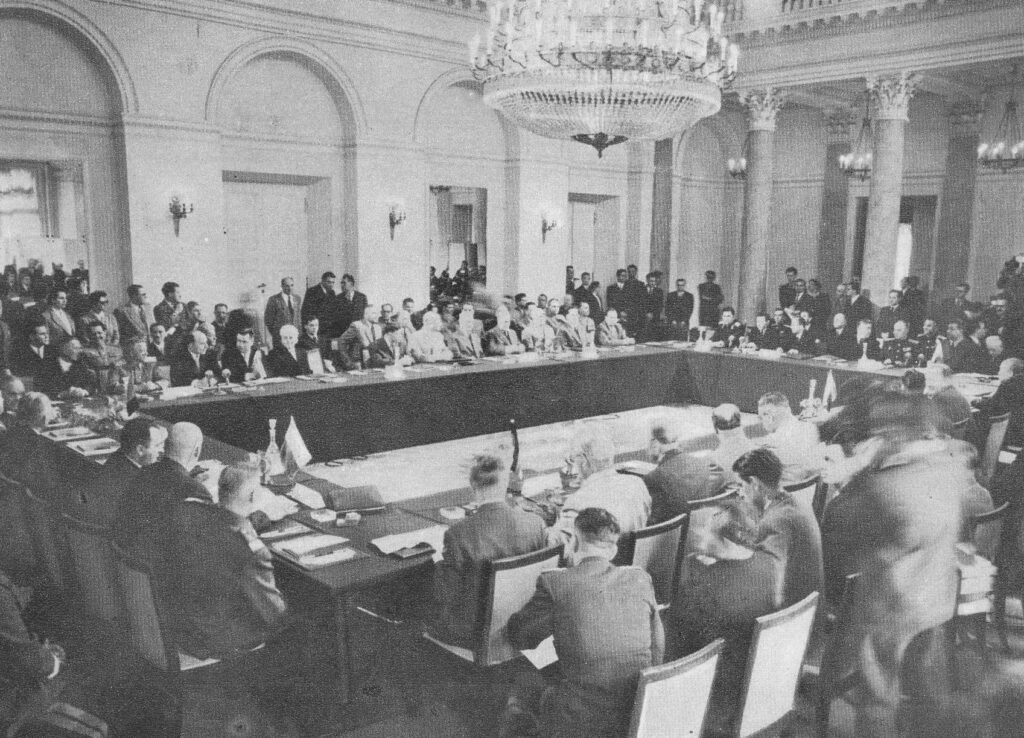
The Warsaw Pact, formally the Warsaw Treaty Organization, was a political and military alliance established on 14 May 1955 between the Soviet Union and several Eastern European countries. It was created as a counterweight to the North Atlantic Treaty Organization (NATO), and it was disbanded in 1991 near the end of the Cold War.
History of the Warsaw Pact
NATO was concluded in 1949 as a collective security alliance among the United States, Canada and Western European nations. After the Second World War the Soviet Union had signed bilateral treaties with each Eastern European state except East Germany, which was then still part of the Soviet-occupied zone of Germany.
The immediate trigger was the entry of the Federal Republic of Germany into NATO in early May 1955. Soviet leaders feared a strengthened NATO and a rearmed West Germany. The treaty’s own preamble refers to the Paris agreements, which provided for a new military alignment in the form of a Western European Union with a remilitarized Western Germany. It also states a wish for a system of European collective security open to all European states, whatever their social and political systems.
Soviet leaders hoped the new organization could contain West Germany and let the Soviet Union negotiate with NATO as an equal partner. The U.S. Office of the Historian also notes that the Soviets saw rising civil unrest in Eastern Europe and judged that a multilateral alliance would tie Eastern European capitals more closely to Moscow.
The Treaty of Friendship, Cooperation and Mutual Assistance was signed in Warsaw on 14 May 1955. The original signatories were the Soviet Union, Albania, Bulgaria, Czechoslovakia, East Germany, Hungary, Poland and Romania. Ratifications were deposited with the Polish government in sequence: Poland on 19 May, East Germany on 24 May, Czechoslovakia on 27 May, Bulgaria on 31 May, the Soviet Union on 1 June, Hungary on 2 June, Romania on 3 June and Albania on 6 June. The treaty entered into force on 6 June 1955.
Structure and membership of the Warsaw Pact
The treaty created two main bodies. Article 5 established a Joint Command of the armed forces that the parties assigned to it, working on jointly agreed principles. Article 6 set up a Political Consultative Committee in which each party was represented by a member of its government or another appointed representative. The committee could create auxiliary bodies as needed.
The treaty was open to accession by other states, whatever their social and political systems, with the agreement of the existing parties. Article 11 set an initial term of 20 years, with an automatic ten-year extension for parties that did not give notice at least a year before expiry. The treaty would also end if a general European treaty of collective security came into force.
The treaty was drawn up in Russian, Polish, Czech and German, and the Polish government acted as its depositary. In practice, members pledged to defend one another and stressed non-interference in internal affairs, and the alliance claimed to rest on collective decision-making. The Office of the Historian concludes that the Soviet Union ultimately controlled most of its decisions.
What did the Warsaw Pact do?
Article 4 was the core defense commitment. If any party suffered an armed attack in Europe, the others were to come to its assistance immediately with all means they considered necessary, including armed force. The article cited the right of individual and collective self-defense under Article 51 of the UN Charter and required that measures be reported to the Security Council and stopped once the Council acted.
Other articles dealt with consultation and cooperation. The parties undertook to refrain from the threat or use of force and to settle disputes peacefully. They committed to consult on important international issues and whenever any member perceived a threat of armed attack. They also agreed not to join coalitions or alliances whose aims conflicted with the treaty, and to foster economic and cultural exchange on the basis of respect for independence and sovereignty.
The treaty text also called for universal reduction of armaments and prohibition of atomic, hydrogen and other weapons of mass destruction. As a military alliance, the pact also committed the parties in Article 5 to adopt other agreed measures to strengthen their defensive power and to guarantee the inviolability of their frontiers and territories.
The treaty was registered with the United Nations Secretariat, although an official English-language text had not been printed in the UN Treaty Series when the U.S. State Department published its collection of documents in 1957.
Use of the Pact to contain dissent
According to the Office of the Historian, the Soviet Union also used the pact to contain popular dissent in its European satellites. It cites Hungary in 1956, Czechoslovakia in 1968 and Poland in 1981 as examples. The treaty text stressed non-interference in internal affairs, which is why this practice is the central criticism of how the alliance operated.
The treaty’s preamble presented the alliance as a response to the Paris agreements and a threat to the security of peaceable European states. The Office of the Historian, by contrast, describes the pact as a tool for tying Eastern European capitals more closely to Moscow. Both accounts are useful for understanding how the alliance was framed and how it worked.
Dissolution of the Warsaw Pact
By the 1980s the alliance was affected by economic slowdowns across Eastern Europe. By the late 1980s, political changes in most member states left the pact virtually ineffective.
In September 1990 East Germany left the pact in preparation for German reunification. By October 1990 Czechoslovakia, Hungary and Poland had withdrawn from all Warsaw Pact military exercises. The pact was officially disbanded in March and July 1991, as the Soviet Union approached its own dissolution.
Significance of the Warsaw Pact
The Warsaw Pact is remembered as the eastern counterpart of NATO in the divided military order of the Cold War. Its life of 36 years, from the treaty’s entry into force in 1955 to its disbanding in 1991, closely tracks the era of Europe’s division.
More in Security Studies
Key facts
- The treaty was signed in Warsaw on 14 May 1955 and entered into force on 6 June 1955.2
- The original parties were the Soviet Union, Albania, Bulgaria, Czechoslovakia, East Germany, Hungary, Poland and Romania.1
- Article 4 committed each party to assist an attacked party with all means it deemed necessary, including armed force.2
- Article 11 set a 20-year term, with a ten-year extension for parties that did not denounce it.2
- East Germany left in September 1990, and the pact was officially disbanded in March and July 1991.1
Related concepts
In the news
Quick checkWhy was the Warsaw Pact formed?Show answer
It followed West Germany's entry into NATO in May 1955, which the Soviet Union feared, and was meant to counterbalance NATO and tie Eastern European states more closely to Moscow. [1]
Sources
- 1. U.S. Department of State, Office of the Historian, Milestones: The Warsaw Treaty Organization, 1955, https://history.state.gov/milestones/1953-1960/warsaw-treaty
- 2. Yale Law School Lillian Goldman Law Library, Avalon Project, The Warsaw Security Pact: May 14, 1955, https://avalon.law.yale.edu/20th_century/warsaw.asp
Editorially reviewed by Specialty Digest Editorial TeamLast reviewed November 4, 2026Researched and drafted with AI assistanceReport an issue