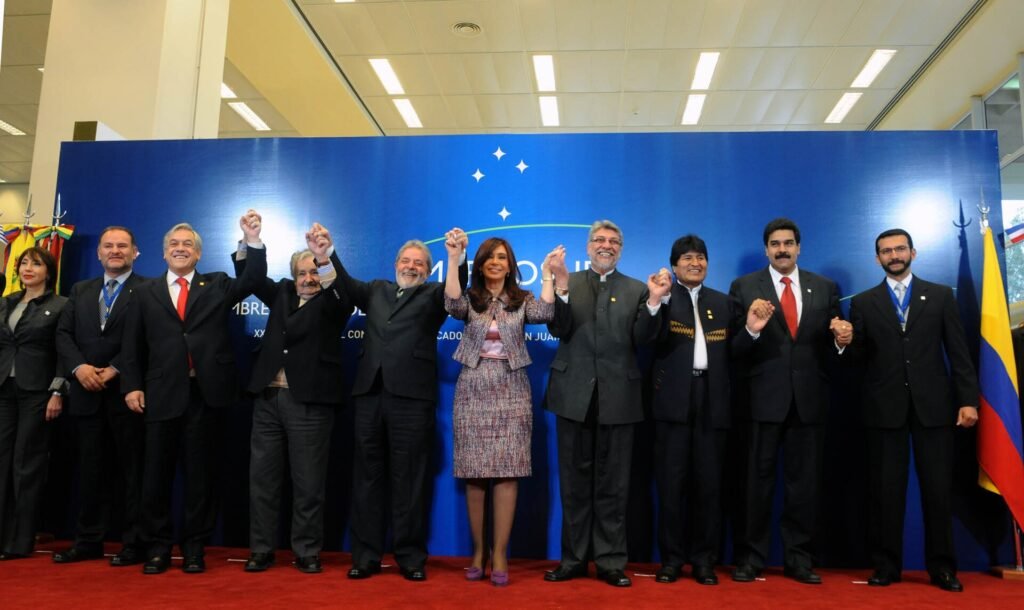
Mercosur, short for Southern Common Market, is an economic and political bloc in South America. It consists of Argentina, Bolivia, Brazil, Paraguay and Uruguay as full members, and it was founded in 1991 to create a common market among its members.
History of Mercosur
Argentina, Brazil, Paraguay and Uruguay signed the Treaty of Asuncion on 26 March 1991, and it entered into force on 29 November 1991. Article 1 committed them to build a common market by 31 December 1994. That market was to involve the free movement of goods, services and factors of production, a common external tariff and common trade policy toward other countries, the coordination of macroeconomic and sectoral policies, and the harmonization of national legislation.
During the transition period the main tool was a trade liberalization program of progressive, linear and automatic tariff reductions, with slower schedules for Paraguay and Uruguay. Under Article 4, members agreed to apply their domestic laws to restrict imports whose prices were influenced by subsidies, dumping or other unfair practices.
The bloc was created partly to cement a rapprochement between Argentina and Brazil, rivals for much of their history. All four founding members had emerged from dictatorships in the 1980s, so strengthening democracy was an early aim as well. In 1994 the members signed the Protocol of Ouro Preto, which formalized Mercosur as a customs union.
Early results were strong. Trade among members rose from $4.1 billion in 1990 to $19 billion in 1998, and its share of the bloc’s total trade grew from about 11 percent to 25 percent. Integration then stalled after Brazil’s currency devaluation in 1999 and Argentina’s financial crisis in 2001.
Structure and membership of Mercosur
Venezuela joined as a full member in 2012 but was suspended in late 2016 for failing to comply with the bloc’s democratic principles. In August 2017 the suspension became indefinite, and there are no provisions for permanent expulsion. Bolivia, previously an associate, completed its accession in 2024 after Brazil’s Congress approved its admission.
Chile, Colombia, Ecuador, Guyana, Panama, Peru and Suriname are associate members. They receive tariff reductions when trading with permanent members but do not have full voting rights or free access to members’ markets. In 2024 the combined gross domestic product of the bloc was roughly $3 trillion, according to World Bank data cited by the Council on Foreign Relations. Argentina and Brazil together account for about 94 percent of that GDP and 92 percent of the bloc’s population.
The Common Market Council is the highest decision-making body. It consists of the foreign and economic ministers of each member and decides by consensus. Its presidency rotates every six months among full members in alphabetical order. Other bodies include the Common Market Group, which coordinates macroeconomic policy, a trade commission, a parliament called Parlasur that has an advisory role, and the Structural Convergence Fund, known as FOCEM.
What does Mercosur do?
Mercosur’s central tool is the common external tariff. The founders agreed to a rate of 35 percent on certain imports from outside the bloc, and the average has since fallen to about 11.5 percent. Residents of the bloc are authorized to live and work anywhere within it, and the Mercosur emblem appears on passports and license plates.
The bloc also negotiates trade agreements with outside partners. It has had a free trade agreement with Egypt since 2017, concluded one with Singapore in 2023, and signed a preferential trade agreement with India in 2004. Economic cooperation agreements cover Bolivia, Chile, Israel and Peru.
Talks with the European Union began in 1999 and repeatedly stalled over fears of cheap South American farm imports and over illegal logging in the Amazon. The two sides signed an agreement in Asuncion, Paraguay, on 17 January 2026. Once fully implemented, it would remove tariffs on more than 90 percent of goods traded between the blocs over fifteen years. The Council on Foreign Relations reports that ratification has been delayed after the European Parliament asked the EU’s top court to review its legality.
Mercosur also has a democratic clause. The Ushuaia Protocol of 1998 states that a rupture in democratic order is grounds for suspension. Members invoked it for the first time in 2012 to suspend Paraguay, a suspension lifted in 2013, and some experts argue that decision was politically motivated.
Funding and governance of Mercosur
FOCEM finances infrastructure projects such as highways, bridges and waterways. Its budget was about $300 million for 2024. Member contributions follow a formula based on GDP: Brazil pays 60 percent, Argentina 30 percent, and Paraguay and Uruguay 5 percent each. Paraguay has received the most funding, followed by Uruguay.
The fund became a subject of internal debate in 2025, when Brazil proposed reducing annual contributions and revising the allocation formula and some members resisted. Decisions in the Common Market Council require consensus, so any one member can block a change.
Criticism and challenges
Gains from Mercosur’s first decade have faded. Intra-bloc trade peaked at about $54 billion in 2011. In 2024 it was around $47 billion, only 11.7 percent of members’ total exports, the same share as in 1990.
Members have also eroded the customs union with exceptions to the common external tariff. After Brazil’s devaluation, Argentina and Brazil each kept 100 tariff lines on national exception lists, Uruguay 225 and Paraguay 649. Critics quoted by the Council on Foreign Relations say the bloc often protects Brazilian and Argentine industries from competition instead of opening markets.
Economic and political turmoil has complicated deeper integration. Corruption probes that began in Brazil in 2014 spread to implicate hundreds of regional political and business elites, and falling commodity prices contributed to recessions. Latin America’s GDP fell 7 percent in 2020, the worst of any world region.
Political friction continues. Uruguay’s push for a free trade agreement with China would require leaving the bloc because of its common tariff commitments, and Argentina has opposed such a deal. The Council on Foreign Relations reports that Argentina’s government, which took office in December 2023, initially threatened to withdraw, and that Brazil’s government wants to modernize the bloc, including by allowing bilateral deals with third countries. The EU agreement and Bolivia’s recent accession bring new pressures to a bloc that has not delivered the deep integration its founders sought.
More in Economics
Key facts
- The Treaty of Asuncion was signed on 26 March 1991 and entered into force on 29 November 1991.1
- The treaty targeted a common market by 31 December 1994, including free movement of goods, services and factors of production.1
- Argentina, Bolivia, Brazil, Paraguay and Uruguay are full members, and Venezuela has been suspended since 2016.2
- Intra-Mercosur trade was about $47 billion in 2024, or 11.7 percent of total exports.2
- The EU and Mercosur signed a trade agreement on 17 January 2026 that would remove tariffs on more than 90 percent of traded goods over fifteen years.2
Related concepts
Quick checkWho are the full members of Mercosur?Show answer
Argentina, Brazil, Paraguay and Uruguay are the founding members, and Bolivia completed its accession in 2024. Venezuela joined in 2012 but has been suspended since 2016. [2]
Sources
- 1. Organization of American States, Foreign Trade Information System (SICE), Treaty of Asuncion (Treaty Establishing a Common Market), http://www.sice.oas.org/trade/mrcsr/TreatyAsun_e.asp
- 2. Council on Foreign Relations, Mercosur: South America's Fractious Trade Bloc, https://www.cfr.org/backgrounder/mercosur-south-americas-fractious-trade-bloc
Editorially reviewed by Specialty Digest Editorial TeamLast reviewed November 4, 2026Researched and drafted with AI assistanceReport an issue