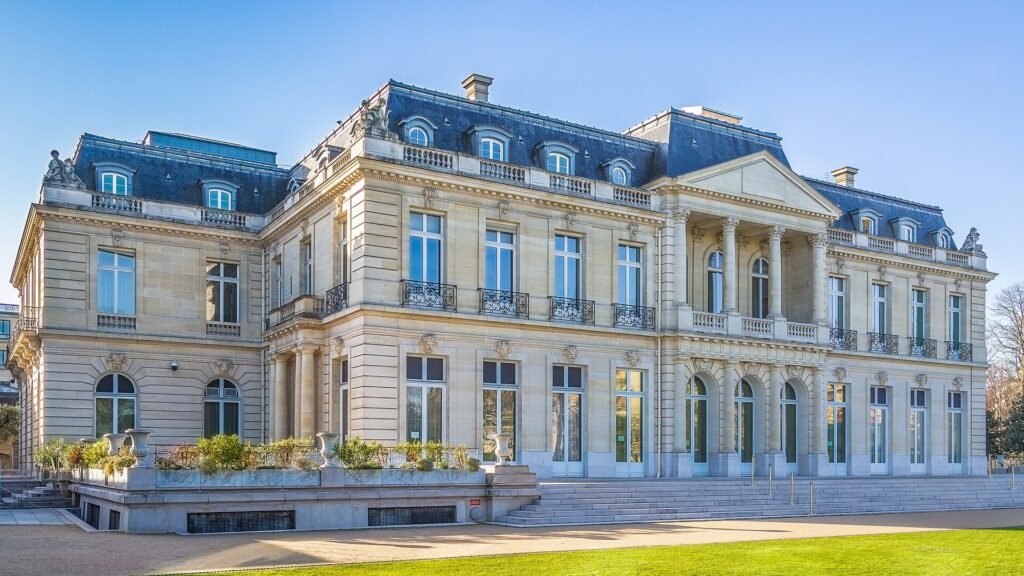
The Organisation for Economic Co-operation and Development, or OECD, is an intergovernmental organization of 38 member countries that analyzes economic and social policy, sets international standards and advises governments. It was founded in 1961 as the successor to the body that coordinated Marshall Plan aid for postwar Europe. Its headquarters are in Paris, France.
History of the OECD
The OECD’s forerunner was the Organisation for European Economic Co-operation, which was formed to administer American and Canadian aid under the Marshall Plan for the reconstruction of Europe after World War II. The convention that turned it into the OECD was signed at the Château de la Muette in Paris on 14 December 1960 and entered into force on 30 September 1961. The Government of Canada notes that 20 countries, including Canada, signed the convention.
Over the decades the organization worked to become more global. Among the policy ideas it developed are the polluter pays principle in the 1970s and PISA, the international assessment of school systems. It has also been active on tax transparency and, more recently, artificial intelligence. In 2007 the members decided to enlarge the organization and to deepen ties with the major emerging economies.
On 5 October 2021, the 60th anniversary year, members adopted a statement titled Trust in Global Co-operation, which sets out the organization’s vision for the next decade. It commits the members to individual liberty, the values of democracy, the rule of law, the defense of human rights and open and transparent market economy principles.
Structure and membership
The OECD Council, where members are represented by ambassadors, defines and oversees the organization’s work as set out in the convention. More than 300 committees and the Secretariat work with the Council to produce the OECD’s output. Mathias Cormann serves as Secretary-General. The European Union also takes part in the work under Supplementary Protocol No. 1 to the convention, though it is not counted as one of the 38 members. The OECD has two main sites, its Paris headquarters and a second in Boulogne-Billancourt next to Paris.
The 38 members are Australia, Austria, Belgium, Canada, Chile, Colombia, Costa Rica, Czechia, Denmark, Estonia, Finland, France, Germany, Greece, Hungary, Iceland, Ireland, Israel, Italy, Japan, Korea, Latvia, Lithuania, Luxembourg, Mexico, the Netherlands, New Zealand, Norway, Poland, Portugal, the Slovak Republic, Slovenia, Spain, Sweden, Switzerland, Türkiye, the United Kingdom and the United States.
Recent growth came in steps. Chile, Slovenia, Israel and Estonia joined in 2010, Latvia became the 35th member in 2016, and Lithuania, Colombia and Costa Rica followed in 2018, 2020 and 2021. A country seeking to join goes through an accession process. The Council decides whether to open discussions, either on its own initiative or after a written request, and then adopts a roadmap that lists the terms, conditions and technical reviews involved.
What the OECD does
The OECD describes its purpose as building better policies for better lives. It draws on evidence-based analysis, standards and global policy networks to advise governments, and it works closely with the G7 and the G20. It also acts as a forum and knowledge hub for data, analysis and best practices in public policy.
Broad themes covered by OECD delegates include trade, social and welfare issues, public governance, development, tax, transport, science and technology, and innovation. Work in practice includes peer learning and country reviews, in which member countries play a key role. The organization reaches out to more than 100 developing and emerging countries beyond its members.
Its Key Partners are Brazil, China, India, Indonesia and South Africa. Together with the 38 members, they account for about 80 percent of the world’s trade and investment, according to the Government of Canada. Each year, a Ministerial Council Meeting gathers ministers from members, and the chair issues a statement afterward.
The organization’s own history page picks out three recent emphases. It says it has helped place well-being and inequalities of income and opportunity high on the international agenda over the past decade. It describes a central role in supporting international dialogue and exchange on tax policy. It also says it has offered insights and support to countries trying to understand the implications of digital transformation and new technologies. The 2021 Ministerial Council Meeting that marked the 60th anniversary was chaired by the United States, with Korea and Luxembourg as vice-chairs, under the theme of building a green and inclusive future.
Funding and governance
The OECD pays for its programme of work through member countries’ national contributions and through voluntary contributions. Governance rests with the Council, where members are represented by ambassadors, and with committees that bring together officials from member governments. Because it is funded and steered by its members, it works as a forum for them rather than as a body that can impose rules on them.
OECD vs. other international organizations
The OECD is often grouped with the International Monetary Fund, the World Bank and the United Nations, but its role differs. It does not lend money in the way the IMF does. It does not run a project portfolio like the World Bank. Its main products are data, comparisons, peer review and recommended standards that governments choose to adopt.
Legacy and impact
What began as a European aid-coordination body now covers members on four continents and a wide range of policy fields. Its data and analysis inform policy decisions in member governments, and its work reaches more than 100 countries beyond its membership. Its statistics and country comparisons are widely used in national policy debates, and its work on topics such as tax cooperation shapes how governments design rules.
More in Economics
Key facts
- The OECD Convention was signed in Paris on 14 December 1960 and entered into force on 30 September 1961.1
- The OECD has 38 member countries, and Costa Rica was the latest to join, in 2021.2
- The OECD grew out of the Organisation for European Economic Co-operation, which administered Marshall Plan aid.1
- More than 300 committees and the Secretariat support the OECD Council.3
- Members and Key Partners together account for about 80 percent of world trade and investment.2
Related concepts
In the news
Quick checkWhat did the OECD replace?Show answer
It replaced the Organisation for European Economic Co-operation, which was set up to administer Marshall Plan aid for rebuilding Europe after the Second World War.
Sources
- OECD, History, https://www.oecd.org/about/history/
- Government of Canada, Global Affairs Canada, Organisation for Economic Co-operation and Development, https://www.international.gc.ca/world-monde/international_relations-relations_internationales/oecd-ocde/index.aspx?lang=eng
- OECD, About the OECD and Members and partners, https://www.oecd.org/en/about.html
Editorially reviewed by Specialty Digest Editorial TeamLast reviewed November 4, 2026Researched and drafted with AI assistanceReport an issue