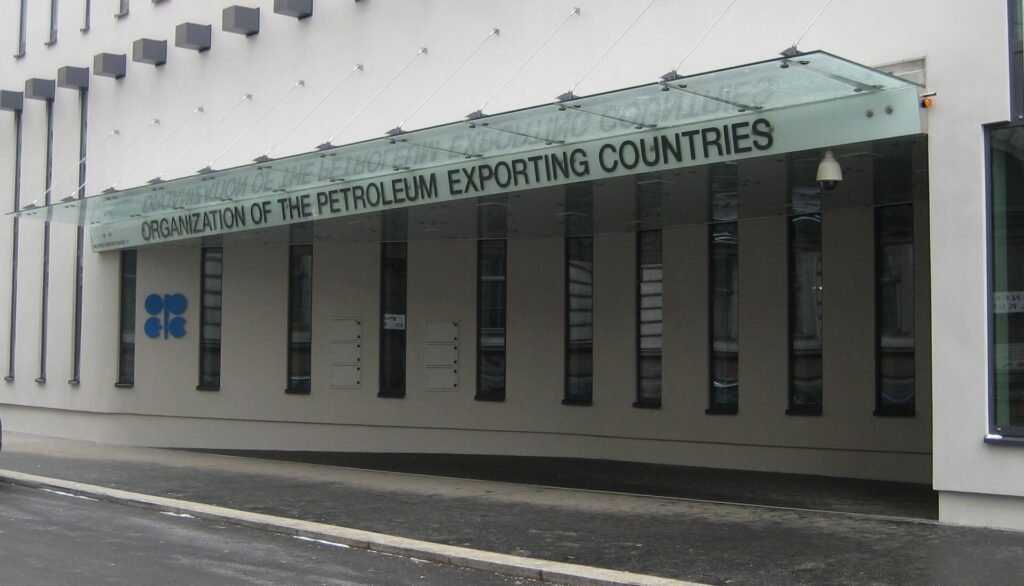
The Organization of the Petroleum Exporting Countries, or OPEC, is a permanent intergovernmental organization of oil-producing countries that coordinates its members’ petroleum policies. It was created at the Baghdad Conference of 10 to 14 September 1960 by Iran, Iraq, Kuwait, Saudi Arabia and Venezuela, and it has been headquartered in Vienna, Austria, since 1965. As of 2024, it had 12 member countries.
History of OPEC
OPEC formed at a time of decolonization, when many new independent states were appearing in the developing world. The international oil market was dominated by a handful of multinational companies known as the Seven Sisters and was largely separate from the markets of the Soviet Union and other centrally planned economies. The new organization set out its objectives and set up a Secretariat, first in Geneva and then in Vienna on 1 September 1965.
In 1968 it adopted a Declaratory Statement of Petroleum Policy in Member Countries, which emphasized every country’s right to permanent sovereignty over its natural resources. Membership had grown to ten by 1969. During the 1970s the members took control of their domestic petroleum industries and began to play a larger role in world oil markets. The first Summit of Heads of State and Government met in Algiers in 1975, and the OPEC Fund for International Development followed in 1976. By 1975 there were 13 members.
The 1973 oil embargo
The 1973 Arab-Israeli War produced the best-known episode in OPEC’s story. The U.S. Office of the Historian says Arab OPEC members imposed an embargo against the United States in retaliation for its decision to resupply the Israeli military, and later extended it to the Netherlands, Portugal and South Africa. The embargo banned petroleum exports to the targeted nations and cut production. The Federal Reserve’s history attributes the production cuts to OAPEC, the Organization of Arab Petroleum Exporting Countries, a related but separate body, so the two accounts differ on which organization to name.
Both sources agree that the effect was large. The embargo strained a U.S. economy that had grown increasingly dependent on foreign oil, and it signaled a shift in the balance of financial power toward oil-producing states.
Later decades
Demand slumped in the early 1980s and the market crashed in 1986, which cut OPEC’s share of a smaller market and its petroleum revenue. In response it introduced a group production adjustment and a Reference Basket for pricing. Summits in Caracas in 2000 and Riyadh in 2007 set stable energy markets, sustainable development and the environment as guiding themes. In December 2016, members and 10 non-OPEC producers signed the Declaration of Cooperation to help rebalance the market, and a Charter of Cooperation followed in 2019.
Mission and structure
Under its Statute, OPEC’s mission is to coordinate and unify the petroleum policies of its member countries and to stabilize oil markets. The aim is an efficient, economic and regular supply of petroleum to consumers, a steady income to producers and a fair return on capital to those investing in the industry. The Secretariat in Vienna carries out the organization’s day-to-day work.
Membership
After the five founders, the members that joined were Qatar in 1961, Indonesia and Libya in 1962, the United Arab Emirates in 1967, Algeria in 1969, Nigeria in 1971, Ecuador in 1973, Gabon in 1975, Angola in 2007, Equatorial Guinea in 2017 and Congo in 2018. Several later left or paused their membership. Qatar ended its membership in January 2019, and Ecuador withdrew effective 1 January 2020 after an earlier suspension. Indonesia suspended its membership in 2009, reactivated it in 2016 and suspended it again later that year. Angola withdrew effective 1 January 2024, and Gabon left in January 1995 and rejoined in July 2016.
That leaves a membership as of 2024 of Algeria, Congo, Equatorial Guinea, Gabon, Iran, Iraq, Kuwait, Libya, Nigeria, Saudi Arabia, the United Arab Emirates and Venezuela.
OPEC and the oil market
The U.S. Energy Information Administration says OPEC seeks to manage production among its members by setting production targets, and that oil prices have historically tended to rise when OPEC lowers them. Those countries collectively produce about 35 percent of the world’s crude oil, and their exports account for around half of all oil traded internationally, according to the analytics firm Vortexa as cited by the agency. These shares matter because they shape the global balance of supply and demand that sets benchmark prices such as Brent crude.
OPEC members also hold almost all of the world’s spare production capacity, which the agency defines as output that can be brought online within 30 days and sustained for at least 90 days. Saudi Arabia, the largest producer within OPEC and the world’s largest oil exporter, has historically held the most spare capacity. The term OPEC+ refers to the coalition of OPEC members and major non-member exporters, the largest of which is Russia.
Criticism and challenges
OPEC’s influence has long been a source of concern for oil-importing countries. After the 1973 embargo, U.S. officials launched a series of efforts to address the foreign policy problems that came with long-term dependence on foreign oil.
The group also faces internal pressures. Three departures from the membership between 2019 and 2024 show that interests can diverge, and the 1986 price collapse showed how quickly revenues can fall when demand weakens. OPEC says all of its members have signed the Paris Agreement on climate change, and that ten had ratified it, so energy-transition policy is now part of its agenda.
Legacy and impact
OPEC turned producing countries from price takers dealing with a few large companies into a bloc that bargains collectively. Its decisions are closely watched by governments, companies and consumers, even as its membership and its share of the market keep changing.
More in Economics
Key facts
- OPEC was created at the Baghdad Conference of 10 to 14 September 1960 by Iran, Iraq, Kuwait, Saudi Arabia and Venezuela.1
- Its headquarters moved from Geneva to Vienna on 1 September 1965.1
- Qatar left in January 2019, Ecuador effective 1 January 2020 and Angola effective 1 January 2024.1
- OPEC countries produce about 35 percent of the world's crude oil.3
- Its Statute sets the mission of coordinating members' petroleum policies and stabilizing oil markets.2
Related concepts
Quick checkWhat is OPEC+?Show answer
OPEC+ is the coalition of OPEC members and a group of major non-OPEC oil exporters, the largest of which is Russia.
Sources
- OPEC, Brief History, https://www.opec.org/opec_web/en/about_us/24.htm
- OPEC, Our Mission, https://www.opec.org/opec_web/en/about_us/23.htm
- U.S. Energy Information Administration, What drives crude oil prices: OPEC, https://www.eia.gov/finance/markets/crudeoil/supply-opec.php
- U.S. Department of State, Office of the Historian, Oil Embargo, 1973-1974, https://history.state.gov/milestones/1969-1976/oil-embargo
- Federal Reserve History, Oil Shock of 1973-74, https://www.federalreservehistory.org/essays/oil-shock-of-1973-74
Editorially reviewed by Specialty Digest Editorial TeamLast reviewed November 4, 2026Researched and drafted with AI assistanceReport an issue