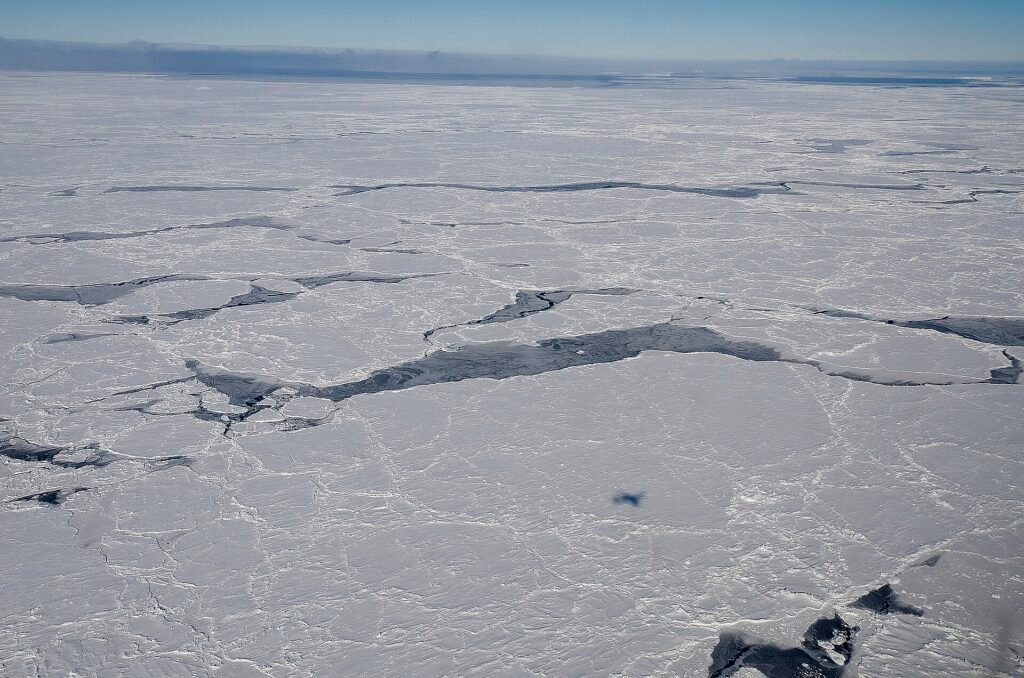
Antarctica was first sighted by people in January 1820, during voyages by Russian and British ships that had set out to explore the far southern ocean. Fabian von Bellingshausen is generally credited with the earliest sighting, but other captains were close behind, and who came first has long been disputed.
Background
For centuries geographers had suspected that a great southern land lay beyond the known world. Navigators found icebergs far to the south, which suggested that land was feeding glaciers into the sea. Captain James Cook crossed the Antarctic Circle in the 1770s but did not see the continent. When Bellingshausen’s ships crossed the Circle on 26 January 1820, they were the first to do so in nearly fifty years.
In 1819, Russia tasked Bellingshausen with going further south than Cook had. A different set of voyages was under way in the South Shetland Islands, which the captain William Smith had discovered the previous year while on a commercial voyage. When Smith reported his find, a British naval officer chartered his ship, the brig Williams, and appointed Edward Bransfield to return and examine the area.
The discovery
On 27 January 1820 Bellingshausen, in command of the ships Vostok and Mirnyi, looked toward solid ice that was probably an ice shelf attached to the land now known as Queen Maud Land. Some accounts give the date as 28 January. His ships were on a two-year voyage around the world to find new lands for the Russian Empire.
Three days later, on 30 January 1820, Bransfield sighted the tip of the Antarctic Peninsula, at what is now called the Trinity Peninsula. He described “high mountains, covered with snow.” The French explorer Dumont d’Urville later named one of them Mount Bransfield, and the passage between the peninsula and the South Shetlands became the Bransfield Strait.
Cool Antarctica adds that the first sighting is now widely acknowledged to be Bellingshausen’s, and that his ships were the first to cross the Antarctic Circle since Cook. The Russian crews were also on the lookout for new lands that could be claimed for the Empire, which is why the voyage was planned as a full two-year circuit.
The American sealer Nathaniel Palmer arrived in the area later, in November 1820. His voyage belongs to the same period of sealing and exploration, though it came after the Russian and British sightings.
How it was confirmed
A sighting from a ship does not prove a continent, and it took many decades to establish what Antarctica was. The first claimed landing on the mainland was by the British-American sealer John Davis, who is said to have taken some crew ashore at Hughes Bay on the Antarctic Peninsula on 7 February 1821, for less than an hour. This cannot be confirmed.
The first undisputed landing came much later, on 24 January 1895, at Cape Adare during a whaling voyage of the ship Antarctic led by Henryk Bull. Six, possibly seven, men rowed ashore in calm conditions, and it is unclear who stepped on the land first because they all landed within moments of one another. The Norwegian Carsten Borchgrevink, who is listed among the visitors to that beach, later returned to it with an expedition of his own.
The race to reach the South Pole then followed. The Norwegian explorer Roald Amundsen reached it on 14 December 1911. About a month later Robert Falcon Scott’s party arrived, but Scott and his companions died on the way back.
Disputes over credit
Several nations have claimed the honor of the first sighting. Historians say that Bellingshausen was technically first, although his achievement was hidden for decades by an incorrect translation of his journal, which led many to assume that he had not seen land. National Geographic quotes the historian David Day on that point. Bellingshausen himself may not have been sure whether he had seen land or an iceberg.
The first landing is disputed in the same way. National Geographic says that Davis, in 1821, was the first person to set foot on Antarctic land, while Cool Antarctica says that this claim cannot be confirmed and treats the 1895 landing as the first undisputed one.
For many years Bransfield was thought to have been the first person to sight the continent, as opposed to nearby islands. Recent analysis of the records, according to Cool Antarctica, shows that Bellingshausen saw the continent earlier. Descriptions of his observations match the lie of the land, the mountain peaks and the ice cap. Some national pride has led British, Irish, Russian and American commentators to favor their own candidate, and the American claim rests on Palmer, who came late. Bellingshausen’s claim is therefore sometimes described as technically the first.
Impact and legacy
Antarctica became a place for science. During the International Geophysical Year of 1957 to 1958, researchers from twelve countries worked on and around the continent, including at stations that later measured the atmosphere. The Halley Bay observatory set up for that effort later produced the ozone measurements behind the discovery of the ozone hole in the 1980s.
The Antarctic Treaty was signed in Washington on 1 December 1959 by the twelve countries that had been active in the International Geophysical Year. It entered into force in 1961 and now has 58 parties. It says that Antarctica shall be used for peaceful purposes only, protects freedom of scientific investigation and requires scientific results to be shared. Seven countries, Argentina, Australia, Chile, France, New Zealand, Norway and the United Kingdom, have territorial claims, some of them overlapping. Article IV preserves the status quo, so that no activity during the treaty counts as a basis for a claim.
Knowledge of Antarctica also matters for understanding climate change and the polar vortex, which shapes the winter weather of the Southern Hemisphere.
Key facts
- Bellingshausen looked toward Antarctic ice on 27 January 1820 (some accounts say 28 January).1
- Edward Bransfield sighted the Antarctic Peninsula on 30 January 1820.1
- The first undisputed landing was at Cape Adare on 24 January 1895.2
- Amundsen reached the South Pole on 14 December 1911.1
- The Antarctic Treaty was signed on 1 December 1959 and entered into force in 1961.3
- The treaty now has 58 parties.3
Related concepts
Quick checkWho discovered Antarctica?Show answer
Fabian von Bellingshausen is generally credited with the first sighting, on 27 or 28 January 1820, with Edward Bransfield seeing the peninsula three days later.
Sources
- 1. National Geographic, Who really discovered Antarctica? Depends who you ask, https://www.nationalgeographic.com/history/article/who-discovered-antarctica-depends-who-ask
- 2. Cool Antarctica, The Discovery of Antarctica: First Sightings and First Landings, https://www.coolantarctica.com/Antarctica%20fact%20file/History/discovery-of-antarctica.php
- 3. Antarctic Treaty Secretariat, The Antarctic Treaty, https://www.ats.aq/e/antarctictreaty.html
Editorially reviewed by Specialty Digest Editorial TeamLast reviewed November 5, 2026Researched and drafted with AI assistanceReport an issue