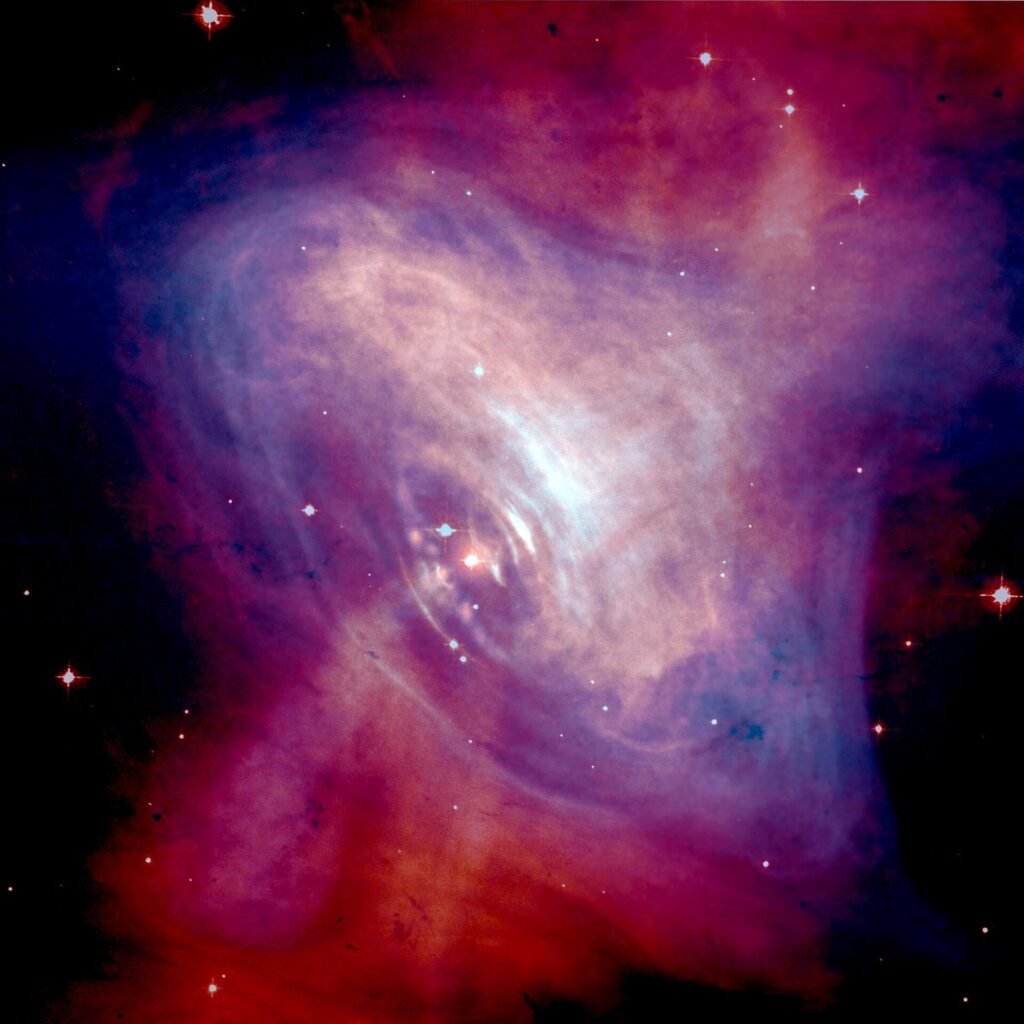
The discovery of pulsars was the 1967 detection of radio sources that emit extremely regular pulses, made at the University of Cambridge by the graduate student Jocelyn Bell, now Jocelyn Bell Burnell, and her supervisor Antony Hewish. Pulsars turned out to be rapidly rotating neutron stars. The finding was announced in the journal Nature in February 1968 and led to a Nobel Prize in 1974.
Background to the discovery of pulsars
The Cambridge radio telescope was designed to study quasars. According to a reference summary from Gale, it was built to detect scintillations, rapid flickers in the radio signals of compact sources such as quasars. Antony Hewish directed the project, with Bell and other volunteers helping to build it.
The Nobel Foundation records that Hewish began a series of observations in the summer of 1967. They soon led to a discovery that was, in its words, extremely interesting and quite unforeseen: some radio sources in space sent out pulses that repeated extremely regularly, at intervals of about a second.
Physics Today reports that Bell helped build the telescope at the Mullard Radio Astronomy Observatory near Cambridge, and that it began operating in July 1967. The reference summary adds that the project took two years and used 120 miles, or 193 kilometers, of cable hung on 128 pairs of poles, covering about 4.5 acres. As part of her doctoral work, Bell reviewed the long paper charts the telescope produced.
The discovery of pulsars
The routine work lasted about two months. Then, according to the reference summary, on 6 August 1967 the telescope picked up a radio source whose signal came in pulses. Bell first took it for interference, which she called scruff, because it did not look like the quasars she was searching for.
Physics Today places the first clear detection of a radio pulsar on 28 November 1967. Sources therefore date the first sighting and the first firm detection differently. In either account, Bell noticed an odd signal among the reams of data and followed up on it.
The pulses came with extraordinary regularity, about once every 1.3 seconds. Neither she nor Hewish believed they had found anything new at first. They suspected a human-made source, such as a signal reflected from the Moon or a satellite, or even a nearby building. After ruling out all known natural and human-made sources, they jokingly called the signal LGM-1, short for little green men.
How the discovery was confirmed
Confirmation came with more sources. In December 1967, Bell found another regularly pulsing source in a different part of the sky, with a slightly shorter period of about 1.2 seconds. Over the Christmas holiday she found two more.
With four independent sources in different directions, the team was confident they had found a new astronomical phenomenon. They published their findings in the February 1968 issue of Nature. The result set off a race among astronomers to find more of what soon came to be called pulsars.
Scientific significance of pulsars
Pulsars proved to be rapidly rotating neutron stars. The Nobel Foundation explains that the discovery confirmed the existence of neutron stars, objects that scientists had speculated about since the 1930s. A neutron star is about 10 kilometers across, yet a single cubic centimeter of its matter weighs millions of tons.
The regular pulses reflect the star’s rotation. The Nobel Foundation adds that the emission shows the star must have an extremely strong magnetic field, millions of times stronger than any used in laboratories on Earth. Each signal carries enormous amounts of energy. The Academy suggested that the neutron star surrounds itself with a plasma, an electrically conducting gas. The Gale reference adds that pulsars have been recognized as crucial to understanding the nature of stars, especially exotic ones.
Disputes over credit for the discovery
The 1974 Nobel Prize in Physics went to Antony Hewish and Martin Ryle. The Royal Swedish Academy of Sciences honored Ryle for his observations and inventions, especially the aperture-synthesis technique, and Hewish for his decisive role in the discovery of pulsars. Bell Burnell, who made the first detection as a graduate student, was not named.
Physics Today describes the omission as controversial. The Gale reference notes that in 1967 relatively few women were established in science, and it treats her discovery as an important example for women scientists. In 1991 she was made a professor of physics at the Open University in England, according to the Gale reference.
Later developments and legacy
The Nobel Foundation noted in 1974 that the discovery made it possible to establish the existence of neutron stars, and astronomers have used pulsars to study these objects ever since. Pulsars also appear in the story of planets beyond the solar system: NASA’s Exoplanet Archive lists eight planets found by timing the pulses of pulsars, as described in the discovery of exoplanets.
The discovery also shows how much can depend on careful attention to routine data. Bell spent her days reviewing long charts from the telescope, and she noticed the unusual “scruff” that others might have dismissed. Once she took it seriously, repeated observations showed that it was a regular and genuine signal from the sky.
The telescope, the 1968 paper in Nature and the 1974 Nobel award together mark the start of pulsar astronomy. The instrument had been designed to study quasars, and it found a different kind of object that nobody had planned to look for. Bell Burnell has since become a leading figure in physics, and the Gale reference notes that her appointment as a professor at the Open University was followed by a doubling of the number of women physics professors in the United Kingdom.
More in Astronomy & Space
Key facts
- Physics Today dates Jocelyn Bell's first detection of a radio pulsar to 28 November 1967; a Gale reference dates the first pulsed signal to 6 August 1967.23
- The first source pulsed about once every 1.3 seconds and was nicknamed LGM-1, for little green men.32
- By the end of December 1967 Bell had found four such sources.23
- The findings were published in Nature in February 1968.2
- Pulsars are rapidly rotating neutron stars about 10 kilometers across.12
- The 1974 Nobel Prize in Physics went to Martin Ryle and Antony Hewish; Bell Burnell was not named, which Physics Today calls controversial.12
Related concepts
Quick checkWho discovered pulsars?Show answer
Jocelyn Bell, a Cambridge graduate student working with Antony Hewish, detected the first pulsar in 1967. The Nobel Prize in 1974 went to Hewish and Martin Ryle.
Sources
- Nobel Foundation, Press release: The 1974 Nobel Prize in Physics, https://www.nobelprize.org/prizes/physics/1974/press-release/
- Physics Today, Detection of the first pulsar, https://physicstoday.aip.org/news/detection-of-the-first-pulsar
- Encyclopedia.com (Gale), The Discovery of Pulsars, https://encyclopedia.com/science/encyclopedias-almanacs-transcripts-and-maps/discovery-pulsars
Editorially reviewed by Specialty Digest Editorial TeamLast reviewed November 5, 2026Researched and drafted with AI assistanceReport an issue