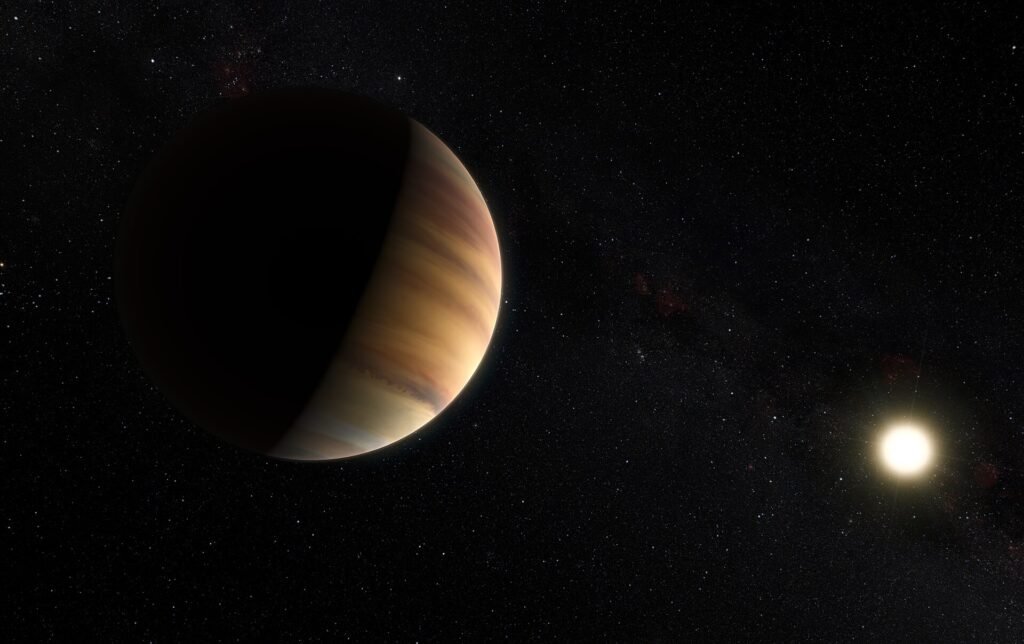
The discovery of exoplanets, planets that orbit stars other than the Sun, entered a new phase on 6 October 1995, when Michel Mayor and Didier Queloz announced 51 Pegasi b. It was the first planet confirmed around a Sun-like star. Since then, NASA has confirmed more than 6,000 exoplanets, and Mayor and Queloz shared the 2019 Nobel Prize in Physics for the first of them.
Background to the discovery of exoplanets
For centuries astronomers assumed that other stars had planets, but nobody could see them. A planet shines only by reflected light and sits very close to a star that outshines it by a huge factor. Finding one requires indirect methods that look for the star’s response to its companion instead of the planet itself.
The most productive early method measures a star’s radial velocity. The Nobel Foundation explains that the wavelengths of starlight shift as the star moves slightly toward and away from us, pulled to and fro by an orbiting planet. These movements are tiny: Jupiter’s gravity makes the Sun move at about 12 meters per second, and Earth’s makes it move at just 0.09 meters per second. Detecting such motion demands extremely sensitive spectrographs.
The discovery of 51 Pegasi b
Mayor and Queloz used custom-made instruments at the Haute-Provence Observatory in southern France. They announced their result at an astronomy conference in Florence, Italy, on 6 October 1995. The Nobel Foundation says the planet orbits the star 51 Pegasi, which lies about 50 light-years from Earth, and is a gaseous ball comparable to Jupiter.
The orbit was a surprise. The planet takes only four days to circle its star, at a distance of about eight million kilometers, and its star heats it to more than 1,000 degrees Celsius. Jupiter, by comparison, needs almost 12 years to circle the Sun. Under the planet-formation ideas of the time, giant planets were expected to form far from their stars, so astronomers had been searching in the wrong place.
Mayor was born in 1942 in Lausanne and Queloz in 1966 in Geneva, and both worked at the University of Geneva. Queloz received his doctorate there in 1995, the year of the discovery, and the Nobel Foundation lists him as also holding a professorship at the University of Cambridge. The 2019 prize was split, with one half going to them and the other half to the cosmologist James Peebles.
How the discovery was confirmed
Almost at once, the American astronomers Paul Butler and Geoffrey Marcy turned their telescope toward 51 Pegasi and confirmed the discovery. A few months later they found two more exoplanets orbiting Sun-like stars. The Nobel Foundation notes that their short orbital periods meant the planets could be watched completing lap after lap.
The close orbit challenged existing theories about how planetary systems form. New models proposed that large gas balls form at the outer edges of their systems and then spiral inward toward the host star.
How exoplanets are found today
Several methods are now in use. NASA describes the transit method, in which a planet crossing in front of its star causes a tiny, repeated dip in the star’s brightness. The Kepler Space Telescope, which operated from 2009 to 2018, stared at one patch of sky containing 150,000 stars for four years and ushered in what NASA calls the modern era of planet hunting.
NASA’s Transiting Exoplanet Survey Satellite, launched in 2018, has confirmed more than 1,000 of its candidates. Other methods include gravitational microlensing, in which a foreground star magnifies the light of a background star, and direct imaging, which captures light from the planet itself.
Scientific significance of exoplanets
Mayor and Queloz’s discovery started a revolution in astronomy. By 2019, when they received the Nobel Prize, more than 4,000 exoplanets were known. NASA’s official count passed 6,000 in 2025, and the NASA Exoplanet Archive listed 6,451 confirmed planets when checked in November 2026.
The Archive breaks the total down by method. Transit detections account for 4,785 planets and radial velocity for 1,204, followed by 292 from microlensing, 98 from direct imaging and eight from timing the pulses of pulsars. Kepler observations alone led to 2,787 confirmed planets.
These numbers show that planets are common. NASA says it has confirmed more than 6,000 exoplanets out of what it believes to be billions that exist, and most of those found so far lie in a small region of the Milky Way. They have also raised the question of whether life exists elsewhere. The site’s entry on the exoplanet explains the concept itself.
What counts as the first exoplanet?
The word first needs care. NASA describes 51 Pegasi b as the first planet discovered orbiting a Sun-like star, identified in October 1995. The Archive also lists planets found by pulsar timing, so planets around other kinds of stars are part of the catalog. The Nobel Foundation’s wording is narrower and more exact: it calls 51 Pegasi b the first planet proven to be orbiting a solar-type star.
Later developments and legacy
NASA marked 2025 as the thirtieth year of exoplanet discoveries, noting how quickly the field has grown since the first detection. Instruments keep improving. NASA reports that the James Webb Space Telescope, launched in 2021, has taken the first direct image of an exoplanet with that observatory, HIP 65426 b, and has detected helium escaping from the atmosphere of the gas giant WASP-107b. Spectroscopy of starlight passing through a planet’s atmosphere can reveal its chemical makeup.
NASA’s Nancy Grace Roman Space Telescope launched on 30 August 2026 and is expected to find about 100,000 more planets when it begins work in early 2027. The search for exoplanets has become one of the most active parts of astronomy, and it all traces back to a four-day orbit seen for the first time in 1995.
More in Astronomy & Space
Key facts
- Michel Mayor and Didier Queloz announced 51 Pegasi b on 6 October 1995 at a conference in Florence, Italy.2
- 51 Pegasi lies about 50 light-years from Earth; its planet orbits in four days at about eight million kilometers.2
- Paul Butler and Geoffrey Marcy confirmed the discovery soon afterward.2
- Mayor and Queloz shared half of the 2019 Nobel Prize in Physics.1
- NASA's confirmed count passed 6,000 in 2025; the NASA Exoplanet Archive listed 6,451 in November 2026.34
- Transit detections account for 4,785 planets and radial velocity for 1,204.4
- Kepler stared at about 150,000 stars for four years.5
Related concepts
Quick checkWho discovered the first exoplanet around a Sun-like star?Show answer
Michel Mayor and Didier Queloz announced 51 Pegasi b in October 1995 from the Haute-Provence Observatory in France. They shared the 2019 Nobel Prize in Physics for it.
Sources
- Nobel Foundation, Press release: The Nobel Prize in Physics 2019, https://www.nobelprize.org/prizes/physics/2019/press-release/
- Nobel Foundation, Popular information: The Nobel Prize in Physics 2019, https://www.nobelprize.org/prizes/physics/2019/popular-information/
- NASA Science, Exoplanets, https://science.nasa.gov/exoplanets/
- NASA Exoplanet Archive, Exoplanet and Candidate Statistics, https://exoplanetarchive.ipac.caltech.edu/docs/counts_detail.html
- NASA Science, How We Find and Characterize Exoplanets, https://science.nasa.gov/exoplanets/how-we-find-and-characterize/
Editorially reviewed by Specialty Digest Editorial TeamLast reviewed November 5, 2026Researched and drafted with AI assistanceReport an issue