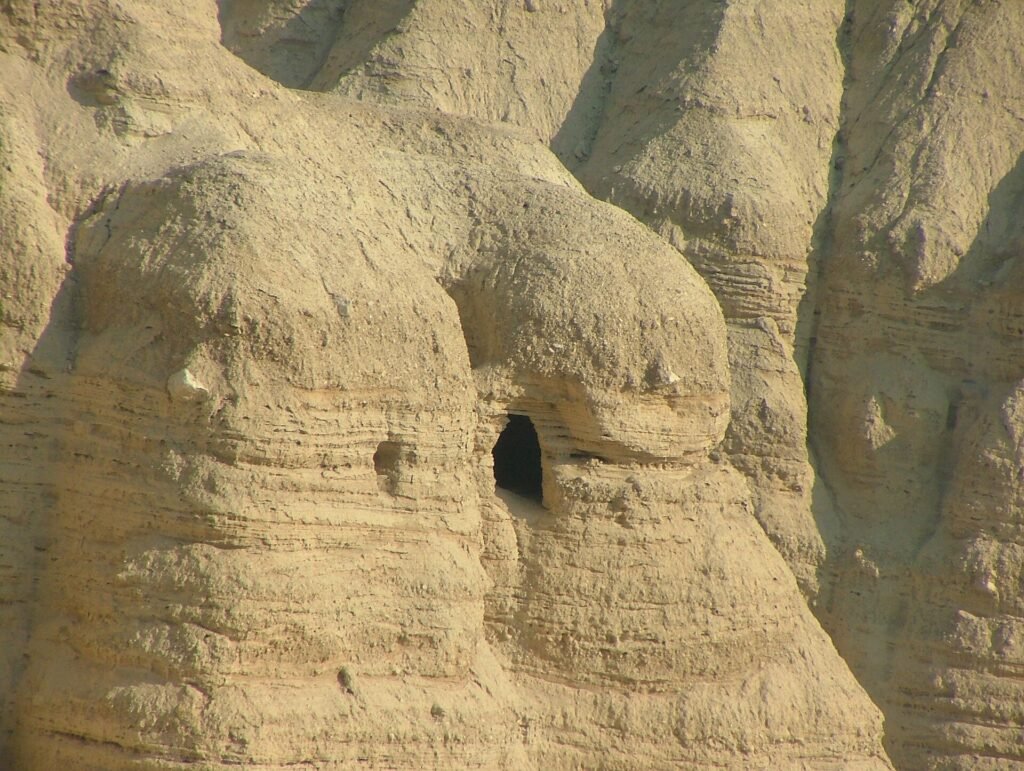
The discovery of the Dead Sea Scrolls began in 1947, when a young Bedouin shepherd of the Ta’amireh tribe found ancient manuscripts in a cave near Qumran, on the northwestern shore of the Dead Sea. Over the next decade Bedouin searchers and archaeologists recovered the remains of more than 900 texts from eleven caves.
The manuscripts, written in Hebrew, Aramaic and Greek, include the oldest known copies of biblical books. They are now central evidence for Jewish life in the Second Temple period.
Background to the discovery of the Dead Sea Scrolls
The scrolls lay in caves in the limestone cliffs of the Judean Desert, around the site of Qumran. For about two thousand years nobody who could read them knew they were there.
Before the find, scholars pictured Judea in the Second Temple period as fairly uniform, partly because of what the historian Josephus, the New Testament and rabbinic texts said. The scrolls later showed a more varied society, with groups such as the Pharisees, Sadducees and Essenes holding sharply different views.
The discovery
As the story is told, a shepherd looking for a stray animal found a cave in a steep hillside near Qumran. He threw a stone into the dark opening and heard pottery break.
Inside the cave were large clay jars, most of them empty. A few were intact with their lids in place and held old scrolls, some wrapped in linen and blackened with age.
The Bedouin goatherds Jum’a and Muhammed ed-Dib are the men who claimed to have found the first scrolls. They took them to Kando, a Bethlehem antiquities dealer, who sent them back to search for more.
In total they brought out seven scrolls. Four were sold through Kando and later reached Archbishop Samuel of the Syrian Orthodox Monastery of St. Mark in Jerusalem, and three went to a second dealer named Salahi.
Hebrew University professor Eliezer Sukenik heard of the finds through an Armenian dealer and recognized the ancient writing on a leather fragment. He acquired the three scrolls Salahi held, and he understood that he was looking at Hebrew manuscripts about a thousand years older than any known biblical text.
How the discovery was confirmed
In 1948 John Trever, then director of the American Schools of Oriental Research in Jerusalem, photographed three of the scrolls held by St. Mark’s: a complete book of Isaiah, a sectarian text called the Community Rule, and a commentary on the book of Habakkuk. The fourth, which could not be opened at the time, was later identified as an Aramaic retelling of parts of Genesis.
Archaeologists excavated the first cave in 1949. They found additional fragments of the same scrolls and pieces of dozens more, which showed that the shepherds’ find was genuine and ancient.
From 1949 to 1956 Roland de Vaux and Gerald Lankester Harding led the archaeological survey of the area. Of the eleven Qumran caves that yielded written remains, five were found by Bedouin and six by archaeologists.
The richest cave was Cave 4, found by Bedouin treasure hunters in 1952. Thousands of fragments from about 500 different scrolls came from it, and Cave 3 produced a unique copper scroll listing what may be sites of hidden treasure.
Archbishop Samuel took his four scrolls to the United States in 1949. In 1954 he advertised them for sale in the Wall Street Journal, and Yigael Yadin, Sukenik’s son, bought them for the State of Israel, so that by 1955 all seven first scrolls were together. The Shrine of the Book, built in 1965, now houses them.
Impact and legacy of the discovery
The scrolls changed the study of the Hebrew Bible. Every book appears among them except Esther, and these are the oldest known copies of the biblical works, which allows scholars to compare ancient wording with later manuscripts. You can read about the collection of sacred writings in the entry on the Bible.
They also changed the picture of ancient Judaism. Many thoughts and practices in the scrolls reappear in later Jewish and Christian writings, so the texts help explain the world in which rabbinic Judaism and early Christianity emerged.
The find began a long archaeological effort. Like the Rosetta Stone, an earlier find that unlocked an ancient script, the scrolls opened a whole body of texts to modern readers, and careful excavation of the surrounding caves added physical context.
The texts also record the history of writing. Most Hebrew scrolls use the square script that is close to modern Hebrew, some use paleo-Hebrew, an ancient script from the First Temple period, and a few use cryptic scripts. Other manuscripts are Aramaic or Greek translations of scripture, which shows how widely the texts circulated.
Work on the manuscripts still goes on. The Israel Antiquities Authority set up a conservation laboratory dedicated to the scrolls, and the pieces are studied as fragile objects as well as texts.
Disputes over credit and publication
Accounts of the first find differ. The Israel Museum describes the story as one that is told, and it says the goatherds Jum’a and Muhammed ed-Dib claimed the discovery, so the exact circumstances rest on later recollection.
Publication was also contested. After the international team began work in 1953, the study of the thousands of fragments stayed in the hands of fewer than a dozen scholars, and that small team slowed publication.
The Library of Congress notes that questions have been raised over the years about the scrolls’ authenticity and about the intentions of the custodians who restricted access. In the early 1990s the Israel Antiquities Authority named Emanuel Tov chief editor, divided the work among about 100 scholars, and by 2001 most of the official editions had appeared.
Scholars also still debate who wrote or collected the scrolls. The Library of Congress says only that they may have come from the community that lived at Qumran.
More in Archaeology
Key facts
- A young Bedouin shepherd of the Ta'amireh tribe found the first scrolls in 1947 in a cave near Qumran.1
- Seven scrolls from Cave 1 were sold through two dealers, and Yigael Yadin bought the last four for Israel in 1954.1
- Eleven Qumran caves yielded written remains, five found by Bedouin and six by archaeologists.2
- The collection includes more than 900 texts in Hebrew, Aramaic and Greek.1
- Every book of the Hebrew Bible appears among the scrolls except Esther.3
Related concepts
Quick checkWho discovered the Dead Sea Scrolls?Show answer
Bedouin goatherds, including Jum'a and Muhammed ed-Dib, are said to have found the first scrolls in 1947, and archaeologists later found more in other Qumran caves.
Sources
- Israel Museum, Dead Sea Scrolls Digital Project, Discovery and Publication, https://www.deadseascrolls.org.il/learn-about-the-scrolls/discovery-and-publication
- Israel Museum, Dead Sea Scrolls Digital Project, Discovery Sites, https://www.deadseascrolls.org.il/learn-about-the-scrolls/discovery-sites
- Israel Museum, Dead Sea Scrolls Digital Project, Scrolls Content, https://www.deadseascrolls.org.il/learn-about-the-scrolls/scrolls-content
- Library of Congress, Scrolls from the Dead Sea exhibition, https://www.loc.gov/exhibits/scrolls/
Editorially reviewed by Specialty Digest Editorial TeamLast reviewed November 5, 2026Researched and drafted with AI assistanceReport an issue