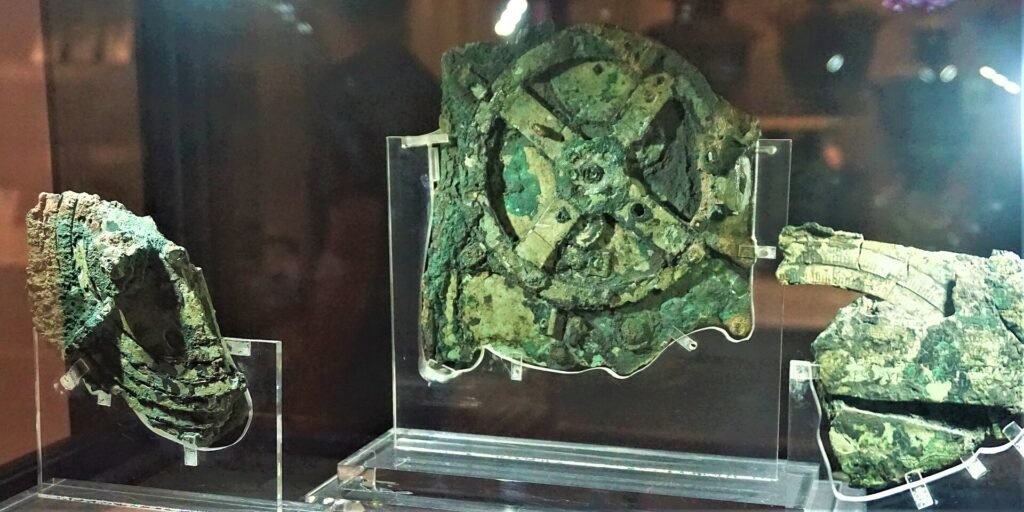
The discovery of the Antikythera mechanism was the recovery of a corroded bronze geared device from a Roman-era shipwreck off the Greek island of Antikythera, found in 1900 and recognized as a calculating instrument in the years that followed. The device was built around the end of the second century BC and calculated and displayed astronomical cycles.
It contains about 30 surviving bronze gear wheels and many inscriptions. Researchers describe it as technically more complex than any known device for at least a thousand years afterward.
Background to the discovery of the Antikythera mechanism
The mechanism was not found on land. It came from the wreck of a cargo ship that sank off the island of Antikythera, and the island gave the object its name.
The wreck was found in 1900, and a Nature paper from 2006 gives both 1900 and 1901 as the year of the discovery. The sources do not explain the difference, so the exact year of recognition is best treated as 1900 or 1901.
Nature calls the object an intricate bronze construction that was found damaged and fragmented. Its gears and inscriptions survive only in pieces, so its specific functions stayed controversial for decades.
The discovery
The surviving pieces are fragments. Researchers label the seven major ones A to G and the minor ones 1 to 757, and fragment A alone holds 27 of the 30 surviving gears, with single gears in fragments B, C and D.
The pieces were damaged, corroded and covered in accretions. Even so, fine mechanical details and thousands of tiny text characters were hidden inside them and went unread for more than 2,000 years.
Early scholars saw that the fragments held gears and inscriptions. In 1905 and 1906 the researcher Rehm wrote notes that described a ring display for the planets, an idea that anticipates modern models even though his mechanical details were wrong because he lacked data.
How the discovery was confirmed
Confirmation of what the device did came slowly, in stages. The historian of science Derek de Solla Price published a major study in 1974 titled Gears from the Greeks, which treated the mechanism as a calendar computer from about 80 BC and suggested that lost gearing once calculated planetary motions.
Price did not attempt a full reconstruction. Later, Wright built the first workable system for the front, showing that planetary motions could be reproduced mechanically, and other researchers simplified the gearing in further attempts.
The pieces needed new tools. Polynomial texture mapping, a method that records how a surface looks under many lighting directions, was used alongside X-ray scanning, and the study received essential support from the Ministry of Culture of Greece and the National Archaeological Museum of Athens.
The biggest advance came in 2005, when a team used surface imaging and high-resolution X-ray tomography on 82 fragments. Computed tomography is a scanning method that builds a three-dimensional picture of what lies inside an object, and it let researchers see the gear teeth and text buried inside the corrosion.
The results, published in Nature in 2006, solved the back of the machine, doubled the number of deciphered inscriptions and allowed the team to reconstruct the function of the gears. The mechanism predicted lunar and solar eclipses using Babylonian arithmetic-progression cycles.
It also reproduced a theory of the Moon. In the second century BC the astronomer Hipparchos developed a theory to explain the irregular speed of the Moon across the sky, and the mechanism contained a mechanical realization of it.
Impact and legacy of the discovery
The device is a unique Greek geared instrument that displayed the phases of the Moon and a luni-solar calendar. Calendars mattered to ancient societies for timing agricultural work and fixing religious festivals, and the mechanism combined several astronomical cycles in one object.
The find matters to the history of technology. Nature describes the mechanism as technically more complex than any known device for at least a millennium afterward. The comparison with later devices is explored in the entry on the mechanical clock, and the idea of a calculating machine is covered under computer.
The wreck is also important to archaeology under water. Recovery of objects from a ship that sank more than 2,000 years ago shows what underwater archaeology can reveal when it is combined with modern imaging.
The 2006 study was an international effort. Its authors included imaging specialists from Hewlett-Packard Laboratories and Foxhollow Technologies in California, whose scanning and texture-mapping methods made the hidden text readable.
The planetary display is the hardest part to settle. Most earlier reconstructions used pointers for the planets, and the 2021 paper offers a different arrangement, so the front of the device remains a matter of informed reconstruction rather than direct evidence.
Research continues. In 2021 a paper in Scientific Reports presented a new model of the front display, proposing how the Sun, Moon and all five planets known in antiquity could have been displayed on the front of the device.
Open questions and disputes
The date of the mechanism is not settled by a single number. The 2006 Nature paper places its construction around the end of the second century BC, while Price titled his study with a date of about 80 BC.
The function of the front display remained deeply controversial for years because much of the physical evidence is lost. The Nature paper accepted that inscriptions support a mechanical display of planetary positions, but the planetary gears themselves are missing.
Credit for understanding the device is shared. Rehm, Price, Wright and the teams who made the 2005 scans, including the authors of the Nature paper, each added a piece, and the modern model of the cosmos builds on all of them.
More in Archaeology
Key facts
- The Antikythera mechanism was recovered from a Roman-era shipwreck off the Greek island of Antikythera, discovered in 1900.1
- It was made around the end of the second century BC and has about 30 surviving bronze gear wheels.1
- The major surviving pieces are fragments A to G, with minor fragments numbered 1 to 757, and fragment A holds 27 of the 30 gears.2
- X-ray tomography and surface imaging of 82 fragments in 2005 revealed eclipse prediction and a mechanical model of the Moon's irregular motion.1
- Derek de Solla Price published Gears from the Greeks in 1974, and a 2021 paper proposed a new model of the planetary display.2
Related concepts
Quick checkWhen was the Antikythera mechanism discovered?Show answer
The shipwreck that held it was found in 1900, and the Nature paper of 2006 gives 1900 and 1901 for the discovery of the mechanism.
Sources
- Freeth T and colleagues, Decoding the ancient Greek astronomical calculator known as the Antikythera Mechanism, Nature, 2006, https://www.nature.com/articles/nature05357
- Freeth T and colleagues, A model of the cosmos in the ancient Greek Antikythera Mechanism, Scientific Reports, 2021, https://www.nature.com/articles/s41598-021-84310-w
Editorially reviewed by Specialty Digest Editorial TeamLast reviewed November 5, 2026Researched and drafted with AI assistanceReport an issue