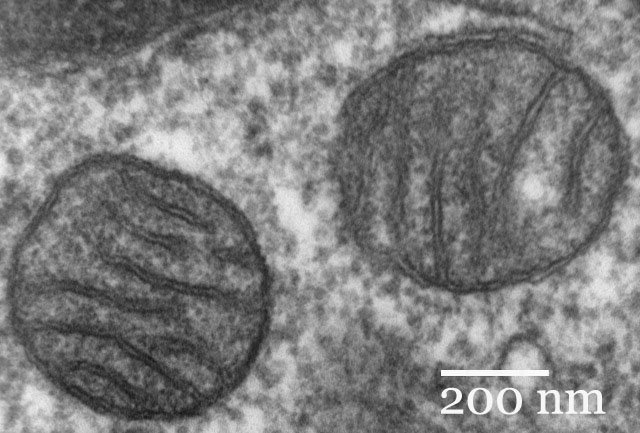
The discovery of mitochondria was a gradual process that ran from the first description of the structures by Rudolf Albrecht von Kölliker in 1857 to their naming by Carl Benda in 1898 and, in the 20th century, to the realization that they make the cell’s energy-carrying molecule ATP and descend from bacteria. Mitochondria are small organelles found in the cells of plants, animals and fungi.
Background
The history of mitochondrial research traces back to Kölliker, who first described the mitochondrion in 1857. Microscopists after him saw threads and granules in many kinds of cells, but the meaning of those structures was unclear. The idea that cells were made of discrete parts with distinct jobs was still developing, as the discovery of cells had only recently been joined by cell theory.
The discovery
In 1890 the German histologist Richard Altmann termed the structures bioblasts. He noted that they occurred in cells everywhere and showed unusual foresight in arguing that they were living inside cells and were responsible for elementary functions of the cell.
In 1898 Carl Benda introduced the name mitochondrion, from the Greek words mitos, meaning thread, and chondros, meaning granule. The name described what the structures looked like under a microscope, not what they did.
How it was confirmed
Function came next. The first well-preserved mitochondria were isolated in 1948 by Hogeboom and colleagues. Their approach of breaking cells open and separating the parts proved advantageous for decades. Around the same period, Albert Claude’s research with the newly developed electron microscope, and his use of a centrifuge to separate the parts of pulverized cells, opened up new ways to study cells in detail. Claude shared the 1974 Nobel Prize in Physiology or Medicine with Christian de Duve and George Palade for discoveries concerning the structural and functional organization of the cell.
With intact mitochondria in hand, biochemists showed that these organelles carry out the final stages of energy production. All life needs energy, and in plants and animals it is stored and transported by the molecule adenosine triphosphate (ATP). In 1961 Peter Mitchell proposed the chemiosmotic theory, which holds that a flow of electrons and hydrogen ions across mitochondrial membranes, driven by differences in electrical potential, powers the making of ATP. Mitchell received the 1978 Nobel Prize in Chemistry for the theory.
In 1997 Paul Boyer and John Walker shared half of the Nobel Prize in Chemistry for elucidating the enzymatic mechanism that underlies the synthesis of ATP. Mitochondria also carry their own small genome, which is described in the entry on mitochondrial DNA.
Disputes over credit
The origin of mitochondria raised a second discovery and a second question of credit. The endosymbiotic theory holds that mitochondria began as bacteria that came to live inside larger host cells. The Russian biologist Konstantin Mereschkowski articulated the theory in 1905, and a 2015 review describes his paper as probably the first thoroughly argued case that some cells arose through the union of two kinds of cells. His argument concerned plastids, the family of organelles that includes the chloroplasts of photosynthesis. He said that plastids are unquestionably reduced cyanobacteria that entered into a symbiosis with a host cell early in evolution.
The theory was repopularized in 1967 by Lynn Sagan, later known as Lynn Margulis, and a paper by Goksøyr mentioned similar ideas the same year. Those were the first suggestions that both chloroplasts and mitochondria descend from endosymbionts, each from a separate one. Margulis tied the theory to biochemical and cytological evidence. Evidence now indicates that mitochondria are of alpha-protobacterial origin, engulfed by cells about two billion years ago.
Researchers still discuss details. The 2015 review notes that Margulis’s version of the theory assumed that the benefit of acquiring mitochondria was the use of oxygen, whereas some anaerobic forms of mitochondria do not fit that classical account.
Impact and legacy
The discovery changed how biologists understand the cell and its history. The endosymbiotic origin of mitochondria is a leading example of symbiosis at the root of complex life, and it shapes current thinking about evolution. The organelle also became a central subject of cell biology.
Three Nobel Prizes mark the stages of this research. The 1974 prize concerned the structure and function of the cell, the 1978 prize the mechanism of energy transfer, and the 1997 prize the enzyme chemistry of ATP synthesis. Each built on the identification of mitochondria as a distinct and living part of the cell.
The 2012 review also summarizes how the organelle works. Electrons from carriers such as NADH and FADH2 pass along a chain of components and eventually reduce oxygen to water. This builds an electrochemical gradient, and the flow of protons back into the matrix is used to make ATP from ADP and phosphate.
Mitochondria are also important in health. A 2012 review states that disturbance of mitochondrial homeostasis can bring about pathophysiological conditions, and mitochondrial research now covers energy metabolism, cell death and disease.
FAQs
Who discovered mitochondria? Rudolf Albrecht von Kölliker first described them in 1857. Richard Altmann called them bioblasts in 1890, and Carl Benda named them mitochondria in 1898.
When were mitochondria first isolated? Hogeboom and colleagues isolated well-preserved mitochondria in 1948, which allowed their chemistry to be studied directly.
What does mitochondrion mean? It comes from the Greek words mitos, for thread, and chondros, for granule.
Who proposed that mitochondria were once bacteria? Konstantin Mereschkowski articulated endosymbiotic theory in 1905, and Lynn Margulis (then Sagan) repopularized it in 1967.
What do mitochondria do? They are the site of much of the cell’s ATP production, according to the chemiosmotic theory for which Peter Mitchell received the 1978 Nobel Prize in Chemistry.
Key facts
- Von Kölliker first described the mitochondrion in 1857, Altmann termed it bioblast in 1890, and Benda named it mitochondrion in 1898.1
- The first well-preserved mitochondria were isolated in 1948 by Hogeboom and colleagues.1
- Mitchell proposed the chemiosmotic theory in 1961 and received the 1978 Nobel Prize in Chemistry.3
- Mereschkowski articulated the endosymbiotic theory in 1905, and Margulis (then Sagan) repopularized it in 1967.12
- Mitochondria are of alpha-protobacterial origin, engulfed by cells through endosymbiosis about two billion years ago.1
- Boyer and Walker shared the 1997 Nobel Prize in Chemistry for the mechanism of ATP synthesis.4
Related concepts
Quick checkWho discovered mitochondria?Show answer
Rudolf Albrecht von Kölliker first described mitochondria in 1857, Richard Altmann termed them bioblasts in 1890, and Carl Benda gave them their name in 1898.
Sources
- Journal of General Physiology (2012), Mitochondrial proteome design: From molecular identity to pathophysiological regulation, https://pmc.ncbi.nlm.nih.gov/articles/PMC3362520/
- Philosophical Transactions of the Royal Society B (2015), Endosymbiotic theories for eukaryote origin, https://pmc.ncbi.nlm.nih.gov/articles/PMC4571569/
- Nobel Prize, Peter D. Mitchell, Facts (Chemistry 1978), https://www.nobelprize.org/prizes/chemistry/1978/mitchell/facts/
- Nobel Prize, The Nobel Prize in Chemistry 1997, https://www.nobelprize.org/prizes/chemistry/1997/summary/
- Nobel Prize, The Nobel Prize in Physiology or Medicine 1974, https://www.nobelprize.org/prizes/medicine/1974/summary/
Editorially reviewed by Specialty Digest Editorial TeamLast reviewed November 5, 2026Researched and drafted with AI assistanceReport an issue