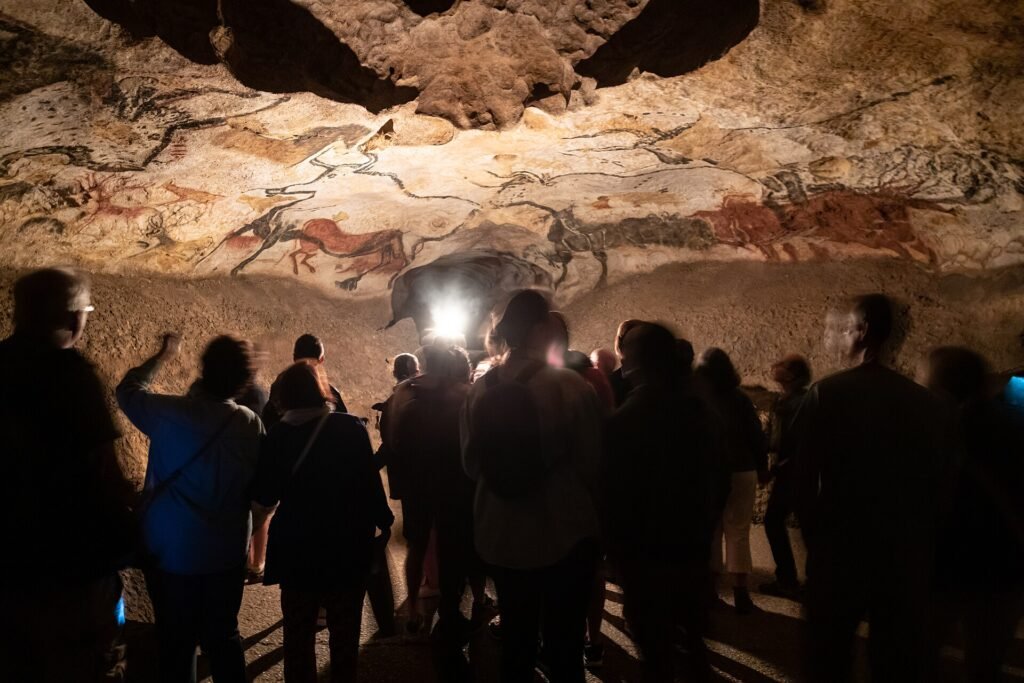
The discovery of the Lascaux cave paintings took place on 12 September 1940, when four boys from the village of Montignac in the Dordogne region of France climbed down a hole on a hillside and found walls covered with painted animals. The cave’s art is among the best-known examples of Paleolithic painting in the world.
The find opened what the French Ministry of Culture calls a new era in knowledge of prehistoric art and human origins. The original cave is now closed to ordinary visitors, and replicas let people see the art.
Background to the discovery of Lascaux
Lascaux lies in the Vezere valley, which UNESCO says contains 147 prehistoric sites from the Paleolithic period and 25 decorated caves. The cave’s entrance is 185 meters above sea level and overlooks the valley floor some 110 meters below.
Local legend said that an underground passage on the hill above Montignac led to the Lascaux manor. Halfway up the hill was a foxes’ den, which people thought could be the entrance to that passage.
The discovery came in the late summer of 1940. The ministry notes that all eyes were fixed on the dramatic events of the war, yet an archaeological find in the Dordogne briefly drew the world’s attention.
The discovery
A young apprentice mechanic named Marcel Ravidat tried to explore the opening first but had to postpone it for lack of tools. Four days later, on 12 September, he returned with three other village boys, Jacques Marsal, Georges Agnel and Simon Coencas.
The boys enlarged the hole, and Ravidat slid down a small vertical shaft onto a cone of scree. By the light of a lamp they had built in a hurry, they walked along a gallery about 30 meters long and saw the first paintings in what is now called the Axial Gallery.
The next day they returned with a rope and lowered themselves into an eight-meter-deep shaft. There they found the scene of a man confronting a bison, and then they told their teacher, Leon Laval, who visited on 18 September.
Popular accounts add that the hole was found when a dog fell into it. The World History Encyclopedia repeats that version, while the French ministry’s account describes the boys exploring a foxhole.
How the discovery was confirmed
The prehistorian Henri Breuil, who had taken refuge in the region during the war, came to the cave to authenticate the paintings. Development work to open the cave to the public was finished in 1948, and Breuil and Severin Blanc began the first excavations a year later.
The cave itself is small. The total length of the accessible areas does not exceed 235 meters, and researchers divide it into seven sectors, including the Hall of the Bulls, the Axial Gallery, the Nave and the Shaft.
Dating took decades. Breuil and Denis Peyrony first linked the paintings to the Gravettian period, and in 1951 charcoal from the Shaft was analyzed in Chicago at the laboratory of W. Frank Libby, the inventor of radiocarbon dating. The result, about 19,000 years before present, pointed to the Magdalenian culture.
Later work changed the numbers. Samples taken by Andre Glory gave ages of 21,000 to 18,000 years before present, and a recent project that dated reindeer bones suggested activity in the cave between 21,500 and 21,000 years ago, during a transition between the Badegoulian and Magdalenian traditions.
The ministry’s pages give a slightly older figure elsewhere, around 23,000 years ago, and the World History Encyclopedia places the art at about 17,000 to 15,000 BCE, so published estimates differ. The disagreement reflects the difficulty of dating painted walls using materials found in the cave.
Impact and legacy of the discovery
The art itself was the main result. The French ministry counts some 600 animal representations in the cave, with horses by far the most numerous, followed by stags and aurochs, then ibex and bison. Carnivores such as bears and felines appear only in the deepest corners.
UNESCO, which counts only the hunting scenes, speaks of about 100 animal figures remarkable for their detail, color and lifelike quality, and it describes the 1940 discovery as of great importance in the history of prehistoric art. The cave contains a single human-like figure, in the Shaft, and also hand images and signs.
Protecting the art became a long-term task. The ministry describes the cave as a fragile ecosystem, and the state provides about 600,000 euros each year to support research on its microbes, climate and conservation.
Age, fatigue and failing eyesight ended Breuil’s own research at Lascaux, and Andre Glory carried out excavations there from 1952 to 1963. Glory died in an automobile accident before he could publish all of his work, so the full record had to be completed by others.
Visitors can now see the art in replicas. Lascaux II, a facsimile of the Hall of the Bulls and the Axial Gallery, opened in 1983, and Lascaux III has traveled as an exhibition since 2012. Lascaux IV, the International Centre for Parietal Art, opened in 2016.
The cave also yielded objects. The World History Encyclopedia reports sandstone lamps that burned animal fat to light the deeper parts, and such artifacts help show how the painters worked. The Vezere sites were added to the World Heritage List in 1979, according to the same source, and careful excavation of the cave floors has added to the story.
Disputes and open questions
The meaning of the images is still debated. The World History Encyclopedia says the exact meaning of the paintings at Lascaux and other sites remains under discussion, though the prevailing view sees a ritual or spiritual element.
The age of the paintings is also uncertain because scientists question how closely the dates from objects match the date of the painting. The ministry notes that its own earlier and later dates are separated by 1,000 to 1,500 years.
Credit for the find belongs to the four boys, who are honored on the ministry’s website, and to the teacher and scholars who recognized the importance of what they had seen.
Key facts
- Marcel Ravidat and three other boys discovered the Lascaux cave on 12 September 1940 near Montignac, France.1
- The cave's accessible areas are no more than 235 meters long and are divided into seven sectors.1
- The ministry counts about 600 animal representations at Lascaux, with horses the most common.1
- Radiocarbon dating since 1951 has given ages between about 19,000 and 21,000 years before present, and ministry pages give estimates up to about 23,000 years ago.1
- Lascaux II opened in 1983, Lascaux III has traveled since 2012, and Lascaux IV opened in 2016.1
Related concepts
Quick checkWho discovered the Lascaux cave and when?Show answer
Marcel Ravidat and three other boys from Montignac, France, found the cave on 12 September 1940 and then told their teacher, Leon Laval.
Sources
- French Ministry of Culture, Lascaux (The discovery; Dating the figures; Themes; Lascaux II and III), https://archeologie.culture.gouv.fr/lascaux/en/discovery
- UNESCO World Heritage Centre, Prehistoric Sites and Decorated Caves of the Vezere Valley, https://whc.unesco.org/en/list/85
- World History Encyclopedia, Lascaux, https://www.worldhistory.org/Lascaux/
Editorially reviewed by Specialty Digest Editorial TeamLast reviewed November 5, 2026Researched and drafted with AI assistanceReport an issue