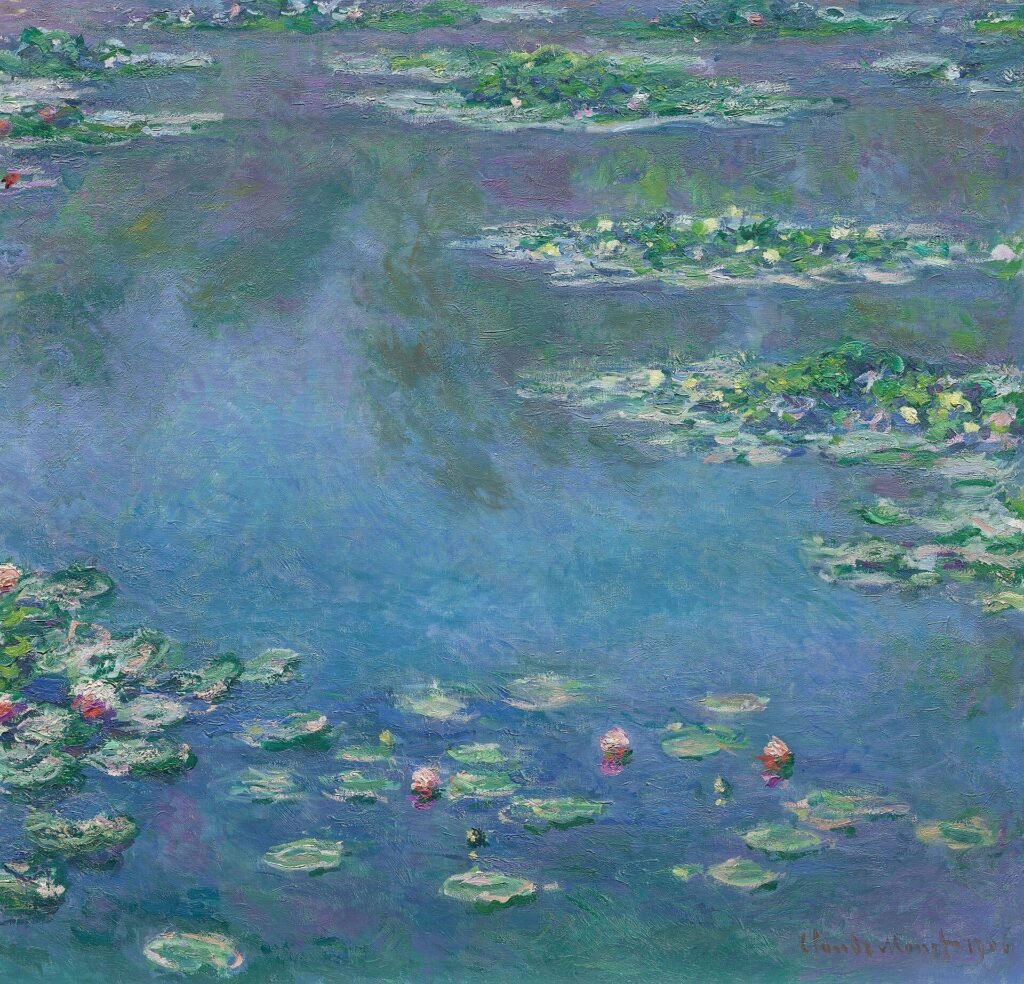
Water Lilies, known in French as Nymphéas, is the title Claude Monet gave to a large body of paintings of the water garden at his home in Giverny, France. The best-known part is a cycle of eight large panels that he gave to the French state and that has been installed at the Musée de l’Orangerie in Paris since 1927. Monet worked on the project from 1915 until his death in 1926, so he never saw it in place.
Background and creation of the Water Lilies
Monet rented a house at Giverny, west of Paris, in 1883 and bought it in 1890. In 1893 he bought more land and gradually turned it into a water garden. The National Gallery in London notes that by the end of the 1890s he had started to paint it, first choosing motifs such as the Japanese bridge and later moving toward immersive views of the water itself, where flowers break the surface and reflect an unseen sky and trees.
The Art Institute of Chicago adds that after 1899, apart from his London and Venice series, Monet mostly painted the pond. Between 1903 and 1908 he made smaller canvases of it. The idea of a larger decoration came early. In August 1897 he described to the writer Maurice Guillemot a plan for a circular room whose walls would be covered with water and plants.
He returned to the plan in April 1914, wrote to the critic Gustave Geffroy about big new paintings, and began work by early summer. In January 1915 he first called the project his Grande décoration. Monet had hardly painted between June 1912 and August 1914 after a series of personal tragedies, and the National Gallery says he felt that painting was a patriotic duty once the First World War began. A new studio built in 1915 and 1916 gave him space for canvases of unusual size.
The day after the Armistice of 11 November 1918, the National Gallery reports, Monet pledged to give a group of the paintings to the French state as a monument to peace. The Art Institute of Chicago dates the formal offer of the three-, four- and five-meter panels to 1922, and the Orangerie’s provenance note also gives 1922 as the year of the donation. The panels were installed in 1927.
Monet also worked toward the panels through a group of nineteen large canvases of the pond, made around 1917 to 1919. Five measured 130 by 200 centimeters and fourteen measured 100 by 200 centimeters. They were much bigger than his earlier pond pictures.
Description of the Water Lilies at the Orangerie
The Orangerie’s own description, reproduced by Google Arts and Culture, says the eight panels follow the passing of the day, from Morning in the east to Sunset in the west. The museum notes that Monet shows no horizon, no top and no bottom, so that water, air, sky and earth blend into a composition without perspective. The lily blossoms set the rhythm, giving the sense of an endless whole.
The scale is large. The panel called Morning is 12.75 meters wide and 2 meters high. The Art Institute of Chicago reproduces a photograph of Room 1 of the cycle, where the canvases surround the visitor, much like the circular room Monet had described to Guillemot decades earlier.
Not every large pond painting went to the Orangerie. The National Gallery notes that other large-scale decorations stayed at Giverny until after the Second World War.
Themes and interpretation of the Water Lilies
The Orangerie calls the cycle Monet’s artistic testament, the culmination of an entire life, and says it was inspired by the water garden at his property. In Guillemot’s account of 1897, the imagined room would have walls of a transparency shifting between green and mauve, with the calm and silence of still water. Monet’s pledge to give the panels to the nation as a monument to peace adds a public meaning to the project.
Scholars read the project as a bridge between two kinds of art. The Chicago catalog quotes the art historian Gloria Groom, who sees the large pond paintings as arising from Monet’s wish to make mural-like pictures that would create an all-over decorative environment. Another Chicago-cited historian, Paul Tucker, argues that Monet let some of the 1917 to 1919 canvases leave his studio so he could reengage with the public market, since he had parted with only a handful of works after selling his Venice pictures in 1912.
Both the 1906 canvas and the 1917 to 1919 studies drop the banks of the pond and concentrate on the water surface. The Art Institute of Chicago describes how Monet kept adjusting the placement of the lily clusters and added the flowers in several stages, before and after he painted the reflections of foliage. In the Chicago study, the result is a thickly worked, highly textured surface built up over many sessions.
Reception and legacy of the Water Lilies
Monet was reluctant to let outsiders see his work in progress, and most of the preparatory studies stayed in his studio until long after his death. The Art Institute of Chicago says they were rediscovered in the 1950s. Dealers and collectors still tried to buy. In June 1920 the dealer Joseph Durand-Ruel came to Giverny with Chicago collectors and a museum trustee’s wife to negotiate a purchase of what was later reported to be thirty paintings. Monet allowed several to leave the studio, selling four to the Bernheim-Jeune gallery in November 1919 and donating one to a Nantes society in 1922.
Paintings from the series are now in museums around the world. The Art Institute of Chicago holds a 1906 canvas and a large 1917 to 1919 study, the Metropolitan Museum of Art in New York has a 1919 canvas, and the National Gallery in London shows a 1917 painting in Room 46. For the full cycle, though, visitors go to the Orangerie in Paris, where the panels are the work Monet intended for the nation.
The series is closely tied to Impressionism, the movement Monet helped start, but it also shows how far his late work moved from the sketch-like harbor views of the 1870s, such as Impression, Sunrise.
More in Visual Arts
Key facts
- Monet bought his Giverny house in 1890 and added a water garden after buying more land in 1893.1
- He built a studio for the large decorations in 1915 and 1916 and pledged a group of them to the French state the day after the Armistice of 11 November 1918.1
- The formal offer of the large panels dates to 1922, and they were installed at the Musée de l'Orangerie in Paris in 1927.23
- The Orangerie cycle has eight panels that follow the day from Morning in the east to Sunset in the west.3
- The panel called Morning is 12.75 meters wide and 2 meters high.3
Related concepts
Quick checkWhere can Monet's Water Lilies cycle be seen?Show answer
At the Musée de l'Orangerie in Paris, where the large panels have been installed since 1927.
Sources
- National Gallery, London, Claude Monet, Water-lilies (L772), https://www.nationalgallery.org.uk/paintings/claude-monet-water-lilies-1
- Art Institute of Chicago, Monet Paintings and Drawings: Cat. 47, Water Lily Pond, 1917/19, https://www.artic.edu/digital-publications/48/monet-paintings-and-drawings-at-the-art-institute-of-chicago-2/421/cat-47-water-lily-pond-191719
- Musée de l'Orangerie via Google Arts and Culture, The Water Lilies - Morning, https://artsandculture.google.com/asset/IAHgEdqp703amQ
Editorially reviewed by Specialty Digest Editorial TeamLast reviewed November 5, 2026Researched and drafted with AI assistanceReport an issue