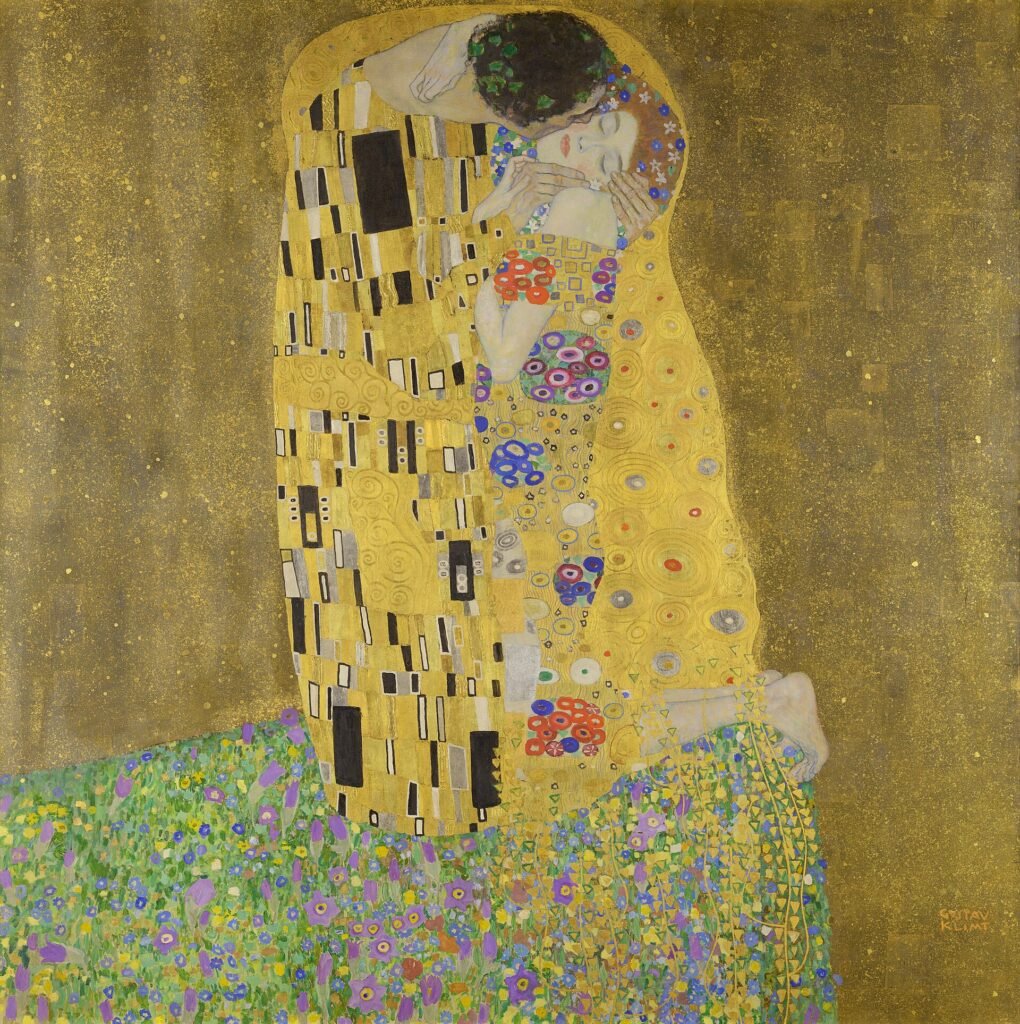
The Kiss (German: Der Kuss) is an oil painting by the Austrian artist Gustav Klimt, dated 1908 to 1909, that shows a couple in an embrace. It measures 180 by 180 centimeters and hangs in the Belvedere museum in Vienna. The Belvedere calls it probably the most popular work by Klimt, and it is often seen as a high point of his Golden Epoch and of Viennese Art Nouveau.
Background and creation of The Kiss
Gustav Klimt (1862 to 1918) was a leading figure of Viennese Modernism around 1900, according to the Belvedere. The museum itself was founded in 1903 as the Modern Gallery, and Klimt and other members of the Secession supported its creation. It was the first state museum in Austria that did not grow out of the imperial collections.
The Belvedere says Klimt gained initial inspiration for his ornamental program in 1903, on a trip to Ravenna to see the Byzantine mosaics. The painting itself belongs to the years 1908 and 1909. It was shown for the first time in 1908 at the Vienna Kunstschau, an art exhibition held on the site of today’s Konzerthaus.
That exhibition was a major event. Tate Etc. describes how a wooden building of about 6,500 square meters was put up in a few months, with more than 50 rooms, courtyards, gardens, a café and even a small cemetery. It was created by Josef Hoffmann, Klimt, Otto Prutscher, Koloman Moser and others to coincide with celebrations of the sixtieth anniversary of Emperor Francis Joseph I’s reign, although the artists had not been invited to take part in the official events. Tate Etc. also lists a room of art for children designed by students of Adolf Böhm, a room of posters by the Wiener Werkstätte, Josef Hoffmann’s silverwork, and Klimt’s own Die drei Lebensalter of 1905. At the opening Klimt called the show a demonstration of Austrian ambitions in art and a faithful report on the state of culture in the empire.
The Tate writer Simon Grant adds a commercial angle. In his view Klimt, guided by the shrewd image-maker Carl Moll, was good at headline-grabbing projects, and the Kunstschau worked like a giant business card to attract clients. Klimt himself said at the opening that exhibitions were not the ideal forum for bringing artists and audiences together and that he would rather work on major public art projects. Yet the show still gave him a stage on which to present his newest paintings, and The Kiss was among them.
Description of The Kiss
The painting is oil on canvas and square in format. It shows two lovers locked in an embrace and surrounded by dense ornament. The Belvedere describes the ornamental design as an encoded program, built around the mystery of existence, love and fulfillment through art.
The picture draws on many sources. Beyond the Byzantine mosaics of Ravenna, the museum says it contains a myriad of motifs from different cultural periods, above all from ancient Egyptian mythology. Because of this layering, the work is as much a study in pattern and surface as a portrait of a couple.
Themes and interpretation of The Kiss
Earlier writers treated the ornaments as traditional symbols that deliver a timeless message. The Belvedere says the latest research shows this is not enough. In its account, the ornaments also point to Klimt’s love for Emilie Flöge and to his engagement with the sculptor Auguste Rodin’s art.
The museum places the painting at the culmination of the Golden Epoch, a decade in which the artist built a puzzling program around love, existence and the redemptive power of art. In that sense the picture works both as a private image of intimacy and as a statement about what art can do.
The museum’s wording is cautious. It says the ornaments “reveal more” than a single traditional message, which leaves the painting open to several readings at once.
Reception and legacy of The Kiss
The picture won immediate institutional approval. According to the Belvedere, the state bought it from the Kunstschau for 25,000 kronen, thereby securing one of the icons of Viennese Jugendstil, the German name for Art Nouveau, and indeed of European modern art for the nation. The Belvedere describes the purchase by the Imperial and Royal Department for Culture and Education as its most notable early acquisition of a Klimt.
Klimt was already collected by the Modern Gallery. It had bought After the Rain, painted in 1898, as early as 1900. Over time it added more, and the Belvedere now has 24 Klimt paintings, the largest single group in any museum collection, with others on permanent loan.
The Belvedere kept buying. The Modern Gallery acquired Klimt’s monumental Medicine, one of three faculty paintings for the University of Vienna, in 1919 with help from patrons including the Bloch-Bauer and Lederer families, and it purchased the portrait of Fritza Riedler in 1937. Another Klimt landscape, Farmhouse in Buchberg of 1911, entered the collection immediately after it was finished.
The painting is also fragile. When Tate Liverpool staged a major Klimt exhibition in 2008, The Kiss was missing because the loan had been declined owing to its delicate nature. It could be seen that year in Vienna, where the Belvedere recreated rooms of the original 1908 Kunstschau for its centenary and showed the painting among works from the first presentation.
The museum is housed in the Belvedere palace. It first occupied only the Lower Belvedere and spread to the Upper Belvedere in 1918, the year Klimt died. Its collection centers on Austrian painting and sculpture of the 14th, 15th and 18th through 21st centuries.
Key facts
- The Kiss is an oil painting measuring 180 by 180 centimeters, dated 1908 to 1909.1
- It was first exhibited in 1908 at the Vienna Kunstschau and bought for the state for 25,000 kronen.1
- Klimt gained early inspiration for his Golden Epoch ornament on a 1903 trip to Ravenna to see Byzantine mosaics.1
- The Belvedere holds 24 Klimt paintings, the largest single collection of his work.2
- Tate Liverpool's 2008 Klimt exhibition lacked The Kiss because the loan was declined owing to its delicate nature.3
Related concepts
Quick checkWhere is Klimt's The Kiss, and when was it bought?Show answer
It is in the Belvedere in Vienna, which acquired it in 1908 when it was first shown at the Kunstschau.
Sources
- Belvedere via Google Arts and Culture, The Kiss (1908-1909) by Gustav Klimt, https://artsandculture.google.com/asset/kuss/HQGxUutM_F6ZGg
- Belvedere via Google Arts and Culture, Discover the Largest Collection of Klimt Paintings at the Belvedere, https://artsandculture.google.com/story/jwWx42PcunhfJw
- Tate Etc., Simon Grant, Gustav Klimt and the 1908 Kunstschau (issue 14, autumn 2008), https://www.tate.org.uk/tate-etc/issue-14-autumn-2008/gustav-klimt-and-1908-kunstschau
Editorially reviewed by Specialty Digest Editorial TeamLast reviewed November 5, 2026Researched and drafted with AI assistanceReport an issue