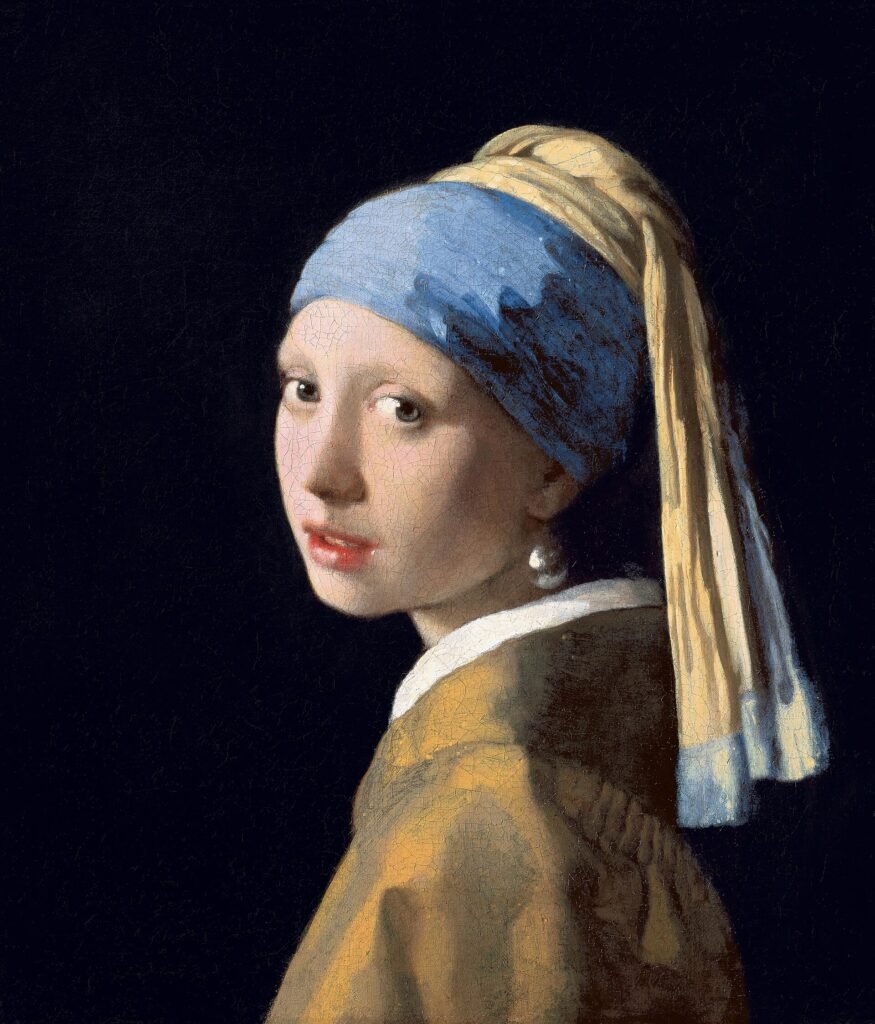
Girl with a Pearl Earring is an oil painting by the Dutch artist Johannes Vermeer, made around 1665 and held by the Mauritshuis museum in The Hague. It measures 44.5 by 39 centimeters and shows a young woman in a turban looking over her shoulder. It is not a portrait but a tronie, a Dutch term for a study of a character or type.
Background and creation of Girl with a Pearl Earring
Vermeer was born in Delft in 1632 and died there in 1675. The Mauritshuis describes him as one of the most famous Dutch painters of the 17th century. He worked slowly, so only about 36 of his paintings are known, and he also worked as an art dealer and valuer.
Tronies were popular in 17th-century Dutch art. They were not made to give the best likeness of a person. A sitter may have posed, but the aim was to study a head representing a particular character or type. According to the Mauritshuis, Rembrandt made the genre popular around 1630 and produced dozens of tronies, often using himself as the model.
The dress adds to the effect. Dutch girls of the period did not wear turbans, so the turban gives the figure an oriental air. It is wound from two pieces of cloth, one blue and one yellow.
Description of Girl with a Pearl Earring
The girl looks back toward the viewer with greyish-blue eyes and slightly parted, moist lips. The Mauritshuis points out that her face is modeled very softly, with gradual transitions and almost invisible brushstrokes. The clothing is more schematic and is brought to life with small dots of paint that suggest reflected light, a typical feature of Vermeer’s technique.
Vermeer also differentiated materials. The white collar is painted in thick impasto, while the turban uses drier paint and the costly pigment ultramarine. The painting is signed at the upper left with the letters IVMeer joined in a ligature.
The pearl that gives the picture its name consists of little more than two brushstrokes, a bright highlight at upper left and the soft reflection of the white collar beneath. The museum says it is too large to be real. It may be a glass drop varnished to give it a matte sheen, or it may simply come from the artist’s imagination. Pearls, both real and imitation, were fashionable from about 1650 to 1680.
Research findings on Girl with a Pearl Earring
In early 2018 the Mauritshuis placed the painting in a glass room so that visitors could watch researchers examine it with imaging equipment. The findings were presented online in April 2020, and the Associated Press reported that they did not reveal who the girl was or whether she existed.
The team confirmed that the girl has eyelashes and found that she is painted in front of a green curtain that has faded from view. Microscopic scans also found tiny fragments of Vermeer’s paintbrush hairs embedded in the paint of her skin.
Infrared imaging showed that Vermeer began on a woven canvas with a grey base layer, sketched the composition in brown and black, and drew the outline in black lines. He then worked from the green background toward the foreground, painting the skin, yellow jacket, white collar and blue headscarf, and finally the quick dabs of white that form the pearl.
Analysis of microscopic paint samples traced the pigments to their origins. The white lead came from the Peak District in northern England, the ultramarine from lapis lazuli found in what is now Afghanistan, and the red from cochineal, an insect-based dye from Mexico and South America. Project leader Abbie Vandivere noted that ultramarine was more valuable than gold in the 17th century, and the team found that Vermeer used a surprising amount of it in the headscarf.
History and ownership of Girl with a Pearl Earring
The early history is uncertain. The Mauritshuis lists the Delft collector Pieter Claesz van Ruijven as a probable first owner before 1674, followed by a sequence of relatives. A Dissius sale in Amsterdam in 1696 probably included the painting, but the records are not definite.
The painting has been known to the general public only since 1881, when it was offered at an auction in The Hague. The cultural official Victor de Stuers attended the viewing with the collector Arnoldus Andries des Tombe. By one account De Stuers recognized it as a Vermeer despite its neglected state, and by another its identity was confirmed only after cleaning revealed the signature. Either way, the two men agreed not to bid against each other, and Des Tombe bought it for 2.30 guilders.
When Des Tombe died on 16 December 1902, he was found to have made a secret will leaving twelve paintings to the Mauritshuis, including this one. The art historian Abraham Bredius, who later directed the museum, had written in 1885 that Vermeer overshadowed everything else in the collection, and he singled out the girl’s head.
Reception and legacy of Girl with a Pearl Earring
The Mauritshuis calls the painting Vermeer’s most famous work and says it enchants hundreds of thousands of visitors every year. The museum has even worked with brain scientists to ask what makes it so hard to look away from. The Associated Press notes that it is sometimes referred to as the Dutch Mona Lisa, a comparison based on the pull of a single face rather than on any shared history.
The picture is now on view in Room 15 of the museum in The Hague, in the Netherlands. The 2018 research also mapped the fine cracks in the paint, creating a baseline against which the museum can monitor the health of the canvas in the future.
More in Visual Arts
Key facts
- Girl with a Pearl Earring is an oil painting on canvas by Johannes Vermeer, dated about 1665, measuring 44.5 by 39 centimeters.1
- The Mauritshuis in The Hague holds it under inventory number 670.1
- It is a tronie, a study of a character or type, and not a portrait of an identified sitter.1
- Research announced in April 2020 confirmed eyelashes and a faded green curtain behind the girl.2
- The painting was sold in 1881 for 2.30 guilders and was bequeathed to the Mauritshuis after the death of Arnoldus Andries des Tombe on 16 December 1902.1
Related concepts
Quick checkIs Girl with a Pearl Earring a portrait of a real person?Show answer
It is a tronie, a study of a type, so it was not made as a portrait. The Mauritshuis says there was probably a sitter, and research in 2020 did not reveal who she was.
Sources
- Mauritshuis, Johannes Vermeer, Girl with a Pearl Earring (collection entry, including provenance), https://www.mauritshuis.nl/en/our-collection/artworks/670-girl-with-a-pearl-earring/
- Mike Corder, Associated Press, Hi-tech scans uncover new details of Girl with a Pearl Earring, but not her identity, PBS NewsHour, 28 April 2020, https://www.pbs.org/newshour/amp/arts/hi-tech-scans-uncover-new-details-of-girl-with-a-pearl-earring-but-not-her-identity
Editorially reviewed by Specialty Digest Editorial TeamLast reviewed November 5, 2026Researched and drafted with AI assistanceReport an issue