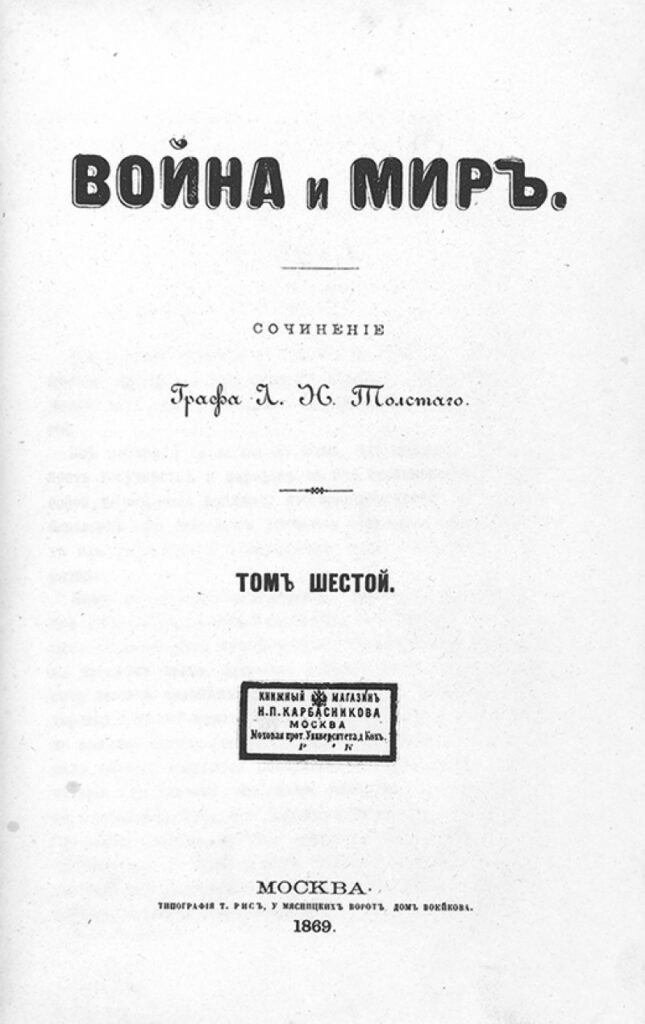
War and Peace is a novel by the Russian writer Leo Tolstoy, published in installments from 1865 and as a complete work in 1869. It follows several aristocratic families through the Napoleonic era, from 1805 to the French invasion of Russia in 1812, and mixes fictional characters with real historical figures. The book runs to about 1,200 pages and is famous for its scale and its essays on history.
Background and writing of War and Peace
Tolstoy began the novel in 1863. He had served as an artillery officer in the Crimean War in the 1850s and drew on those memories, and he consulted primary and secondary sources and interviewed veterans and other eyewitnesses of the earlier conflict.
The work was published in Russia between 1865 and 1869, first in a literary magazine and then as a book. The Program of Liberal Studies at the University of Notre Dame lists the novel as dating from 1865 to 1869, and a standard critical edition carries the publication history, Tolstoy’s letters and diaries, and three drafts of his introduction.
The Russian journal that carried the early installments also serialized Dostoevsky’s Crime and Punishment in 1866, so the two great works of the era appeared in the same pages.
Plot summary of War and Peace
The story opens in 1805 at a society party in St. Petersburg, where talk turns to Napoleon and the possibility of war. The main figures come from three households: the Rostovs, the Bolkonskys and the Bezukhovs.
Pierre Bezukhov is an awkward, thoughtful young man who suddenly inherits a fortune and makes an unhappy marriage. Prince Andrei Bolkonsky is a proud officer who joins the army looking for glory and finds disillusion. Natasha Rostova is a lively young woman whose first love affair ends in scandal.
As the war goes on, their lives intersect with real events, including the defeat at Austerlitz in 1805 and the Battle of Borodino in 1812. French forces enter Moscow, the city burns, and the invaders begin a costly retreat through the Russian winter.
In the closing chapters, the survivors have married and settled into family life. Two epilogues follow, the second of which is devoted to Tolstoy’s general theory of how history works.
Historical setting of War and Peace
The book is set during the wars that followed the French Revolution. In 1805 Russia joined other European powers against France, and the allied defeat at Austerlitz in December of that year opens the military action of the story.
In June 1812 Napoleon led a very large army across the Niemen river into Russia. The Russian army fell back, fought the Battle of Borodino near Moscow in September, and then abandoned the city, which was occupied and largely burned. The French began their retreat in the autumn, and cold, hunger and attacks reduced the army sharply by the end of the year.
Characters in War and Peace
The novel has hundreds of characters, but a handful carry the story. Pierre searches for purpose through freemasonry, wealth, war and captivity. Andrei is rational and ambitious, and Natasha stands for warmth and spontaneity. Nikolai Rostov is a brave but conventional soldier, and his future wife Princess Marya Bolkonskaya is devout and patient.
Napoleon and the Russian commander Mikhail Kutuzov appear as historical characters. Tolstoy shows Napoleon as vain and cut off from events, and Kutuzov as a general who understands that he cannot fully control the course of battle.
Themes in War and Peace
History and historiography are the book’s most distinctive concern. According to the Davis Center at Harvard, Tolstoy treated the 1812 invasion, including Borodino, as a test of how historians explain events. He rejected the Great Man theory, the idea that individual leaders such as Napoleon shape history, and argued that countless small causes combine to produce outcomes.
Fate and free will form a second theme. Tolstoy states an interpretation of events and then lets his characters act it out, so that personal decisions and large historical forces keep pressing against each other.
The novel also compares private and public life. Peace-time scenes of family, love and spiritual doubt receive as much attention as battles, and many characters find meaning in ordinary relationships rather than in rank or glory.
Tolstoy also criticized historians who explained battles through small what-if questions, such as whether an illness of Napoleon affected the result at Borodino. For him, such explanations missed the larger web of causes that no single person could command.
Style and form of War and Peace
Tolstoy did not regard the work as a novel in the usual sense. He described it as a form of historical writing of its own kind, and it moves between narrative scenes, battle descriptions and open essays on historical method.
Its prose is direct and exact, and it uses French dialogue in drawing-room scenes to show how far the Russian aristocracy had adopted another culture.
Reception and legacy of War and Peace
The book has been translated many times into English and other languages. Because the original mixes Russian and French, translators have to decide how to present the French passages, and different versions handle this in different ways.
By the late nineteenth century the book had become a reference point in its own right, shaping popular ideas of the war of 1812. It regained special popularity in 1941, when the Soviet Union faced the Nazi invasion and readers turned to its picture of Russian resistance. Tolstoy followed it with Anna Karenina in the 1870s.
Adaptations include a large Soviet film of the 1960s and several television series, and the book remains one of the most widely read works of world literature. Its length has become a cultural joke, but readers also cite its range of human types and its sense of life continuing amid great events.
More in Literature
Key facts
- War and Peace is a novel by Leo Tolstoy, published between 1865 and 1869.2
- Tolstoy began it in 1863 and drew on his own military service and on interviews with veterans.1
- The novel runs to about 1,200 pages and covers the Napoleonic wars, including the 1812 invasion of Russia and the Battle of Borodino.1
- Tolstoy rejected the Great Man theory of history and called the work a form of historiography of its own kind.1
- The book regained special popularity in 1941, when the Soviet Union faced the Nazi invasion.1
Related concepts
Quick checkWhat period of history does War and Peace cover?Show answer
It follows Russian families from 1805 through the French invasion of Russia in 1812, with real events such as Austerlitz and Borodino.
Sources
- Davis Center for Russian and Eurasian Studies, Harvard University, Tolstoy Takes, https://daviscenter.fas.harvard.edu/insights/tolstoy-takes
- Program of Liberal Studies, University of Notre Dame, War and Peace (Leo Tolstoy, 1865-69), https://pls.nd.edu/the-major/what-will-i-read/war-peace/
- Cambridge Companion to Dostoevskii, sample chapter (Library of Congress catalog enrichment), https://catdir.loc.gov/catdir/samples/cam033/2002067684.pdf
Editorially reviewed by Specialty Digest Editorial TeamLast reviewed November 5, 2026Researched and drafted with AI assistanceReport an issue