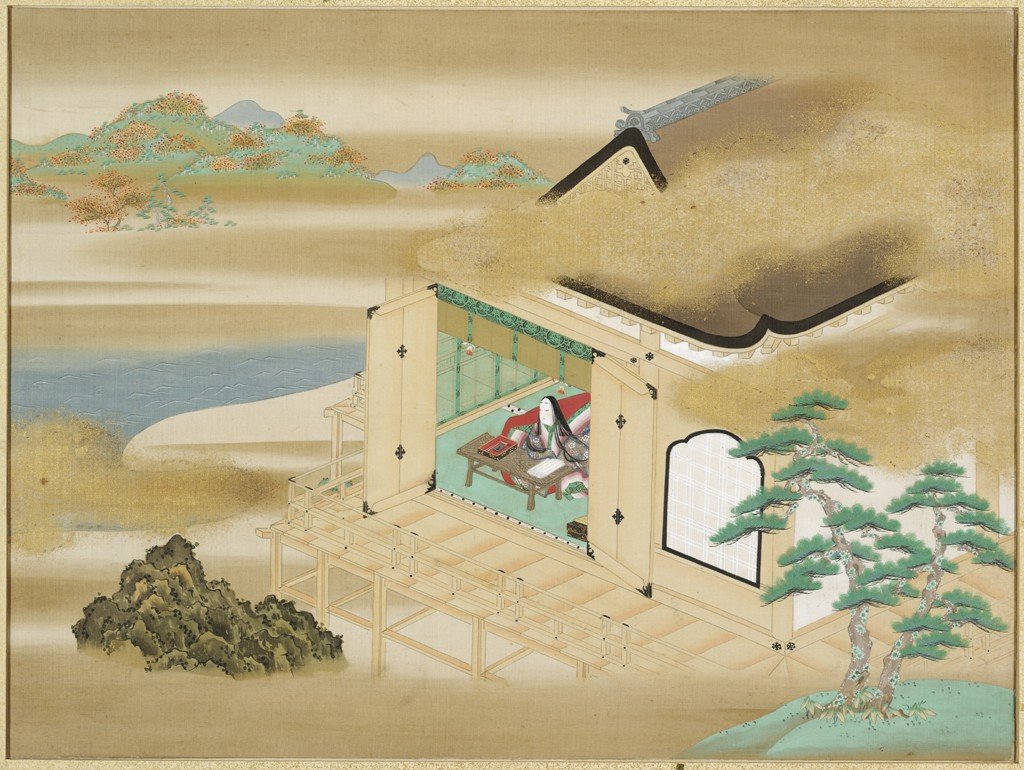
The Tale of Genji is a long Japanese prose narrative written by the court lady Murasaki Shikibu in the early eleventh century, during the Heian period. It follows the life and loves of Hikaru Genji, an emperor’s son who is reduced to commoner rank, and then the next generation of his family. It is often called the world’s first novel, a description that depends on how one defines the form.
Background and creation of The Tale of Genji
Little is known for certain about Murasaki Shikibu. Sources disagree on the exact years of her life: one reference gives about 973 to after 1013, and another gives 978 to 1014, each marked as uncertain. Arthur Waley, who produced the first major English translation, noted that she was born in the last quarter of the tenth century, lost her husband in 1001, and a few years later became a lady-in-waiting to the Empress Akiko, partly because of her skill in Chinese.
Her diary gives a rare clue about the date of the book. A passage that apparently refers to 1008 says that her tale was read aloud to the Emperor, so the opening chapters were already in circulation. The whole work of 54 chapters may have taken longer, and another diary, the Sarashina Diary, shows that a complete Genji was already a classic by 1022. A common modern estimate places the finished work around 1020.
The work belongs to the refined world of the imperial court in what is now Kyoto. Murasaki wrote in Japanese rather than in Chinese, the formal language of official writing, which allowed her to describe feelings, gossip and the small details of court life. A later legend says she began composing the tale at the temple of Ishiyama-dera beside Lake Biwa, a scene that artists painted many times.
Plot of The Tale of Genji
The story opens at the court of an unnamed emperor. His favorite concubine, Kiritsubo, has little family support, and after her death the emperor lowers their brilliant, beautiful son to commoner rank. This is the Genji of the title. He is forced into a life outside the line of succession but remains close to the center of court life.
The first part follows Genji’s love affairs and their consequences. He loves Fujitsubo, a consort of his father, and their secret child is raised as the emperor’s heir. He marries Aoi, courts women such as Utsusemi and Yugao, and adopts a young girl who becomes known as Murasaki and later his second wife. Political rivals send him into exile on the coast, yet he returns to power and reaches a peak of influence and splendor.
The later chapters are darker. Genji’s relationships bring grief to those around him, and the death of Murasaki leaves him desolate. The final thirteen chapters turn to Kaoru, who is raised as Genji’s son, and to the rival Niou, whose entanglements with women in the district of Uji end without a clear resolution. A minority of scholars have questioned whether Murasaki wrote these last chapters, though most attribute the whole work to her.
Characters are usually identified by court rank, family relation or the chapter in which they appear, not by personal names. That convention gives the book a distance and delicacy, and it makes the genealogy of its many characters part of the reader’s work.
The chapters carry titles taken from key images or poems, such as Kiritsubo, The Broom-Tree and Utsusemi, so readers can find their way around a very long work by name. Scholars also note that some chapters run in parallel with others, covering the same stretch of time from a different angle, and that the order of a few chapters is debated.
Themes in The Tale of Genji
The most famous theme is impermanence. Murasaki returns again and again to the Japanese idea of mono no aware, a sensitivity to the passing beauty of things and the sadness it carries. Cherry blossoms, autumn leaves and moonlight are linked to love, rank and life itself, all of which fade.
The book also examines desire and its consequences. Genji is portrayed as charming and generous but also as impulsive, and his affairs hurt women who have few choices in a society organized around marriage, family politics and rank. Readers disagree about whether Murasaki endorses Genji or quietly criticizes him, and that ambiguity is part of the book’s staying power.
Buddhist ideas of transience and attachment run through the later chapters, and poetry is built into everyday life. Characters exchange short verses in place of direct statements, so the narrative doubles as a record of the poetry that shaped courtly communication.
Reception and legacy of The Tale of Genji
The Tale of Genji has been illustrated since the early twelfth century, when painters began producing the pictorial tradition known as Genji-e. Scenes from the tale and portraits of its author decorated scrolls, screens and albums through the centuries, including an album of 54 illustrations by the Tosa school artist Tosa Mitsuoki.
Arthur Waley published his English translation in installments beginning in 1925, and later translators have reworked the text for new generations. The work is retranslated into modern Japanese regularly, because the original language of the Heian court is hard for contemporary readers to follow without help.
Today the book is a cornerstone of the study of literature from Japan and a reference point in discussions of early narrative worldwide. Its characters also moved onto the stage, notably in Noh plays such as Aoi no Ue, which dramatizes the jealous spirit of Lady Rokujō. Its mix of psychological detail, social observation and seasonal imagery has influenced Japanese writing for a thousand years.
More in Literature
Key facts
- The Tale of Genji was written by Murasaki Shikibu in the early eleventh century, during the Heian period.2
- The complete work has 54 chapters.1
- A diary passage that apparently refers to 1008 mentions the tale being read aloud to the Emperor.1
- The Sarashina Diary shows that a complete Genji was already a classic by 1022.1
- Murasaki's lifespan is given as about 973 to after 1013 by one source and as 978 to 1014 by another, both uncertain.23
- Genji-e illustrations of the tale date from the early twelfth century.3
Related concepts
Quick checkWho wrote The Tale of Genji, and in which period?Show answer
Murasaki Shikibu, a court lady, wrote it in the early eleventh century during the Heian period.
Sources
- Project Gutenberg, The Tale of Genji by Lady Murasaki, translated by Arthur Waley (1925), preface and chapters (ebook 66057), https://www.gutenberg.org/ebooks/66057
- World History Encyclopedia, Tale of Genji, https://www.worldhistory.org/Tale_of_Genji/
- JAANUS (Japanese Architecture and Art Net Users System, hosted by Columbia University), Murasaki Shikibu, https://projects.mcah.columbia.edu/jaanus/record/murasakishikibu
Editorially reviewed by Specialty Digest Editorial TeamLast reviewed November 5, 2026Researched and drafted with AI assistanceReport an issue