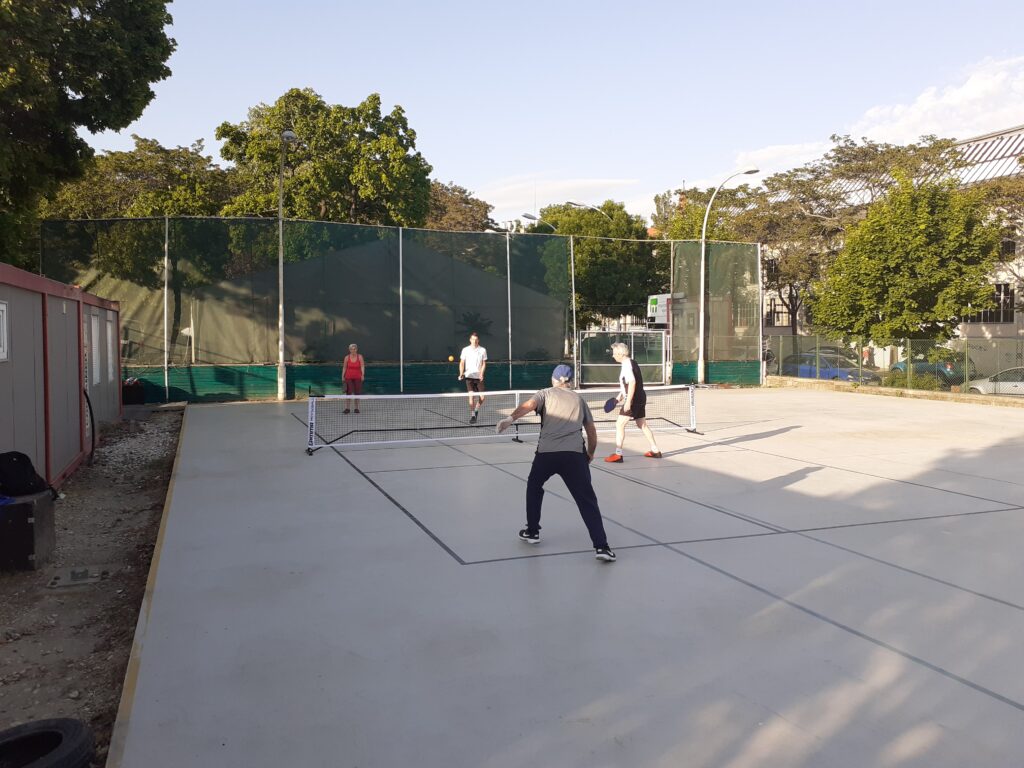
Pickleball is a paddle sport for two or four players, played with a perforated plastic ball over a low net on a court the size of a doubles badminton court. It blends features of tennis, badminton and table tennis. The game was invented in 1965 on Bainbridge Island, Washington, near Seattle, and remained a regional pastime for decades before becoming the fastest-growing sport in the United States in the early 2020s, which raises the question of why pickleball is so popular.[1][2]
The Sports & Fitness Industry Association (SFIA) estimated that 24.3 million Americans played pickleball in 2025, up from 4.2 million in 2020.[1] Researchers, journalists and sports bodies point to several reasons: a small court with simple entry rules, a social doubles format, pandemic-era demand for outdoor activity, and a rapid conversion of existing courts. The surge has also brought rising injury counts among older players and large commercial investment.
| Invented | Summer 1965, Bainbridge Island, Washington, U.S. |
|---|---|
| Court | 20 by 44 feet (6.10 by 13.41 m), for singles and doubles |
| Net height | 36 inches at the sidelines, 34 inches at the center |
| Non-volley zone | 7 feet from the net on each side |
| U.S. players, 2025 | About 24.3 million (SFIA estimate) |
History
Origins
According to USA Pickleball, the sport’s national governing body, the game began in the summer of 1965. Joel Pritchard, then a Washington state legislator who later served in the U.S. House of Representatives and as the state’s lieutenant governor, and his friend Bill Bell, a businessman, returned from a round of golf to Pritchard’s Bainbridge Island home and found their families bored.[2][3] The property had an old badminton court, but they could not find a full set of rackets, so they improvised with table tennis paddles and a perforated plastic ball. They first hung the net at badminton height, 60 inches, then lowered it to 36 inches because the ball bounced well on the asphalt.[2]
The following weekend, Barney McCallum joined them. The three men wrote rules that drew heavily on badminton, aiming at a game the whole family could play together.[2]
Name
Pritchard’s wife, Joan, named the game within days of its invention, according to USA Pickleball, comparing its mixture of other sports to the “pickle boat,” a regatta crew assembled from leftover rowers.[2] A rival account, which McCallum maintained, held that the game was named after the family’s dog, Pickles. USA Pickleball’s magazine reported that the dog was born in 1968, three years after the game was named, and concluded that the dog was named for the game rather than the reverse.[2]
Organization and spread
The first permanent court was built in 1967 in the backyard of Pritchard’s neighbor Bob O’Brian, and a corporation was formed in 1972 to protect the new sport.[2] The first known tournament took place in spring 1976 at the South Center Athletic Club in Tukwila, Washington. The United States Amateur Pickleball Association was organized in 1984 and issued the first rulebook that March, and by 1990 the game was being played in all 50 states.[2]
USA Pickleball describes a 2008 segment on ABC’s Good Morning America as the sport’s first mass-media exposure, and the first nationally televised broadcast, on CBS Sports Network, came from the 2016 US Open in Naples, Florida. The association, renamed USA Pickleball in 2020, ended 2021 with just over 53,000 members.[2]
Gameplay and equipment
A regulation court measures 20 by 44 feet (6.10 by 13.41 meters), the same size as a doubles badminton court for both singles and doubles. The net stands 36 inches high at the sidelines and 34 inches at the center.[4] A tennis doubles court, by comparison, is 78 feet long and 36 feet wide.[5] On each side of the net lies a 7-foot non-volley zone, nicknamed the “kitchen,” where players may not hit the ball out of the air while standing.[4]
Serves must be made underhand, and under the two-bounce rule the ball must bounce once on each side after the serve before either team may volley. The rule prevents the serve-and-volley tactic common in tennis and gives the returning team time to reach the net.[4]
Why is pickleball so popular?
The evidence supports some explanations more firmly than others.
Accessibility
The small court and the players’ control over pace lower the barrier to entry. Researchers in an ACE-sponsored study led by Lance Dalleck observed that the intensity and competitiveness of a match are set by the players themselves, which makes the game suitable for beginners and older adults while leaving room for faster, more skilled play.[6]
A social format
Doubles on a compact court keep players within conversation range. The same researchers noted frequent socializing, conversation and laughter before, during and after matches.[6] Sandra Webber, a physical-therapy professor at the University of Manitoba who studies the sport, has called its social side especially valuable for older adults.[7] NBC News reported that players built networks of pickup groups on Facebook and WhatsApp.[8] Some commentators, such as writers at The Nation, argue that the sport’s appeal also reflects demand for in-person community amid rising social isolation; this is an interpretation rather than a measured finding.[9]
The pandemic effect
Participation was rising before 2020, having doubled since 2014 by NBC News’s account, but the COVID-19 pandemic accelerated the trend by making an outdoor, non-contact activity attractive while gyms and team sports were restricted.[8] USA Pickleball reported that its membership grew 43 percent in 2021, its largest single year of growth to that point, and described 2022 as a year of unprecedented media coverage.[2]
Courts and community infrastructure
The number of places to play grew with the player base. USA Pickleball’s directory listed 39 locations in North America in 2003, about 150 courts in all, and the association counted nearly 21,000 known courts in the United States by 2018. It attributes the sport’s spread to community centers, school physical-education classes, YMCA facilities and retirement communities.[2] Front Office Sports reported that over five years, derelict basketball and tennis courts and vacant lots across the country were converted into pickleball courts.[10]
Participation and demographics
SFIA, whose reports track participation across more than 100 sports and fitness activities, reported 19.8 million U.S. players in 2024, a 45.8 percent rise from 2023 and a 311 percent rise over three years.[11] Its 2026 report estimated 24.3 million players in 2025, an increase of 22.8 percent, making pickleball the fastest-growing U.S. sport for a fifth consecutive year.[1][12] SFIA put tennis at 27.3 million players in 2025.[12]
The number of “core” players, defined by SFIA as those who play eight or more times a year, rose from 1.4 million in 2020 to about 7.5 million in 2025. Women made up 42.9 percent of participants in 2025, up from 38.6 percent in 2020.[1][13]
Growth is slowing in percentage terms. The 2025 rise of 22.8 percent was roughly half the 2024 rise, and SFIA’s mid-year 2025 report said early indicators suggested the sport’s explosive growth may be slowing.[11][14]
Health benefits and injuries
Physical activity
Small studies suggest that pickleball can count toward weekly exercise targets. In the ACE-sponsored study of 15 adults aged 40 to 85, play met guidelines for improving and maintaining cardiorespiratory fitness and burned about 350 calories per hour.[6] A University of Manitoba study published in 2022 in the Journal of Aging and Physical Activity found average heart rates of about 111 beats per minute, in the moderate range, among players averaging 62 years of age, with singles producing more movement than doubles.[7] A North Carolina State University pilot study of 33 adults aged 65 and older found an average of more than 68 minutes of moderate-to-vigorous activity per session, which the researchers said could help players reach recommended weekly totals.[15]
Webber cautioned that pickleball should not be a person’s only exercise, because strength training is also needed.[7] For wider guidance, see this explainer on how much exercise adults need.
Injuries
Emergency-department data show a steep rise in pickleball injuries. A study using the U.S. Consumer Product Safety Commission’s injury surveillance system estimated 19,012 pickleball injuries treated in U.S. emergency departments from 2001 to 2017, rising from 2013. Of the patients, 90.9 percent were aged 50 or older, and strains or sprains (28.7 percent) and fractures (27.7 percent) were the most common injuries.[16] Research presented at the American Academy of Orthopaedic Surgeons’ 2024 meeting found that fractures had risen about 90-fold since 2002; patients averaged 66.4 years of age, women accounted for 69 percent, and falls caused 92 percent.[17] A 2026 study from Vanderbilt University Medical Center found that the wrist was the most commonly injured part of the upper extremity (45 percent), and that 68.7 percent of those injuries were fractures.[18]
These figures count injuries, not injury rates, and participation rose steeply over the same period, so they do not show by themselves that pickleball is riskier per hour played than other racket sports; the 2020 study noted many similarities with injuries in other racket sports.[16] Strains and sprains can stem from repeated loading, a pattern known as overuse injury, while fractures mostly follow falls.[17]
Professional play and commercial investment
The sport’s two main professional organizations, the PPA Tour and Major League Pickleball, merged in 2024.[20] In May 2026, Apollo Sports Capital led a $225 million investment in Pickleball Inc., the new parent company of both, which also holds retail, media, software, court-construction and facility interests.[19][20] The company said the PPA Tour averaged 791,000 viewers on CBS in January 2026 and Major League Pickleball 499,000 in August 2025, records for each.[19] The two properties carry presenting sponsors, Carvana and DoorDash respectively, a typical sport sponsorship arrangement.[19] CBS News noted that earnings are far smaller for most players, many of whom play part-time while holding other jobs.[21]
FAQs
How many people play pickleball in the United States? SFIA estimated that 24.3 million Americans played pickleball in 2025, up from 4.2 million in 2020.
Why is it called pickleball? USA Pickleball says Joan Pritchard named it after the “pickle boat” of leftover rowers. A rival story credits the family dog, but the dog is reported to have been born three years after the game was named.
Is pickleball good exercise? Small studies show moderate-intensity activity that can count toward weekly targets, although researchers advise adding strength training.
Is pickleball more dangerous than other racket sports? Injury counts have risen sharply, mostly fractures from falls among older players, but the data count injuries rather than injury rates, and participation has also grown.
Is pickleball still growing? Yes, but more slowly: participation rose 22.8 percent in 2025, compared with 45.8 percent in 2024.
More in Health
- SFIA, U.S. Pickleball Participation
- USA Pickleball, History of the Game
- WSU Magazine, A Concise History of Pickleball
- Pickleball.com, A Deep Dive into the Rules of Pickleball
- The Dink, Pickleball Court Dimensions
- ACE, Can Pickleball Help Middle-aged and Older Adults Get Fit?
- AARP, Health Benefits of Pickleball
- NBC News, Pickleball: fastest-growing sport
- The Nation, Pickleball and Social Capital
- Front Office Sports, How Pickleball Became a Private Equity Rollup
- SFIA, 2025 Topline Participation Report
- The Dink, 24 Million Americans Now Playing Pickleball
- RecManagement, Pickleball Sees Ongoing Surge
- The Dink, Is U.S. Pickleball Participation Leveling Off?
- EurekAlert, NC State pilot study
- Forrester et al., 2020, PubMed
- HealthDay, AAOS pickleball fractures
- Vanderbilt study, 2026, PMC
- Pickleball.com, Apollo Sports Capital investment
- Sportcal, Apollo leads $225m investment
- CBS News, Pickleball Inc. investment