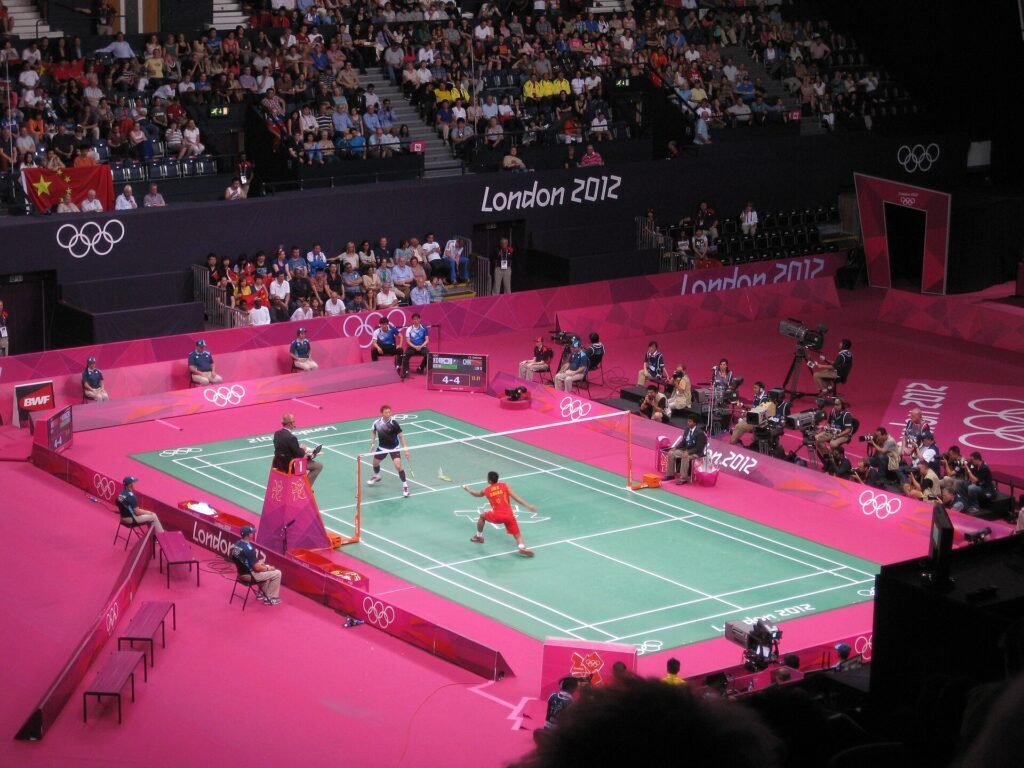
Badminton is a racket sport in which players hit a feathered or synthetic shuttlecock over a high net, scoring when it lands in the opponent’s court or the opponent cannot return it. It is governed by the Badminton World Federation, which reported 204 member associations in January 2026, and it has been an Olympic medal sport since Barcelona 1992.
History of badminton
Olympedia reports that badminton was invented in India, where English soldiers adopted it in the nineteenth century and then carried it to Great Britain. The game was originally called Poona. It took hold in England in 1873, when it was shown at a party given by the Duke of Beaufort at his country estate, Badminton, in Gloucestershire.
The Badminton Association was formed in September 1893 to bring uniformity to the rules. It mainly administered the game in England, but overseas clubs affiliated to it, and the growth of the sport created a need for a worldwide body.
On 5 July 1934, at Bush House in London, the International Badminton Federation came into being with nine founding members: Canada, Denmark, England, France, Ireland, the Netherlands, New Zealand, Scotland and Wales. It later became the Badminton World Federation, or BWF, on 24 September 2006, and moved its headquarters from the United Kingdom to Malaysia.
The sport’s path to the Olympics was gradual. Badminton was a demonstration sport at Munich in 1972 and at Seoul in 1988, and it became a full medal sport at Barcelona in 1992.
Rules and gameplay of badminton
A match is the best of three games. A game goes to 21 points, and every rally won adds a point to the winning side, whoever served. If the score reaches 20-all, a side must lead by two points to win.
The scoring has a ceiling. At 29-all, the side that scores the 30th point wins the game.
Players change ends after the first game and after the second game if a third is needed. In the third game, they change again when one side first reaches 11 points.
Service is tightly regulated. The server and receiver stand in diagonally opposite service courts, and both feet must stay in contact with the floor until the shuttle is hit. The racket head must first strike the base of the shuttle, the whole shuttle must be below the server’s waist, and the racket shaft must point downward at the moment of contact.
In singles and doubles, a side serves from the right-hand court when its score is even and from the left-hand court when it is odd. Olympic competition has included men’s and women’s singles and doubles since the sport’s debut, with a mixed doubles event added at Atlanta in 1996.
Equipment and venues for badminton
The shuttle is the sport’s defining piece of equipment. A feathered shuttle has 16 feathers, each 62 to 70 millimeters long, set in a base 25 to 28 millimeters across. The shuttle weighs between 4.74 and 5.50 grams, and the Laws allow non-feathered shuttles to vary by up to 10 percent in measurements and weight.
The net is 760 millimeters deep and at least 6.1 meters wide. Its top edge stands 1.524 meters above the floor at the center and 1.55 meters over the doubles sidelines, and the posts are 1.55 meters tall.
A racket may be no more than 680 millimeters long and 230 millimeters wide overall. Its stringed area may not exceed 280 millimeters by 220 millimeters, apart from limited extensions that the Laws permit.
These figures come from the June 2016 revised edition of the BWF Laws of Badminton, so readers should check the current edition for any later changes.
Governing bodies and major competitions
The BWF oversees the sport worldwide. The Thomas Cup, the world men’s team championship, was first held in 1948 and 1949 with 10 teams, and Malaya beat Denmark 8-1 in the final. The trophy was commissioned in 1939 by Sir George Thomas, the federation’s president and a 21-time All England winner.
The Uber Cup for women followed in 1956 and 1957 with 11 teams, and the United States beat Denmark 6-1 in the final. Before an official championship existed, the All England tournament was long treated as the unofficial world championship, and the first official World Championships took place in Malmo, Sweden, in 1977.
The sport has also faced division. A rival World Badminton Federation formed in 1978 and ran its own events, until the two groups reconciled in May 1981. The first international open tournament with prize money was held at the Royal Albert Hall in 1979.
Records and notable moments in badminton
Through 2024, China, Indonesia and South Korea together have won 96 of the 136 Olympic badminton medals and 37 of the 44 gold medals. China leads the all-time table with 22 golds and 52 medals, followed by Indonesia and South Korea with 22 medals each and Denmark with 10.
Gao Ling of China is the only player to have won four Olympic badminton medals, and eight players have won three. Thirteen players have won two gold medals, among them China’s Fu Haifeng, who also added a silver.
Viktor Axelsen of Denmark is the only gold medalist in that group who is not from an Asian country, with two golds and a bronze in men’s singles.
Global participation in badminton
The BWF began with nine members and has grown steadily. It reported 201 members in July 2024 and 204 member associations, including 13 associate members, by January 2026.
The sport was once confined to pockets of Asia, Europe and North America, according to the BWF. Its own history credits the arrival of China and South Korea on the international circuit in the early 1980s with increasing the level of competition and attracting new fans.
Beyond the three leading nations, medals have gone to Malaysia with 11, Japan with six, Chinese Taipei with three, and Great Britain and India with three each. Spain has one gold, and the Netherlands one silver.
Badminton has also been part of the Youth Summer Olympics since its first edition in Singapore in 2010.
More in Sports Coaching and Performance
Key facts
- Array
Related concepts
Quick checkHow is a game of badminton scored?Show answer
Every rally adds a point to the winning side. A game goes to 21 points, a side must lead by two at 20-all, and the side that scores the 30th point wins at 29-all.
Sources
- Array
Editorially reviewed by Specialty Digest Editorial TeamLast reviewed November 4, 2026Researched and drafted with AI assistanceReport an issue