The Klondike Gold Rush was a migration of about 100,000 prospectors to the Klondike region of Canada’s Yukon between 1896 and 1899, after gold was discovered on a tributary of the Klondike River. Most travelers reached the goldfields through the ports of Skagway and Dyea in southeast Alaska, crossing the Chilkoot and White passes on foot. Although only a few hundred people became rich, the rush transformed the Yukon, spurred settlement of Alaska, and led to further gold strikes at Nome and Fairbanks [1][2].
| Discovery | August 16, 1896, on Bonanza Creek |
|---|---|
| Stampede begins | July 1897, after gold ships reach San Francisco and Seattle |
| People who set out | About 100,000 |
| People who reached Dawson | About 30,000 to 40,000 |
| Main routes | Chilkoot Pass and White Pass via Dyea and Skagway |
| White Pass and Yukon Route | Begun 1898, completed 1900 |
| End of the rush | 1899, as prospectors left for Nome |
Discovery on Bonanza Creek
Gold was found on August 16, 1896, on Bonanza Creek, then called Rabbit Creek, a tributary of the Klondike River. The official discoverer is usually given as George Carmack, who was working with Skookum Jim and Tagish Charlie, though historians note that it is unclear whether Carmack or Skookum Jim actually found the gold. Claims were registered the next day at the police post at the mouth of the Fortymile River [1].
News reached the outside world in 1897. The first boats left the area in June, and the stampede began on July 14, 1897, in San Francisco. Three days later, in Seattle, the steamships Excelsior and Portland arrived carrying gold, and the press reported a total of $1,139,000, which the historical record suggests was an underestimate [1]. The reports arrived during an economic depression, and thousands of people decided to try their luck in the north.
The Stampede
About 100,000 people set out for the Klondike, and roughly 30,000 to 40,000 of them reached it. Of those who arrived, about 15,000 to 20,000 became prospectors, and no more than 4,000 struck gold, with only a few hundred growing rich. An estimated 60 to 80 percent of the prospectors were Americans or recent immigrants to the United States [1].
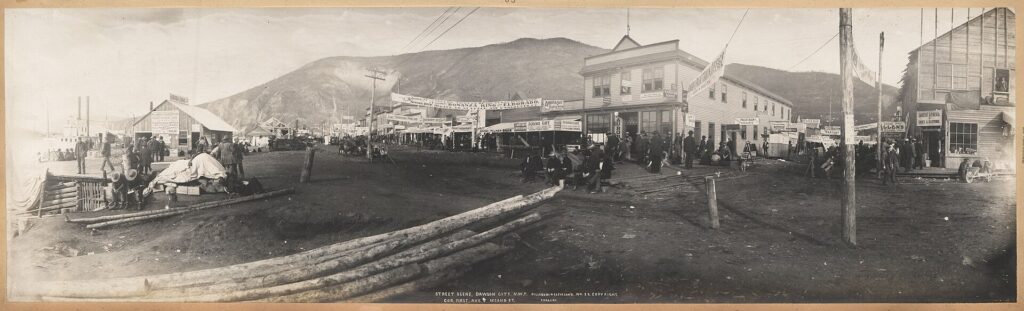
Dawson City, at the junction of the Klondike and Yukon rivers, grew from about 500 people in 1896 to about 17,000 by the summer of 1898, with an even larger population in the surrounding creeks and goldfields [1].
Routes to the Goldfields
Most prospectors landed at Dyea or Skagway in southeast Alaska and crossed either the Chilkoot Pass or the White Pass into Canada. About 22,000 people used the Chilkoot Pass, whose last slope of about 1,000 feet was climbed on foot, with packers charging up to $1 per pound for carrying loads on the later stages. An avalanche on April 3, 1898, killed more than 60 people on the pass, and an aerial tramway opened that spring capable of moving about nine tonnes of goods an hour to the summit [1].
Canadian authorities required every entrant to bring a year’s supply of food, typically about 1,150 pounds. With camping gear and tools, a traveler carried close to a ton, which often meant making dozens of trips up the trail. After crossing the passes, prospectors built boats at Lakes Bennett and Lindeman. In May 1898, 7,124 boats left for the last 500 miles to Dawson City. Other routes included the Stikine, All-Canadian, Edmonton and Valdez routes, and the all-water route via St. Michael was known as the rich man’s route [1].
Skagway, Dyea and the Railway
The rush created boom towns. Skagway and Dyea expanded rapidly as the gateways to the passes, and Skagway’s population swelled with merchants, outfitters, saloons and railway builders. Construction of the White Pass and Yukon Route railway began in 1898 and was completed in 1900, after which the Chilkoot trail and its tramways became obsolete [1][3]. Today the Klondike Gold Rush National Historical Park, managed by the National Park Service, preserves the history of this era in Skagway and along the Chilkoot Trail [3].
Gold Production
An estimated 14 million ounces of gold were taken from the area up to 2013, with about half from Bonanza Creek and a quarter from Hunker Creek. Production peaked in 1903, after heavier equipment replaced hand methods [1].
The End of the Rush and the Nome Strike
The rush faltered from 1898 onward because many newcomers could not make a living. Gold was found at Nome in the winter of 1898 to 1899, and in 1899 about 2,500 people left Dawson for Nome in August and September alone. Britannica also lists later strikes at Nome in 1898 and Fairbanks in 1903 among the discoveries that drew prospectors across Alaska [1][2]. Dawson City’s population dropped to about 2,000 by 1912, to about 500 by 1972, and to about 1,300 by 2006 [1].
Impact on Alaska
The rush drew national attention to the far north and helped end Alaska’s long period of sparse settlement after the 1867 purchase. Services, shipping lines and government authority expanded in southeast Alaska, and the Alaska Boundary Tribunal of 1903 later settled the border questions that the traffic through the passes had made urgent [2]. The gold rush also shaped Alaska’s identity and its image as a frontier of opportunity.
In Literature
The gold rush inspired memorable writing. Works from the period include Jack London’s The Call of the Wild, Robert Service’s The Spell of the Yukon and The Cremation of Sam McGee. London went north to seek gold but earned most of his money by working for prospectors, and a case of scurvy ended his mining career [1].
FAQs
When was gold discovered in the Klondike? Gold was found on August 16, 1896, on Bonanza Creek, a tributary of the Klondike River.
How many people took part in the Klondike Gold Rush? About 100,000 set out, and roughly 30,000 to 40,000 reached the Klondike.
Why did prospectors pass through Alaska? Most reached the Yukon goldfields by landing at Dyea or Skagway in southeast Alaska and crossing the Chilkoot or White passes.
What was the Chilkoot Pass? It was a steep mountain trail that about 22,000 stampeders used, famous for its final climb of about 1,000 feet.
Why did the Klondike Gold Rush end? Many prospectors could not make a living, and the 1899 gold strike at Nome drew thousands away.
Sources
- Wikipedia: Klondike Gold Rush
- Encyclopaedia Britannica: History of Alaska
- National Park Service: Alaska parks
More in History
Key facts
Quick checkOn what creek was Klondike gold discovered in 1896?Show answer
Bonanza Creek
Sources
- Wikipedia. Klondike Gold Rush. 2026 (accessed 2026-11-11)
- Encyclopaedia Britannica. History of Alaska. 2026 (accessed 2026-11-11)
- National Park Service. Alaska parks. 2026 (accessed 2026-11-11)
Editorially reviewed by Specialty Digest Editorial TeamLast reviewed November 11, 2026Researched and drafted with AI assistanceReport an issue