Kindness is easy to praise and hard to measure, which may be why it rarely makes the news. World Kindness Day, observed every year on November 13, asks us to look at it more closely. It is not a United Nations day. It began with a network of civil society groups, and it has lasted because the idea behind it is simple: small acts of care, repeated by many people, change how a community feels. The evidence now reaches well beyond sentiment. Researchers link kindness to better wellbeing, and the World Health Organization treats social connection as a public health priority. The day also pairs naturally with the International Day for Tolerance, which follows three days later.
From a Tokyo conference to a global day
The World Kindness Movement says its formation crystallized at a conference in Tokyo in 1997, when Japan brought together like-minded kindness organizations from around the world. A declaration to establish the movement is dated September 20, 1997. The movement introduced World Kindness Day in 1998, and its own timeline records the launch on November 13, 1998. At that stage it was a coalition of national nongovernmental organizations with a primary focus on kindness.
The movement itself was later launched in Singapore on November 18, 2000, at its third conference, and it registered as a nongovernmental organization under Swiss law in 2019.
Because the day belongs to a civil society network, there is no General Assembly resolution behind it and no official annual theme from the United Nations. That is worth stating plainly. The day matters because people choose to mark it, in schools, workplaces, faith communities and neighborhoods, not because any government requires it.
What counts as kindness
Researchers usually study kindness under the name prosocial behavior, meaning voluntary acts intended to benefit others. Surveys track three broad forms: giving money, giving time and helping a stranger. Kindness also includes small gestures that never appear in a survey, such as holding a door, checking on a neighbor or listening without hurrying.
This breadth matters for measurement. A donation can be counted, but a kind word cannot, so the largest studies rely on what people say they did recently. Keep that in mind throughout this article: the figures below are self-reports and modeled estimates, useful for patterns more than for precision.
The numbers behind everyday help
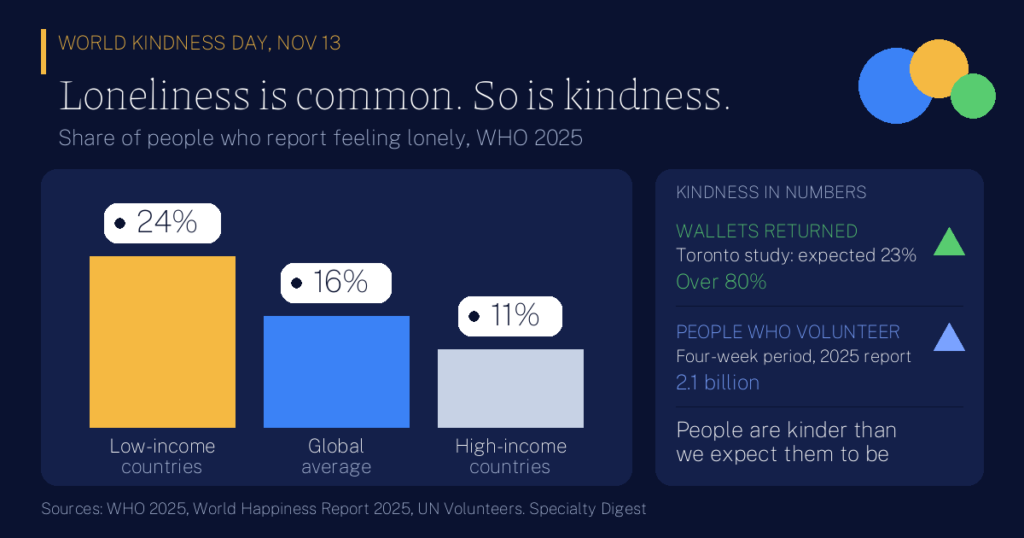
Start with the helpers. The 2026 State of the World’s Volunteerism Report from UN Volunteers, published in December 2025, estimates that 34.5 percent of working-age people, about 2.1 billion individuals, volunteer in a typical four-week period. Africa records the highest regional rate, at 58.5 percent. The report also notes that direct help, such as helping neighbors, is significantly more common than volunteering through an organization. Most kindness, in other words, happens informally and goes uncounted by institutions.
- 2.1 billionworking-age people who volunteer in a four-week period, 2025 report
- 34.5%of working-age people worldwide volunteer in that period
- 58.5%volunteering rate in Africa, the highest region
- About 10%by which benevolent acts in 2024 still exceeded pre-pandemic levels
The 2025 World Happiness Report devoted a chapter to caring and sharing. It found that benevolent acts fell between 2023 and 2024 but were still about 10 percent above their pre-pandemic levels.
We underestimate each other
One striking finding is about expectation. In the wallet experiments the World Happiness Report reviews, researchers left lost wallets in public places to see who would return them. In a Toronto study, people expected 23 percent of wallets to come back, and the actual return was over 80 percent. A 40-country study covering more than 17,000 wallets found actual returns 1.8 times higher than expected. The report concludes that people are far too pessimistic about the benevolence of others.
This matters because belief shapes behavior. The report finds that expecting kindness from others is a stronger predictor of happiness than major actual or expected harms. A world that assumes strangers are selfish is likely to feel colder and trust less, even when the facts are better than the fear.
Example 1: the street experiment. Suppose a neighborhood group guesses that 2 of every 10 lost wallets on its streets would be returned. It then leaves 10 wallets out and gets 7 back. The numbers are round and made up, but the pattern matches the research: expectations run well below reality.
What kindness does for the giver
Does being kind improve your own life? The evidence says yes, modestly. A meta-analysis of 27 experimental studies with 4,045 participants (Curry and colleagues, 2018) found that performing acts of kindness raised the doer’s happiness, with a small-to-medium effect of 0.28. A larger 2020 review in Psychological Bulletin (Hui and colleagues) pooled 201 samples and 198,213 participants and found a modest overall link between prosociality and wellbeing, with a correlation of .13.
Both results are modest, and both deserve careful reading. Kindness is not a cure for depression, and happier people may also be more inclined to help, so cause and effect likely run both ways. The honest summary is that kindness helps a little, on average, at almost no cost.
Example 2: the thank-you habit. Imagine a team of 20 colleagues in which each person sends one sincere thank-you note a week. Over 50 working weeks that is 1,000 notes a year, each taking a minute or two. The numbers are round and illustrative, but they show how a tiny habit multiplies when many people share it.
Loneliness, the problem kindness meets
The WHO Commission on Social Connection, launched in November 2023, reported in June 2025 that loneliness is linked to an estimated 100 deaths every hour, more than 871,000 deaths a year. About 1 in 6 people worldwide, 15.8 percent, report feeling lonely. Between 17 and 21 percent of people aged 13 to 29 do, with the highest rates among teenagers. About 24 percent of people in low-income countries report loneliness, twice the roughly 11 percent in high-income countries. In May 2025 the World Health Assembly adopted its first resolution on social connection.
Meals show the same pattern at home. The World Happiness Report notes that in 2023 roughly 1 in 4 Americans ate all of their meals alone the previous day, an increase of 53 percent since 2003, and that people who eat with others more often are much happier.
If loneliness or low mood weighs on you, a doctor, a counselor or a local helpline can help. Kindness works best alongside professional care, never in place of it.
Example 3: one shared dinner. Picture a retiree who eats dinner alone seven nights a week. If a neighbor invites her for one dinner a week, she shares 52 meals a year instead of none, and the neighbor gains the same. The figures are round and illustrative, but they show how a small, regular invitation changes a week.
How to mark the day
Because the day has no official script, the best observance is local and specific. Check on one person who lives alone. Share a meal. Thank someone whose work goes unnoticed. Give an hour to a volunteer group. No single act transforms a life, but the research suggests that making kindness a habit helps both the giver and the community, and that the people around you are probably kinder than you expect.
Key Takeaways
- It is a civil society day. The World Kindness Movement launched it on November 13, 1998, and no UN resolution created it.
- Most kindness is informal. About 2.1 billion people volunteer in a typical four-week period, and direct help is more common than organized volunteering.
- We expect too little of strangers. People predicted 23 percent of wallets would return in Toronto, and over 80 percent did.
- The giver benefits a little. Meta-analyses find small to modest gains in happiness and wellbeing from kind acts.
- Loneliness is a health issue. WHO links it to about 100 deaths every hour, and 1 in 6 people report it.
- Small habits scale. A thank-you, a shared meal or a check-in costs little and adds up across a community.
How solid is this? World Kindness Day is an awareness day, so there is no official UN theme or count of observers. The loneliness figures are WHO estimates, and the 871,000 figure is described by WHO as a linked estimate, not proof of cause. Wellbeing studies rely on self-reports and show association, and the three worked examples use round, made-up numbers. See also the International Days hub and the International Days Calendar.
More in Society
- World Kindness Movement. Our story: Tokyo 1997, World Kindness Day 1998, Singapore 2000.
- World Health Organization. Social connection linked to improved health and reduced risk of early death (30 June 2025).
- World Health Organization. Social connection: questions and answers (2025).
- Helliwell et al. World Happiness Report 2025, Chapter 2: Caring and sharing.
- UN Volunteers. 2026 State of the World’s Volunteerism Report: overview (December 2025).
- Curry et al. Happy to help? A systematic review and meta-analysis of the effects of performing acts of kindness on the well-being of the actor (2018).
- Hui et al. Rewards of kindness? A meta-analysis of the link between prosociality and well-being, Psychological Bulletin (2020).