A journalist is killed, and the story stops there. No arrest, no trial, no answer for the family or the public. For most of the people who have died doing this work, that is how it ends. The International Day to End Impunity for Crimes against Journalists, observed every November 2, asks the world to change that ending. Impunity means that those who commit a crime are never held to account, and when the crime is the killing of a reporter, the damage reaches far beyond one person. It teaches everyone else to stay quiet.
Why November 2
The date was chosen to remember two French journalists who were assassinated in Mali on November 2, 2013. That same year, the United Nations General Assembly adopted resolution 68/163, which proclaimed November 2 as the International Day to End Impunity for Crimes against Journalists. UNESCO, the UN agency responsible for press freedom, leads the observance and publishes the main data behind it.
The day rests on a simple idea: protecting journalists is protecting the public’s right to know. When reporters can expose corruption, report on a crisis or explain a new law without fear, citizens decide with better facts. It also pairs naturally with World Television Day, which looks at how media shapes public understanding.
What impunity really means
Impunity is not one failure but a chain of them. A killing may never be properly investigated. A suspect may be named but never arrested. A trial may begin and stall. A person who carried out an attack may be punished while those who ordered it walk free. UNESCO counts a case as resolved only when the justice process reaches a conclusion, and it asks governments every two years to report what happened to each killing on its list.
Example 1: counting a gap. Imagine a country where 20 journalists are killed over two years, and courts reach a final judgment in 3 of those cases. The other 17 are unresolved, so the impunity rate is 17 out of 20, or 85 percent. The numbers are round and illustrative, but they show how the rate is calculated and why even a handful of convictions leaves the picture bleak.
The numbers behind the day
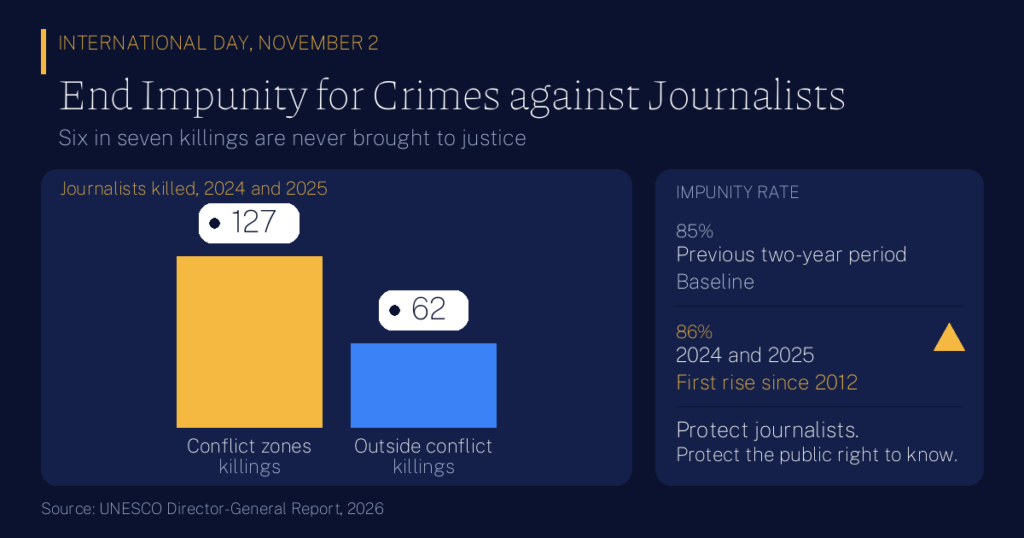
The most recent figures come from the UNESCO Director-General’s Report on the Safety of Journalists and the Danger of Impunity, which is published every two years. For 2024 and 2025, it recorded 189 journalists and media workers killed. That is 20 percent more than in the previous two-year period and the highest number since 2014 and 2015, according to UN News. Of those killings, 127, or 67 percent, happened in conflict zones. By subtraction, 62 took place outside them.
Among single countries, UN News reports that the State of Palestine recorded the most killings in both years, 30 in 2024 and 32 in 2025. The report also counts 50 journalists killed by drone strikes, and 15 who were killed while wearing press vests or traveling in clearly marked press vehicles. In seven attacks, more than one journalist died.
- 189journalists and media workers killed in 2024 and 2025
- 86%of those killings unresolved, the share UNESCO tracks as impunity
- 50killed by drone strikes, across six war zones
- 14women journalists killed in 2024 and 2025
A rare setback in the fight against impunity
The impunity rate for 2024 and 2025 stands at 86 percent. It was 85 percent in the previous period. UNESCO says this is the first rise since it began measuring impunity in 2012, which is why its announcement carried the headline that six out of seven journalist killings are not brought to justice. For killings in conflict settings, Secretary-General Antonio Guterres said impunity is close to 100 percent.
There is encouraging news in one place. UNESCO says impunity for killings outside conflict zones fell from 94 percent in 2012 to 77 percent in 2026, a drop of 17 percentage points. That shows that sustained investigation, specialized prosecutors and political will can work. The challenge is to bring the same results to war zones, where gathering evidence is hardest.
Example 2: the silence that follows. Picture a newsroom of 10 reporters covering local government. After a colleague is attacked and nobody is charged, 3 of them quietly drop their investigations into contracts and land deals. The figures are made up, but the pattern is the one the observance warns about: unpunished violence leads to self-censorship, and self-censorship leaves the public with less information.
Who is most at risk
The threats are changing, and the 2026 campaign, Threats evolve. Impunity endures., is built around that. According to the UN observance page, the focus is on how new technologies and weapons are transforming the dangers journalists face, particularly in conflict zones. In war, drones and multi-victim strikes now claim reporters who are clearly marked as press.
Women journalists face a distinct set of risks. UNESCO’s 2026 release says 14 women journalists were killed in 2024 and 2025, and 93 percent of them died while covering conflicts. It also cites a 2025 UN Women and ICFJ study, which found that 75 percent of women journalists had experienced online or offline abuse. UNESCO adds that the share of women journalists who said online attacks were linked to offline violence rose from 20 percent in a 2020 survey to more than 40 percent in 2025.
Why it matters beyond the newsroom
When a killing goes unpunished, the harm spreads in three directions. Families wait without answers. Other journalists weigh whether a story is worth their lives. And citizens lose access to the information they need to judge leaders, follow public money and understand crises. The UN observance page notes that since 1993, more than 1,700 journalists have been killed. Press freedom is therefore treated as a condition for other rights, from elections to public health.
Example 3: a cost in plain terms. Suppose a district spends $2 million a year on road repairs, and a local reporter who covered the contracts is silenced. If even 5 percent of that budget is lost to waste nobody reports, that is $100,000 a year. The figures are rounded and illustrative, but they show how a threat to one reporter can carry a price for a whole community.
How the day is marked, and what progress needs
UNESCO marks the day with the release of its Director-General’s report, a global event at its Paris headquarters, and a policy dialogue, while UN offices and partners hold local events worldwide. Progress, according to UNESCO and the UN, depends on practical steps: prompt and independent investigations, protections for journalists at risk, specialized prosecutors, and fair trials that reach those who order attacks. Reporters who face threats can contact press freedom groups and national journalists’ unions, which often offer legal and safety help.
Key Takeaways
- The date honors a specific loss. November 2 recalls two French journalists killed in Mali in 2013, and the UN adopted the day that same year.
- Impunity means no accountability. It covers failures at every stage, from investigation to trial.
- The toll is high. UNESCO recorded 189 journalists and media workers killed in 2024 and 2025, the most since 2014 and 2015.
- Six in seven remain unresolved. The impunity rate rose to 86 percent, the first rise UNESCO has recorded since 2012.
- Conflict zones are the hardest. Two thirds of killings happened in conflict, where impunity is close to 100 percent.
- Change is possible. Outside conflict zones, impunity fell from 94 percent in 2012 to 77 percent in 2026.
- The public pays too. Silenced reporters mean less information for everyone, so support independent journalism.
How solid is this? The figures come from UNESCO’s Director-General’s Report for 2024 and 2025 as released and reported in November 2026. UNESCO’s own pages report slightly different counts for killings outside conflict zones, so this article uses the 127 conflict killings and the 189 total and gives 62 as the difference. Earlier preliminary counts for single years differ from the two-year total. The three worked examples use round, made-up numbers. See also the International Days hub and the International Days Calendar.
More in Society
- United Nations, International Day to End Impunity for Crimes Against Journalists
- UNESCO, International Day to End Impunity for Crimes against Journalists
- UN News, Six in seven journalist murders go unpunished, UNESCO reports (November 2026)
- UNESCO, Six out of seven journalists’ killings are not brought to justice (November 2026)
- UNESCO, Director-General’s Report on the Safety of Journalists and the Danger of Impunity