A language is more than a way to exchange information. It carries stories, songs, humor and a sense of who a people are. Romani, spoken by Roma communities across Europe and beyond, has carried all of that for roughly a thousand years, mostly without a country of its own, a national school system or a flag on a government building. World Day of Romani Language, observed every year on November 5, asks the world to notice that a living language with deep roots has too often been treated as invisible. It is a close cousin of the themes behind the International Day for Tolerance, because respect for a language is respect for the people who speak it.
A language that traveled
Romani belongs to the Indo-Aryan family of languages. A Council of Europe history toolkit explains that linguistic evidence shows the Roma originated in north-western India, where their language shares similarities with other Indo-Aryan languages. Exact dates are hard to fix, but the toolkit says the Roma left India around the turn of the first millennium at the latest, traveling through Persian and Armenian areas to the Byzantine Empire and from there into Europe. They reached Europe around the 13th century and had spread across the continent by the 16th century at the latest.
Along the way the language absorbed words and sounds from the places it passed through, which is one reason it now exists in many varieties. It is a remarkable case of a language that survived centuries of movement without the usual supports of a state: no ministry, no national curriculum, and for most of its history little writing.
How the day came about
The modern movement for Romani recognition has a landmark. In 1971 the first World Roma Congress met near London, and the term “Roma” was declared the official self-designation of the various Roma groups. The anthem “Gelem, Gelem” was also institutionalized then, according to the Council of Europe toolkit. Decades later, on November 4, 2015, UNESCO’s General Conference proclaimed November 5 as World Day of Romani Language.
UNESCO states the aims plainly: to promote the preservation of the Romani language and culture, to improve the well-being of Romani people, and to recognize that the diversity of languages is a source of strength for societies. The day is also meant to help further development and research of the language in UNESCO member states.
What the language looks like
UNESCO describes Romani as a language of about 33,000 words with 17 dialects, and notes that speakers of different dialects can understand each other. A great deal of work has gone into building a common standard form, yet UNESCO also says much more remains to be done. That tension is typical of a language that is vital in daily life but has had limited access to schools, publishing and public services.
- 33,000words in the Romani language, per UNESCO
- 17dialects, mutually understandable, per UNESCO
- 10 to 12 millionRoma estimated to live in Europe, per the Council of Europe
- 16Council of Europe states recognizing Romani as a minority language
Example 1: the missing classroom hours. Suppose a school offers Romani as a subject for two hours a week over a 36-week year. That is 72 hours a year, or 576 hours across eight years of primary school. The figures are round and illustrative, but they show what “taught as a subject at all appropriate levels” can mean in practice, and how little a child gets if the offer is missing entirely.
Protection in law, and what it asks
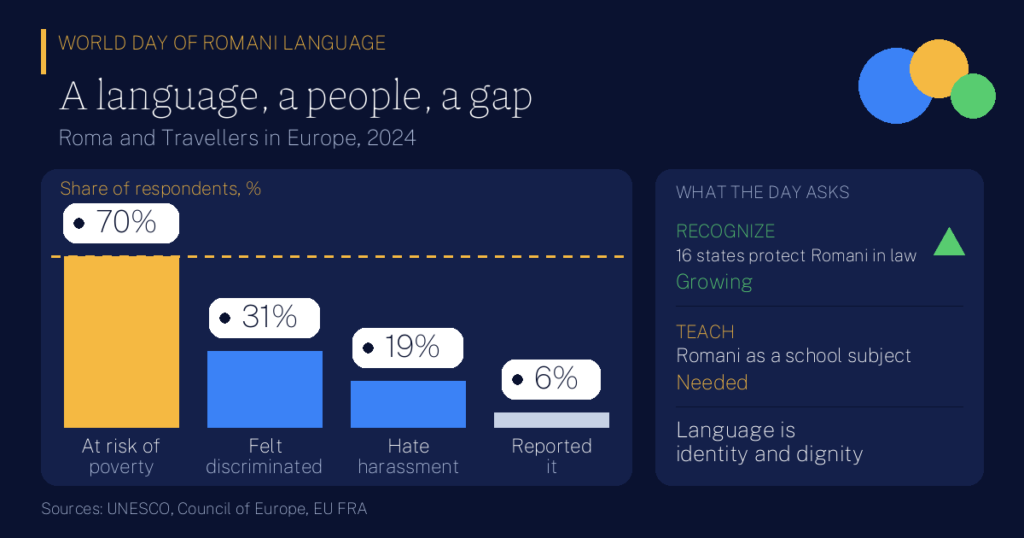
The main legal tool is the European Charter for Regional or Minority Languages, which the Council of Europe describes as the only legally binding instrument for protecting minority languages, including Romani. Sixteen member states have recognized Romani under it: Austria, Bosnia and Herzegovina, the Czech Republic, Finland, Germany, Hungary, Montenegro, the Netherlands, Norway, Poland, Romania, Serbia, Slovakia, Slovenia, Sweden and Ukraine.
The Charter’s Committee of Experts has recommended that states develop a coherent strategy for Romani and teach it as a subject at all appropriate levels, from pre-school to vocational education. The Council of Europe has also developed a Curriculum Framework for Romani and a European Language Portfolio, and in March 2022 it launched a plurilingual policy experiment in primary schools in Greece, the Slovak Republic and Slovenia. On the day itself, the Council of Europe has called on member states to step up efforts to recognize, protect, promote and develop the language, including its use in education, media and public life.
Why it matters: a life measured in numbers
Language rights do not stand apart from everyday life. The EU Agency for Fundamental Rights (FRA) ran its Roma Survey 2024 in 10 EU member states and three accession countries, with 10,126 interviews. The results show a mixed picture. Hate-motivated harassment fell, but discrimination did not.
About 31 percent of Roma and Traveller respondents felt discriminated against because of their ethnic background in the previous 12 months, compared with 26 percent in 2016. FRA called this no substantial change. Harassment fell from 30 to 19 percent. Yet only 6 percent of victims of discrimination reported it or made a complaint, down from 16 percent in 2016.
Example 2: the reporting gap. Imagine 100 people who experience discrimination in a year. At the 2016 rate, about 16 would file a complaint. At the 2024 rate, about 6 would. The 100 is a round, illustrative number, but it shows how much unfairness never reaches an office, a court or a statistic, and why services in a person’s own language can matter when someone seeks help.
Poverty tells a similar story. Seventy percent of Roma and Traveller respondents lived at risk of poverty in 2024, down from 80 percent in 2016, against 16 percent for the general EU population in 2024.
Example 3: the poverty line. If a country’s median income were 1,000 units a month, the line would sit at 600. A household below it counts as at risk of poverty. The numbers are made up to show the method, but the gap between 70 percent and 16 percent shows how far inclusion still has to go.
How the day is marked, and what progress asks
UNESCO has not set a single global theme for the day. Observances usually take the form of readings, school lessons, publications, concerts and talks led by Romani writers, teachers and artists. For the Council of Europe the goal is practical: let children learn Romani at school and let adults use it in everyday life.
Real progress rests on a few clear steps. States can recognize Romani under the Charter and follow the recommendations of its experts. Schools can train teachers and offer the language as a subject. Public bodies can provide information in Romani, and people of every background can learn about the culture rather than rely on stereotypes. Because Roma communities have historically been treated unfairly, listening to Romani voices should lead the way.
Key Takeaways
- Romani has Indian roots. Linguistic evidence points to north-western India and the Indo-Aryan family, with arrival in Europe around the 13th century.
- The day is recent. UNESCO proclaimed November 5 as World Day of Romani Language in 2015.
- The language is rich and varied. UNESCO cites about 33,000 words and 17 mutually understandable dialects.
- Legal protection is growing. Sixteen Council of Europe states recognize Romani under the European Charter for Regional or Minority Languages.
- Schools are the key. Experts recommend teaching Romani as a subject from pre-school onward.
- Inclusion is unfinished. In 2024, 31 percent of surveyed Roma and Travellers felt discriminated against, and only 6 percent of victims reported it.
- Respect starts with listening. Learning a few facts about Romani culture is a simple way to challenge stereotypes.
How solid is this? Language facts come from UNESCO and the Council of Europe. Survey figures come from the EU Agency for Fundamental Rights, Roma Survey 2024, which covers 13 countries and is not a worldwide count. No reliable global count of Romani speakers is cited here because the sources read did not give one. The three worked examples use round, made-up numbers. See also the International Days hub and the International Days Calendar.
More in Society
- UNESCO, World Day of Romani Language
- Council of Europe, Roma and Travellers: Language
- Council of Europe, statement on the World Day of Romani Language
- Council of Europe, Toolkit for teaching Roma and/or Traveller history, Tool 3
- EU Agency for Fundamental Rights, Rights of Roma and Travellers in 13 European countries: Roma Survey 2024