Almost everyone has a story about cancer, whether their own, a parent’s or a friend’s. Yet the disease is not one illness. It is hundreds, each with its own causes, treatments and odds. World Cancer Day, observed every February 4, asks the world to hold two ideas together: cancer is a vast shared challenge, and every person facing it is a person with a unique life. The day is also a practical call to prevent what can be prevented, to find cancer early and to make sure good care reaches everyone, not only people in wealthy countries.
From a Paris summit to a global day
World Cancer Day was born on February 4, 2000, at the World Summit Against Cancer for the New Millennium in Paris. The summit produced the Paris Charter Against Cancer, which aims to promote research, prevent cancer, improve patient services, raise awareness and mobilize the global community. The Charter included the adoption of World Cancer Day.
The day is an initiative of the Union for International Cancer Control, or UICC. Founded in 1933 and based in Geneva, UICC describes itself as the largest and oldest international cancer organization, with more than 1,110 member organizations in over 170 countries and territories. Unlike many days in this series, World Cancer Day was not created by a United Nations General Assembly resolution. It is led by a membership organization, and the World Health Organization (WHO) and its International Agency for Research on Cancer (IARC) supply much of the data that gives the day its weight.
What “cancer” actually means
Cancer begins when cells in the body grow out of control and can spread to other organs. Doctors name each type by where it starts: lung, breast, colon and rectum, prostate, stomach and many more.
The numbers behind the day
WHO’s July 2026 release describes an estimated 20.6 million new cases and close to 10 million deaths each year. Cancer is the second leading cause of death worldwide after cardiovascular disease, and it claims more than 26,000 lives every day. WHO’s fact sheet counts nearly 10 million deaths in 2024, close to one in six deaths. Without urgent action, annual cases are projected to rise to nearly 35 million by 2050.
Lung cancer leads both lists. In 2024 it caused 1.86 million deaths, ahead of colon and rectum cancer (918,000), liver cancer (732,000), breast cancer (694,000) and stomach cancer (642,000).
Why prevention is the strongest lever
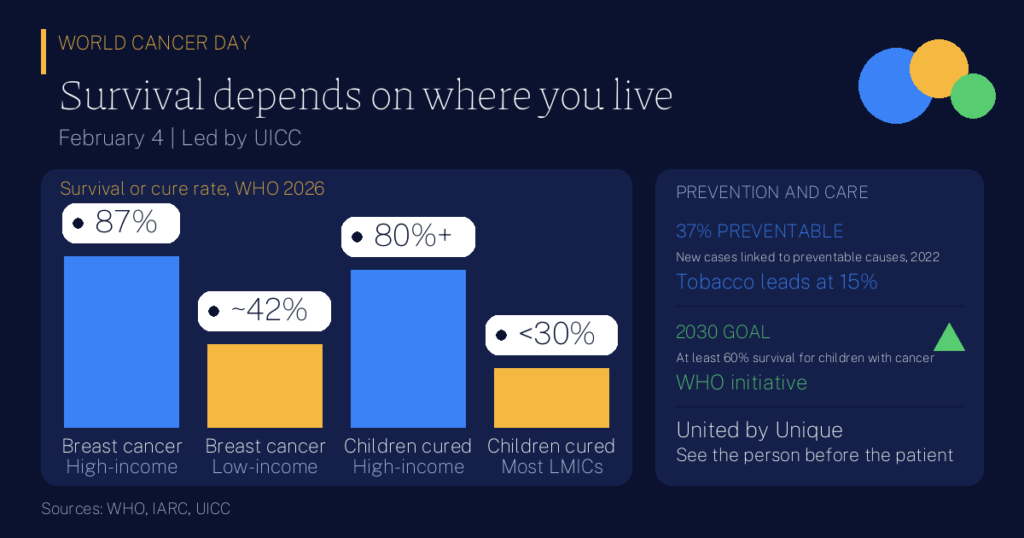
Here is the most hopeful fact of the day. A WHO and IARC study released on February 3, 2026, found that 37 percent of all new cancer cases in 2022, around 7.1 million, were linked to preventable causes. It examined 30 causes, including, for the first time, nine cancer-causing infections, using data from 185 countries and 36 cancer types. Tobacco was the leading cause at 15 percent of all new cases, followed by infections at 10 percent and alcohol at 3 percent.
The shares differ by sex: 45 percent of new cases in men and 30 percent in women were linked to preventable causes. Lung, stomach and cervical cancer together made up nearly half of all preventable cases. Lung cancer was mainly tied to smoking and air pollution, stomach cancer largely to Helicobacter pylori infection, and cervical cancer overwhelmingly to the human papillomavirus (HPV). Vaccination against HPV and hepatitis B, tobacco and alcohol control, cleaner air, safer workplaces and healthier food and activity environments all work. For a closer look at one such success story, see World Cervical Cancer Elimination Day.
Example 1: the power of a share. Imagine a town where 1,000 people are diagnosed with cancer in a year. If the global 37 percent share applied exactly, about 370 of those cases would be linked to causes that could have been avoided. The numbers are round and illustrative, but they show why a 37 percent share means hundreds of families, not a statistic.
Finding it early, treating it well
WHO notes that mortality falls when cancer is detected and treated early. Early diagnosis rests on three steps: knowing the symptoms, reaching a clinic that can evaluate them, and a fast referral to treatment. Breast, cervical, oral and colorectal cancers have high cure probabilities when found early and treated according to best practice.
Example 2: the two clocks. Picture two patients with the same small lump. One lives near a clinic and is seen within weeks. The other must travel a day, pay out of pocket and is told to come back later. The tumor is the same, but the odds are not. The scenario is invented, yet it mirrors the gaps WHO documents below.
The gap between rich and poor care
Cancer is not equally survivable. WHO reports that 87 percent of women with breast cancer in high-income countries are alive five years later, versus only about 42 percent in low-income countries. For children, more than 80 percent with cancer are cured in high-income countries, while in most low- and middle-income countries fewer than 30 percent are. WHO’s Global Initiative for Childhood Cancer, launched in 2018 with St. Jude Children’s Research Hospital, aims for at least 60 percent survival for all children with cancer by 2030.
Access to medicines tells the same story. WHO reports that the 20 priority cancer medicines it tracks are available in 9 to 54 percent of low- and lower-middle-income countries, compared with 68 to 94 percent in high-income countries. Fewer than one in three countries include cancer care in their universal health coverage packages. In WHO’s first survey of people affected by cancer, at least 45 percent reported financial hardship and more than half reported mental health challenges.
Example 3: a ward of one hundred. Suppose 100 children are treated for cancer in a high-income setting and 100 in a low-income one. At the rates above, roughly 80 children recover in the first group and perhaps 30 in the second. The figures are rounded and illustrative, but the 50-child difference is what the 2030 goal tries to close.
- 7.1 millionnew cases in 2022 linked to preventable causes
- 27%drop in tobacco use since 2010
- 82%of countries have a national cancer plan, up from 50% in 2010
- 400,000children and adolescents develop cancer each year
How the day is marked: United by Unique
The 2025 to 2027 campaign theme is “United by Unique.” It places people at the center of care and their stories at the heart of the conversation: behind every diagnosis lies a human story, and care that fits each person’s needs, delivered with compassion and empathy, leads to the best outcomes. The campaign is a three-year journey from raising awareness to taking action. The 2026 focus is people-centered care, an approach that engages the needs, values and active participation of individuals, families and communities. UICC reports that its 2026 campaign drew more than 30,000 press articles in 164 countries and 1,000 activities in 89 countries.
There is good news in the backdrop. WHO’s 2026 status report says tobacco use is down 27 percent since 2010 and 82 percent of countries now have national cancer control plans, up from 50 percent in 2010.
Key Takeaways
- The day began in Paris in 2000. It grew from the Paris Charter Against Cancer and is led by UICC.
- The burden is large and growing. About 20.6 million new cases a year could reach nearly 35 million by 2050 without action.
- Prevention works. 37 percent of new cases in 2022 were linked to preventable causes, led by tobacco at 15 percent.
- Early detection saves lives. Breast, cervical, oral and colorectal cancers are often curable when found early.
- Geography shapes survival. Breast cancer survival is 87 percent in high-income countries and about 42 percent in low-income ones.
- Children are part of the gap. More than 80 percent are cured in rich countries, and fewer than 30 percent in most poorer ones.
- Progress is possible. Tobacco use is down 27 percent since 2010, and “United by Unique” reminds us to see the person before the patient.
How solid is this? Global case and death counts are modeled estimates from WHO and IARC, and the 2022 and 2024 figures come from different releases and may not match exactly. WHO’s fact sheet puts the preventable share at roughly 38 percent, close to the 37 percent in the 2026 study. The three worked examples use round, made-up numbers to show an idea. This article is general information, not medical advice; if you have a symptom or concern, please talk with a health professional. See also the International Days hub and the International Days Calendar.
More in Health
- WHO, Cancer fact sheet (July 3, 2026)
- WHO and IARC, Four in ten cancer cases could be prevented globally (February 3, 2026)
- WHO, Urgent action as new cancer cases are projected to nearly double by 2050 (July 8, 2026)
- WHO, Childhood cancer fact sheet (March 2026)
- UICC, World Cancer Day: Our story
- UICC, World Cancer Day campaign: United by Unique