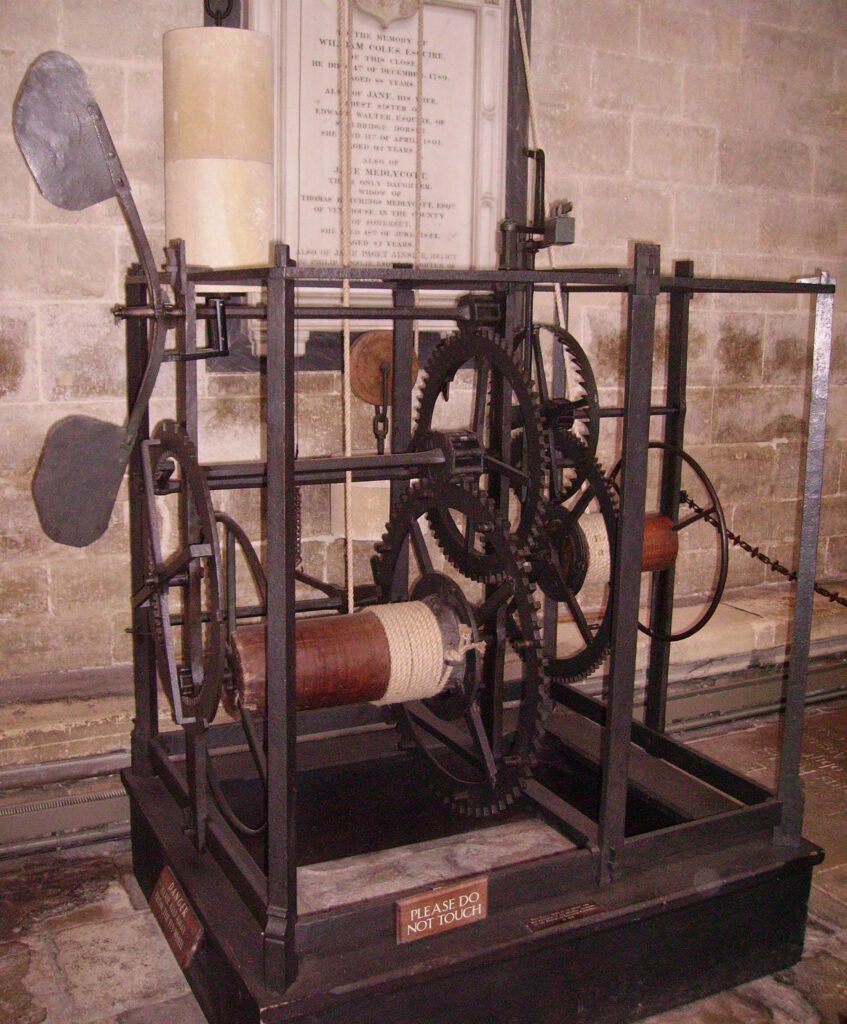
A mechanical clock is a timekeeper driven by a falling weight or a coiled spring and regulated by an escapement, a device that releases the stored energy in small, equal steps. Large weight-driven mechanical clocks first appeared in the towers of Italian cities in the first half of the 14th century, and the maker of the first one is unknown.
History of the mechanical clock
The National Institute of Standards and Technology (NIST) notes that for most of the Middle Ages, which ran roughly from 500 to 1500, European timekeeping relied on sundials. Then, in the first half of the 14th century, large mechanical clocks began to appear in the towers of several big Italian cities. NIST says there is no evidence or record of working models before these public clocks, which were driven by weights and regulated by a verge-and-foliot escapement.
England has some of the earliest records. Richard of Wallingford designed a clock for the Abbey of St. Albans by 1336, the year of his death, and it was completed about 1356. The clock itself was lost in the dissolution of the monasteries around 1537, but Richard’s treatise on its construction survives in the Bodleian Library at Oxford. A clock was installed at Salisbury Cathedral in 1386, and most experts believe that the clock still standing there is that very machine, with some replaced parts. The Linda Hall Library, a science library in Kansas City, calls it probably the oldest surviving example of its kind.
The first clocks served monks. Their main job was to mark the canonical hours that structured the day of a religious order, and they did this by sounding bells. The Salisbury clock has no face or hands, and it is not clear that it ever had either, because the bell was the signal that mattered.
Accuracy then improved in steps. NIST records that Peter Henlein of Nuremberg made spring-powered clocks between 1500 and 1510, which allowed smaller, portable clocks. In 1656 the Dutch scientist Christiaan Huygens built the first pendulum clock, with an error of less than a minute a day, and later refinements cut the error to under 10 seconds a day. Around 1675 Huygens added the balance wheel and spring that are still found in some wristwatches.
Inventor and origins of the mechanical clock
No inventor can be named for the first mechanical clock. The Linda Hall Library says the maker of the Salisbury clock is unknown, and NIST says that nothing is known of any machine before the Italian tower clocks. What is documented is the sequence of improvements by named people that followed.
The pendulum clock shows how credit can be shared. NIST credits Huygens with building the first one in 1656, but it also says Galileo Galilei studied the swing of a pendulum as early as 1582 and sketched a design for a pendulum clock. He never built it before he died in 1642.
How a mechanical clock works
In an early clock, hanging weights turn a train of gears. Something has to control how fast the gears turn, and that part is the escapement. In the verge-and-foliot design, a horizontal bar called the foliot pivots in the middle and carries adjustable weights at both ends. It sits on top of a vertical rod, the verge, which has two small tabs called pallets that catch the teeth of a crown-shaped wheel. As the verge swings back and forth, the wheel advances one tooth at a time, which produces the familiar tick and tock.
The speed depended on the turning resistance of the foliot, which could be adjusted only roughly by sliding the weights. NIST adds that the rate of these clocks depended heavily on the driving force and the friction in the drive, so they were hard to regulate. Their gears were also used for a second train that struck the bells.
A pendulum gives a more regular beat, because it has a natural period of swing. In London in 1671, William Clement began building clocks with an anchor, or recoil, escapement, which interferes less with the pendulum than the verge. George Graham improved accuracy to about a second a day in 1721 by compensating for changes in pendulum length with temperature.
Types of mechanical clocks
Weight-driven tower clocks were the first type, followed by spring-driven table and portable clocks. Pendulum clocks became the standard for accurate timekeeping on land. At sea, John Harrison built a marine chronometer with a spring and balance wheel, completed by 1761, which kept time on a rolling ship to about one-fifth of a second a day and met the requirements of the British longitude prize.
Observatories used even more precise designs. Siegmund Riefler’s clock with a nearly free pendulum, introduced in 1889, reached about a hundredth of a second a day. The Shortt clock, demonstrated in 1921, used a master pendulum kept free of mechanical work and a second slave pendulum that gave it gentle pushes and drove the hands.
Impact of the mechanical clock
Mechanical clocks changed how communities and institutions organized time. A bell struck by a clock could call a whole town or monastery to the same schedule without a person watching a sundial. Improvements in pocket and marine timekeepers followed, and Harrison’s chronometer, according to NIST, determined longitude to within half a degree after a voyage to the West Indies and so won the prize offered by the British government in 1714. Another early navigation instrument is covered in the entry on the compass.
Uses today
Mechanical movements still run wristwatches and decorative clocks, and some historic tower clocks, such as the one at Salisbury, are preserved as heritage objects. For precise time, mechanical clocks were overtaken in the 20th century. Quartz clocks, developed from the 1920s onward, improved performance because they have no gears or escapements, and NIST says they dominate the market in numbers because their performance is excellent for the price. Atomic clocks have substantially surpassed even quartz in accuracy.
More in Mechanical Engineering
Key facts
- Large weight-driven mechanical clocks appeared in Italian city towers in the first half of the 14th century.1
- A clock was installed at Salisbury Cathedral in 1386, and the surviving clock is believed to be that machine.2
- Christiaan Huygens built the first pendulum clock in 1656, with an error under one minute a day.1
- John Harrison's marine chronometer of 1761 kept time to about one-fifth of a second a day.1
- Quartz clocks, developed from the 1920s, overtook mechanical clocks in precision.1
Related concepts
In the news
Quick checkWho invented the mechanical clock?Show answer
The maker of the first mechanical clock is unknown. The earliest records point to Italian city towers in the early 1300s, and later improvements are credited to named makers such as Huygens and Harrison.
Sources
- National Institute of Standards and Technology (NIST), A Walk Through Time: A Revolution in Timekeeping, https://www.nist.gov/node/446006
- Linda Hall Library, Scientist of the Day: Salisbury Cathedral Clock, https://www.lindahall.org/about/news/scientist-of-the-day/salisbury-cathedral-clock/
Editorially reviewed by Specialty Digest Editorial TeamLast reviewed November 4, 2026Researched and drafted with AI assistanceReport an issue