Every society makes quiet decisions about who gets a fair chance. Who finds work that pays enough to live on, who is protected when illness or old age arrives, and who is simply left out. World Day of Social Justice, observed every year on February 20, asks the world to look hard at those decisions. It is not a celebration of an achievement. It is a reminder that peace and prosperity within and among nations rest on fairness, and that fairness has to be built, funded and measured.
From a labor charter to a United Nations day
The idea has deep roots in the world of work. The International Labour Organization (ILO) adopted its Constitution in 1919, and later statements of principle followed: the Philadelphia Declaration of 1944 and the Declaration on Fundamental Principles and Rights at Work of 1998. On June 10, 2008, the International Labour Conference, with representatives of governments, employers and workers from 182 member states, unanimously adopted the ILO Declaration on Social Justice for a Fair Globalization. The UN describes it as the third major statement of principles and policies adopted by the Conference since 1919.
The General Assembly acted a little earlier. On November 26, 2007, it unanimously declared that February 20 would be celebrated annually as the World Day of Social Justice, starting with its sixty-third session, so the first observance fell in 2009. The resolution urged efforts in poverty eradication, full employment and decent work, gender equality, and access to social well-being and justice for all. In December 2008 the Assembly also welcomed the ILO Declaration in resolution A/RES/63/199.
What social justice means in practice
The UN pages on the day do not offer a single formal definition, but the Assembly’s wording is clear about the territory: work that is decent, income that is secure, equal treatment of women and men, and a fair share in well-being. In everyday terms, it asks whether the rules of an economy give ordinary people a realistic way to earn, learn, stay healthy and be protected when life goes wrong.
Example 1: two workers, one wage. Picture two neighbors who each earn the same amount per month. One has a written contract, paid sick leave and a pension contribution. The other works day to day with no contract. When both fall ill for a month, the first keeps an income and the second loses it. The numbers are round and illustrative, but the gap between them is what the phrase decent work is meant to close. The same principle covers the people who keep cities running, including the sanitation workers highlighted on World Toilet Day.
The numbers behind the day
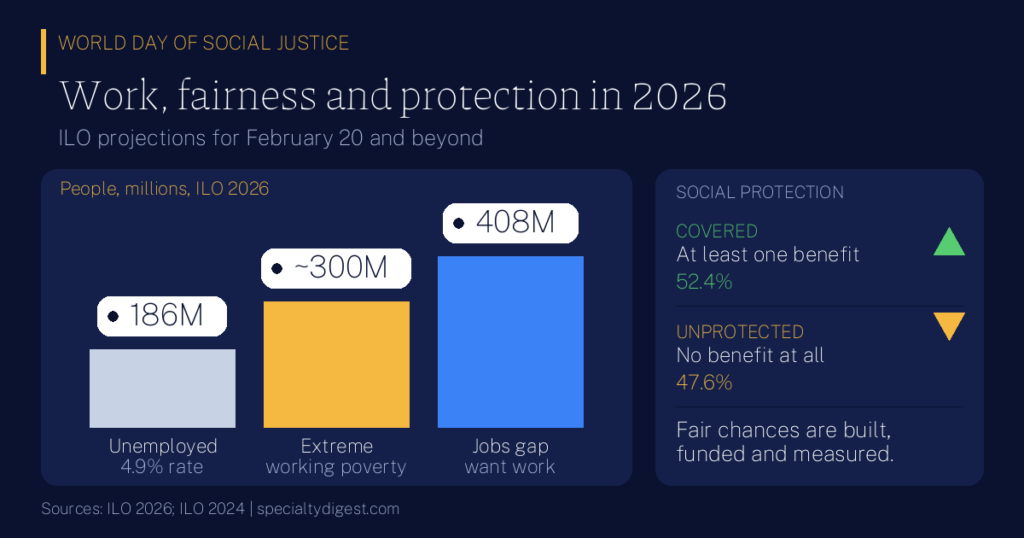
In January 2026 the ILO published its Employment and Social Trends 2026 report. It projects the global unemployment rate to hold steady at 4.9 percent in 2026, which UN News reports is equivalent to about 186 million people out of work. That headline looks calm, yet it hides a much larger shortfall. The ILO projects a global jobs gap of 408 million in 2026, meaning people who want paid work but cannot get it. It also reports that 2.1 billion workers remain in informal employment, and that nearly 300 million workers live in extreme working poverty.
- 4.9%global unemployment rate projected for 2026
- 408 millionglobal jobs gap projected for 2026
- 12.4%youth unemployment rate in the 2026 projection
- 260 millionyoung people, about 20 percent, not in employment, education or training
The safety net that is only half built
Social protection is the set of systems, from child benefits to pensions, that cushions people against shocks. According to the ILO World Social Protection Report 2024 to 2026, 52.4 percent of the world’s population is covered by at least one social protection benefit, and the remaining 47.6 percent are left unprotected. The ILO also reports that in 2023 countries spent 12.9 percent of GDP on social protection excluding health care, and 19.3 percent when health care is included.
Example 2: the cost of a gap. Suppose a town of 10,000 people has a pension scheme that reaches 5,000 of them. Everyone in the other half depends on family help in old age, and when the family cannot give it, hunger and ill health follow. If the scheme grows to cover 6,000 people, 1,000 more households gain a floor under their feet. The figures are made up and round, but the logic is the one behind the ILO’s call for protection from birth to old age.
Who is left behind
The averages hide sharp differences. The ILO report finds that young people face the hardest entry into the labor market: youth unemployment is projected at 12.4 percent, and about one in five young people, around 260 million, are outside work, school and training. Informality is concentrated in some regions. UN News reports that in sub-Saharan Africa nearly nine in ten workers are informal, while in Latin America and the Caribbean 51.1 percent of employment was informal in 2025. In sub-Saharan Africa over half of workers fall below the moderate poverty line, according to the same report.
Example 3: a first job. Imagine a school graduate in a place where only one job exists for every three young people who want one. She spends two years in short, unpaid placements, so her skills and savings grow slowly while friends with openings move ahead. The numbers are illustrative, yet they show why a jobs gap is not only a statistic. It is a delay in a whole life.
How the day is marked, and what progress needs
Each year the UN Department of Economic and Social Affairs and partners organize events and discussions. In 2026 the day is commemorated under the theme Renewed Commitment to Social Development and Social Justice, and the UN framed the day as a call for coordinated action that links equitable, inclusive policies on jobs, income and social protection. Governments, employers, workers and community groups can all take part. The practical agenda is concrete: create decent jobs, formalize informal work, extend social protection to the half still without it, and make sure women, young people and rural communities share in the gains.
Key Takeaways
- The day is old ideas, newly organized. The Assembly named February 20 in 2007, building on a century of ILO principles.
- Social justice is about fair chances. The resolution links it to decent work, gender equality, poverty eradication and well-being for all.
- Low unemployment can hide big gaps. A 4.9 percent rate sits beside a 408 million jobs gap in 2026.
- Informality is the norm for many. The ILO counts 2.1 billion workers in informal employment.
- Half the world lacks a safety net. 52.4 percent have at least one social protection benefit, and 47.6 percent do not.
- Young people need a first rung. About 260 million are outside work, school and training.
- Progress is a choice. Jobs, protection and equal treatment are policies that communities can ask for and measure.
How solid is this? Labor figures are ILO projections for 2026 and are revised as new data arrive. The social protection coverage share comes from the ILO 2024 report and the year of that estimate is not stated on the summary page used here. The UN pages on the day give no formal definition of social justice, so this article describes it through the Assembly’s own wording. The three worked examples use round, made-up numbers to show an idea. See also the International Days hub and the International Days Calendar.
More in Society
- United Nations, World Day of Social Justice
- UN News, UN declares 20 February as World Day of Social Justice (2007)
- UN DESA, World Day of Social Justice: A call for coordinated action (2026)
- ILO, Employment and Social Trends 2026
- UN News, Global employment stable but decent jobs in short supply (January 2026)
- ILO, World Social Protection Report 2024 to 2026, In figures