Seagrass rarely makes the news. It is not a coral reef or a whale, and from a boat it can look like a green smudge under the water. Yet these meadows quietly store carbon, shelter young fish and soften waves before they reach the shore. World Seagrass Day, observed every March 1, asks the world to notice a plant it has long overlooked, and to protect it before more of it disappears.
A day created in 2022
The UN General Assembly proclaimed March 1 as World Seagrass Day in 2022, in resolution A/RES/76/265. The UN observance page says the day invites governments and people to raise awareness of seagrass ecosystems and to act on their protection and restoration. UNEP, the UN Environment Programme, describes itself as providing global leadership on seagrass ecosystems, and the day sits alongside two UN efforts running from 2021 to 2030: the Decade on Ecosystem Restoration and the Decade of Ocean Science. The UN page does not list an annual theme for the day.
What seagrass actually is
Seagrasses are flowering plants that live fully underwater in shallow coastal seas. They are not seaweeds, which are algae. Seagrasses have roots, stems, leaves, flowers and seeds, and they grow in sandy or muddy sea floors from the tropics to the Arctic circle. Their roots bind sediment in place, and their blades slow moving water so that particles settle out. That simple design is the source of most of their value.
There are 72 known species. Meadows are found in 159 countries across six continents and cover more than 300,000 square kilometers, according to UNEP and the UN. That is a vast footprint in total, but it is tiny against the size of the ocean, as the next numbers show.
The numbers behind the day
Seagrass meadows cover about 0.1 percent of the ocean floor, yet UNEP says they store up to 18 percent of the world’s oceanic carbon. The figure comes from the 2020 UNEP report Out of the Blue and is repeated on the UN observance page. Few habitats punch so far above their weight.
The losses are just as striking. The UN page and UNEP report that almost 30 percent of global seagrass area has been lost since the late 19th century. UNEP’s seagrass page adds that the habitat has been declining since the 1930s and that the loss rate is equivalent to a football field of seagrass every 30 minutes.
- 159countries have seagrass meadows
- 72known seagrass species
- ~30%of global area lost since the late 19th century
- 26targets under ten Sustainable Development Goals supported by restoration
Example 1: the football field clock. If a football field of seagrass is lost every 30 minutes, that is 48 fields a day, or about 17,500 a year. This is simple arithmetic on UNEP’s stated rate, rounded and illustrative. It shows how a loss that feels invisible adds up.
Why it matters: carbon, fish and coasts
Seagrass is often called a blue carbon ecosystem, meaning a coastal habitat that locks away carbon in plants and, above all, in the mud beneath them. When a meadow is destroyed, part of that stored carbon can be released again. Protecting meadows therefore helps slow climate change, and rebuilding them can win some of that storage back.
The second job is food. UNEP reports that seagrass is a nursery habitat for more than a fifth of the world’s 25 largest fisheries, and its 2020 report notes that meadows support food and livelihoods for hundreds of millions of people. Juvenile Atlantic cod, for example, use seagrass in the North Atlantic, and that cod is fished by fleets from more than a dozen nations. A loss of nursery habitat in one place can be felt in markets far away.
The third job is defense. UNEP says seagrasses act as a first line of defense along coasts, reducing wave energy and protecting people from floods and storms. The same pages say that thousands of species of fish, shellfish, dugongs, seahorses and turtles depend on these meadows.
Example 2: a fishing village. Imagine a village of 500 families where half earn income from reef and lagoon fishing, with young fish raised in a nearby meadow. If the meadow is dredged and the young fish decline, 250 families feel the pinch first. The numbers are made up and rounded, but the chain they show is the one UN agencies describe: nursery habitat, then catch, then income.
Who is left behind: a protection gap
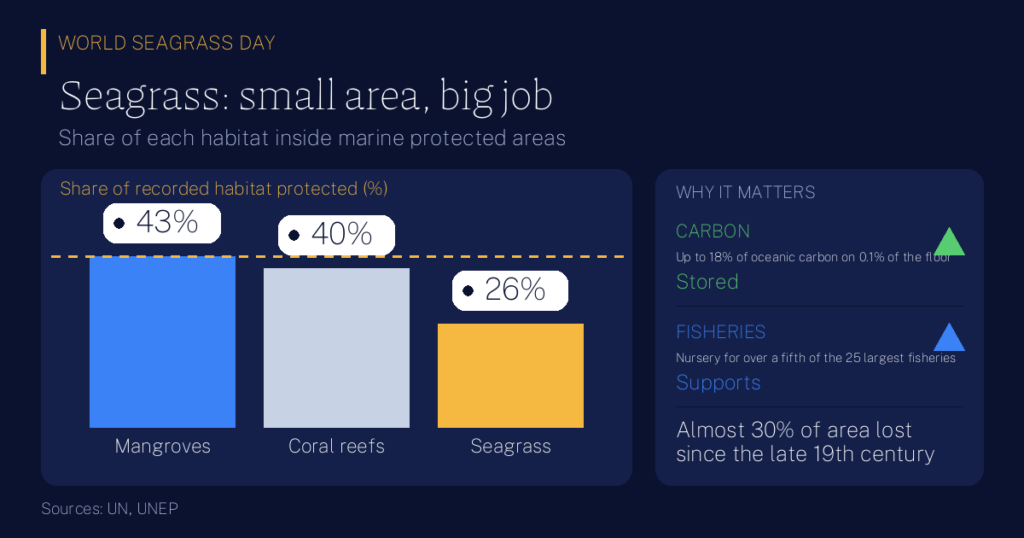
Species and habitats cannot speak for themselves, so their protection depends on laws and budgets. Here the data show a gap. According to UNEP’s 2020 report, only 26 percent of recorded seagrass meadows fall inside marine protected areas, compared with 40 percent of coral reefs and 43 percent of mangroves.
Bars here are drawn on one common scale, so the shorter crimson bar shows the gap. The species picture is also worrying. Of the 72 known species, at least 22 are in decline, and the UN page says 21 percent of seagrass species are listed as Near Threatened, Vulnerable or Endangered on the IUCN Red List.
Example 3: a city’s coastline. Suppose a coastal city has 100 hectares of meadow in its bay, and development removes 30 hectares, close to the global share lost over a century and a half. The city then has 70 hectares left to buffer waves and hold carbon. The numbers are round and illustrative, but they show how a long-run global trend can be felt in a single bay.
How the day is marked, and what progress needs
On March 1, researchers, schools, coastal communities and governments host talks, beach events, restoration drives and data releases. The UN notes that seagrass restoration supports 26 targets and indicators across ten Sustainable Development Goals, and it points to World Restoration Flagships as a showcase for restoration projects. Progress needs three things: mapping meadows so they are counted, protecting them in law and in practice, and restoring them where they have been lost. Like World Wetlands Day, this observance is about habitats whose value is easy to miss until they are gone.
Key Takeaways
- Seagrass is a plant, not a seaweed. It has roots, flowers and seeds, and meadows exist in 159 countries on six continents.
- Small area, big carbon role. About 0.1 percent of the ocean floor holds up to 18 percent of oceanic carbon, according to UNEP.
- Fisheries lean on it. Meadows are nursery habitat for more than a fifth of the 25 largest fisheries.
- Losses are large. Almost 30 percent of global area has been lost since the late 19th century.
- The protection gap is real. Only 26 percent of meadows sit inside marine protected areas, against 40 percent of reefs and 43 percent of mangroves.
- Species are at risk. At least 22 of 72 species are in decline.
- Restoration pays several ways. It supports 26 targets under ten Sustainable Development Goals.
How solid is this? Global seagrass area, carbon and loss figures are estimates from UNEP’s 2020 Out of the Blue report and its web pages, and mapping is still incomplete, so they are revised as data improve. “Up to 18 percent” is an upper figure, not an average. UNEP pages and the UN page cite the resolution with different document symbols, so check the General Assembly record for the exact citation. The three worked examples use round, made-up numbers. See also the International Days hub and the International Days Calendar.
More in Nature
- United Nations. World Seagrass Day, 1 March.
- UN General Assembly. Resolution A/RES/76/265, World Seagrass Day (2022).
- UNEP. Seagrass meadows.
- UNEP. Protection of seagrasses key to building resilience to climate change, disasters (press release, 8 June 2020).
- United Nations. List of International Days and Weeks.