Some of the most valuable places on Earth look, at first glance, like mud, reeds and shallow water. Marshes, peatlands, mangroves and floodplains rarely make it onto postcards, yet they shelter wildlife, supply food and income, and sit at the meeting point of land and water. World Wetlands Day, observed every year on February 2, asks the world to look again. It is a natural companion to World Water Day, because the story of fresh water cannot be told without the places where water lingers.
A treaty signed on the shores of the Caspian Sea
The date is a birthday. February 2 marks the adoption of the Convention on Wetlands of International Importance in 1971, in the Iranian city of Ramsar on the shores of the Caspian Sea. The treaty is still widely called the Ramsar Convention, and it is an international agreement devoted to a single kind of ecosystem. The day itself became official much later. On August 30, 2021, the UN General Assembly proclaimed February 2 as World Wetlands Day.
In 2026 the Convention marks its 55th anniversary. According to the key messages of the Global Wetland Outlook 2025, it now has 172 Contracting Parties, and more than 2,530 Wetlands of International Importance covering around 2.58 million square kilometers have been named under it.
What counts as a wetland
The word covers a wide family of places: marshes, peatlands, mangroves, river floodplains, lakes and shallow coastal waters. What unites them is water that is present long enough to shape the soil and the life that grows in it. That makes wetlands hard to picture as a single thing, and it is one reason they have been easy to overlook, drain or fill in.
The Convention’s approach rests on two ideas: conserving wetlands and using them wisely, so that people can keep drawing food, water and income from them without wearing them out. That balance matters because most wetlands are not sealed-off reserves. They are working landscapes where people fish, graze animals and farm, and the aim is to keep them healthy while they are used.
Example 1: the floodplain town. Imagine a town of 10,000 people beside a river, with a 500-hectare marsh upstream. In a wet year the marsh spreads out and slows the flood water, so the river reaches town more gently. Now suppose the marsh is drained for farmland. The same rain may arrive faster and higher, and the town must pay for walls and repairs. The numbers are round and illustrative, but the logic is why wetlands are often called natural infrastructure.
The numbers behind the day
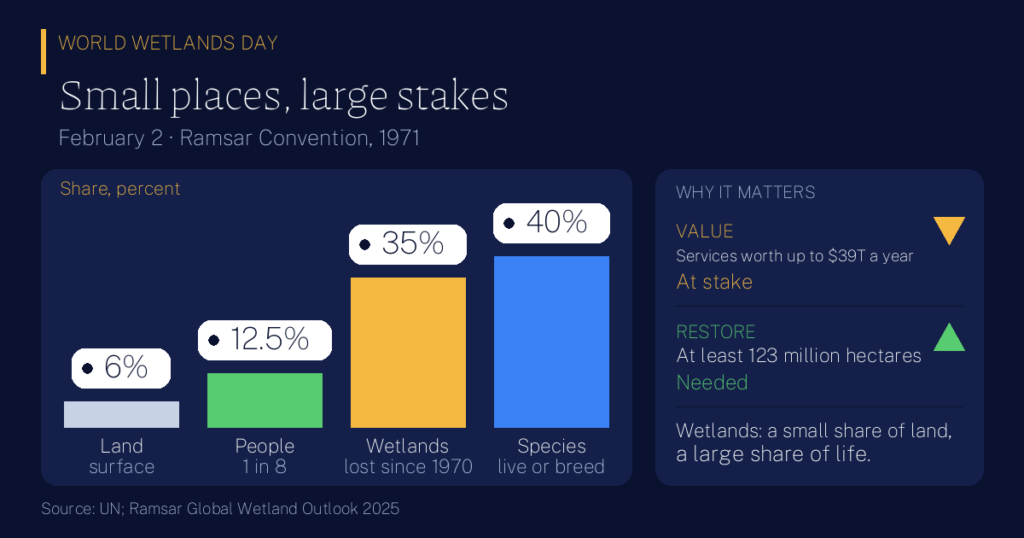
Wetlands cover only around 6 percent of the Earth’s land surface, according to the United Nations. Yet the UN reports that 40 percent of all plant and animal species live or breed in wetlands. More than a billion people, about one in eight people on Earth, depend on wetlands for their livelihoods. A small share of the map carries a very large share of life and work.
- 172Contracting Parties to the Ramsar Convention
- 2,530+Wetlands of International Importance
- 2.58 million km²area covered by those sites
- 123 million haat least, needing restoration to meet current targets
A quiet disappearing act
The Global Wetland Outlook 2025 finds that all natural wetland types have declined since 1970, with an average annual loss of 0.52 percent, and that over 400 million hectares have disappeared. The United Nations puts the same story in a single sentence: in just 50 years, since 1970, 35 percent of the world’s wetlands have been lost. It also says wetlands are disappearing three times faster than forests. The two sources express the loss in different ways, one as a yearly rate and one as a total over five decades, so each figure is best read in its own terms.
Example 2: the district map. Suppose a district had 200 hectares of wetland in 1970. If it lost wetlands at the global share of 35 percent, that is 70 hectares gone and 130 left. The district is made up, and real places vary widely, but the arithmetic shows how steady losses add up over a lifetime.
Why the loss costs real money
Protecting wetlands is not only about beauty. The Global Wetland Outlook 2025 says wetlands provide ecosystem services worth up to $39 trillion per year, counted in international or US dollars. It also says the global value of wetlands lost in the last 50 years exceeds $5.1 trillion. The report notes that restoring at least 123 million hectares is required to meet current targets.
Example 3: does restoration pay? Suppose restoring a 100-hectare marsh costs $1 million and the services it returns are worth $150,000 a year. The value would match the cost in about seven years and keep going afterward. These round numbers are made up for illustration, and real projects differ, but they show why planners weigh restoration over the long run.
People, culture and knowledge
Behind the statistics are fishers, farmers, reed cutters and whole communities whose homes and incomes are tied to wetlands. Many carry generations of local knowledge about when waters rise, where fish gather and how to harvest without harm. That is the heart of the 2026 theme, “Wetlands and traditional knowledge: Celebrating cultural heritage.” UNESCO notes that almost 120 World Heritage properties overlap wholly or partially with more than 170 wetlands recognized under the Ramsar Convention, so natural and cultural value often sit in the same place.
How the day is marked
Governments, schools, community groups and conservation organizations hold clean-ups, guided walks, exhibitions and talks, and the Ramsar Secretariat publishes campaign materials each year. You do not need a famous site to take part. A local pond, river bank or coastal flat counts. Learning what lives there and who depends on it is a fine place to begin.
A useful question for any group is simple: which wetland is closest to us, who depends on it, and is it getting healthier or worse? Answering it turns a global day into a local habit, which is where lasting protection usually starts.
Key Takeaways
- The date is a treaty birthday. February 2 marks the 1971 adoption of the Convention on Wetlands in Ramsar, Iran.
- The day is official. The UN General Assembly proclaimed it on August 30, 2021.
- Small area, big role. Wetlands cover around 6 percent of land yet host 40 percent of species and support about one in eight people.
- The losses are large. The UN reports 35 percent of wetlands lost since 1970, and the Global Wetland Outlook counts over 400 million hectares.
- Loss has a price. Services worth up to $39 trillion a year are at stake, and lost wetlands exceed $5.1 trillion in value.
- Restoration is needed. At least 123 million hectares must be restored to meet current targets.
- Knowledge matters. The 2026 theme honors the traditional knowledge of people who live with wetlands.
How solid is this? Figures come from United Nations pages and the Ramsar Convention’s Global Wetland Outlook 2025 key messages, and the sources do not always state a reference year, so treat them as the latest published values. Loss rates and totals are expressed differently by each source. The three worked examples use round, made-up numbers. See also World Water Day, the International Days hub and the International Days Calendar.
More in Nature