You can go weeks without food and days without water, but only minutes without air. Yet air is the one resource almost nobody gets to choose. The International Day of Clean Air for Blue Skies, observed every September 7, asks the world to treat that shared breath as a matter of health, fairness and shared responsibility. Its message is simple and unusually hopeful: air pollution is largely made by human activity, so it can be reduced by human decisions. Like World Water Day, it points to a basic need that is easy to ignore until it fails.
From a clean-sky campaign to a UN day
The General Assembly designated September 7 as the International Day of Clean Air for blue skies in 2019, through Resolution 74/212, and the first Day was held in 2020. In a statement for that inaugural observance, the President of the 74th General Assembly thanked the Republic of Korea and the co-sponsors of the resolution for their leadership, and thanked UNEP and the Republic of Korea for convening the event. UNEP has continued to host the Day. The 2025 observance was the sixth, held under the theme “Racing for Air,” which stresses the need to speed up solutions and collective action for clean air for all. The 2026 observance is the seventh. UNEP announces a new theme each year, so check its page for the current one.
What “clean air” actually means
Dirty air is not one thing. The World Health Organization (WHO) describes particulate matter, often shortened to PM, as a common stand-in for air pollution as a whole. These are tiny airborne particles, including sulfates, nitrates, black carbon and dust, and the smallest, called PM2.5, can travel deep into the lungs. Other important pollutants include nitrogen dioxide from burning fuel in traffic and industry, sulfur dioxide from burning coal and oil, ground-level ozone formed in sunlight, and carbon monoxide from incomplete burning. WHO says PM2.5 and PM10 come mainly from human activities linked to burning fossil fuels.
In 2021 WHO tightened its guidelines, making them more stringent, especially for particles and nitrogen dioxide. They are not legal limits. They are the levels below which health risks fall, and they give every country a common yardstick.
Example 1: a smoggy day. Suppose a city’s monitors record a PM2.5 average of 30 micrograms per cubic meter for a day. That is twice the WHO 24-hour guideline of 15. The numbers here are round and illustrative, but they show how guidelines turn a vague feeling that the air is bad into something a city can measure, track and act on.
The numbers behind the day
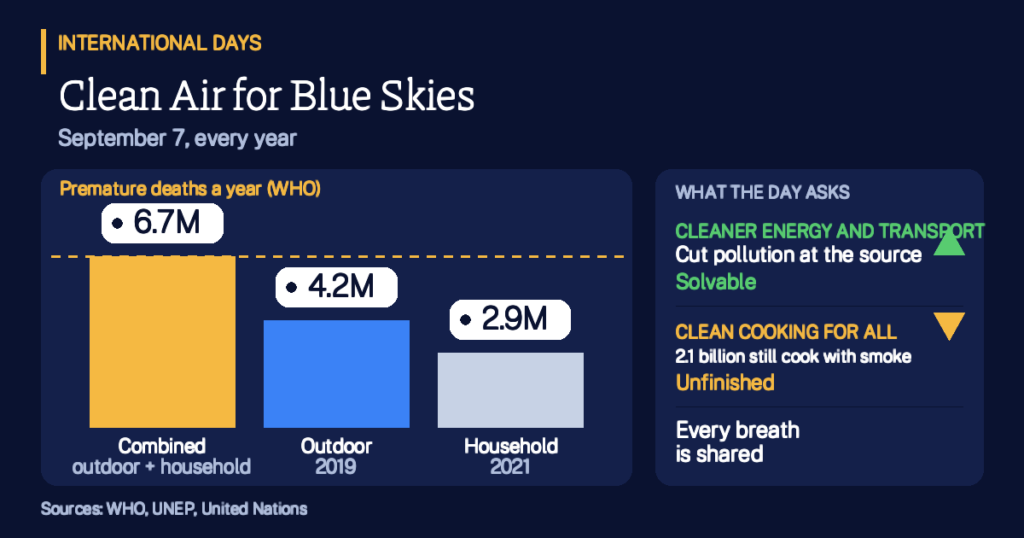
WHO reports that in 2019, 99 percent of the world’s population lived in places where its air quality guideline levels were not met. Its fact sheets estimate that outdoor air pollution caused 4.2 million premature deaths in 2019, with 89 percent of them in low- and middle-income countries. Household air pollution, mostly from cooking, caused 2.9 million deaths in 2021, including more than 309,000 children under 5. WHO gives a combined figure of about 6.7 million premature deaths a year.
Other groups count differently. UNEP’s 2025 page for the Day cites around 8.1 million premature deaths a year, calling air pollution the second leading risk factor for death, and links that figure to the State of Global Air 2024 report. The estimates differ because researchers use different methods and cover different pollution sources, but they agree on the main point: the toll is in the millions every year.
How dirty air harms the body
Fine particles pass from the lungs into the bloodstream, which is why the damage reaches the heart and brain as well as the airways. WHO’s breakdown of outdoor air pollution deaths in 2019 shows that most come from cardiovascular disease rather than lung disease alone.
Children are especially exposed. WHO calls air pollution one of the greatest environmental risks to child health. Household smoke almost doubles the risk of lower respiratory infection in childhood and is responsible for 44 percent of all pneumonia deaths in children under 5. Household exposure also links to low birth weight, tuberculosis and cataract.
Example 2: the cost of a bad week. Imagine a town of 100,000 people where a smoke-filled week sends 200 extra patients, many of them children and older adults, to clinics with breathing trouble. If each visit costs the family a day of work or school, that is hundreds of lost days from one event. The figures are round and illustrative, but they show how pollution drains health, schools and local budgets at the same time.
Who breathes the worst air
The burden is not shared evenly. WHO’s 2022 city data found that 17 percent of cities in high-income countries met the guideline for PM2.5 or PM10, compared with less than 1 percent in low- and middle-income countries. At home, the problem is the kitchen. About 2.1 billion people cook with open fires or inefficient stoves that burn wood, crop waste, charcoal, coal, dung or kerosene. In 2021, 14 percent of urban residents relied on polluting fuels, compared with 49 percent of rural residents. And household smoke does not stay indoors: WHO notes it is also a major contributor to outdoor pollution.
- 99%of people lived where WHO guideline levels were not met, 2019
- 2.1 billionpeople cook with open fires or inefficient stoves
- 49%of rural people relied on polluting fuels, 2021
- 923 millionpeople in sub-Saharan Africa lacked clean cooking, 2022
WHO also warns that on current trends only 78 percent of people are expected to have clean cooking by 2030, which would leave nearly 1.8 billion without it. Cleaner stoves and fuels are among the most direct fixes, because they protect health inside the home and cut pollution outside it.
Example 3: a stove program. Picture a district of 10,000 households where 6,000 cook over open fires. A program swaps 3,000 of them to clean stoves. Half of the exposed homes now breathe far less smoke, but the other 3,000 still do. The numbers are round and illustrative, and they show why progress that looks large can still leave half the job undone.
How the day is marked, and what progress needs
The Day is not a ceremony for its own sake. In the words of the 2020 statement from the General Assembly President, it was created to build momentum for action. Each year UNEP and partners host events, including regional commemorations and a gathering in New York, and encourage governments, companies, schools and families to take part. Real progress comes from a mix of choices: cleaner power and transport, cleaner cooking, monitoring that is public and trusted, and guidelines that countries work steadily toward. Individuals can help by choosing walking, cycling and public transport where possible, supporting clean cooking programs, and asking local officials what the air quality is and what is being done.
Key Takeaways
- The day is young but purposeful. The General Assembly designated September 7 in 2019, and the first observance was in 2020.
- Almost everyone breathes air above WHO limits. WHO reported 99 percent of people in 2019.
- The toll is in the millions. WHO estimates about 6.7 million premature deaths a year from outdoor and household pollution combined.
- Most deaths come through the heart. Heart disease and stroke caused 68 percent of outdoor air pollution deaths in 2019.
- Children and the poor carry more of the burden. About 2.1 billion people still cook with polluting fuels, and household smoke causes 44 percent of pneumonia deaths in young children.
- Guidelines give everyone a yardstick. WHO’s 2021 values, such as 5 micrograms per cubic meter of PM2.5 a year, show what healthy air looks like.
- Solutions exist. Cleaner energy, transport and cooking cut pollution at its source, so the problem is solvable.
How solid is this? Death and exposure figures are modeled estimates from WHO and vary by year, method and source, which is why UNEP’s 8.1 million and WHO’s 6.7 million differ. The 2026 theme was not available when this article was written. The three worked examples use round, made-up numbers to show an idea. See also the International Days hub and the International Days Calendar.
More in Nature
- United Nations, Statement of the President of the 74th General Assembly, International Day for Clean Air for Blue Skies (2020)
- UNEP, International Day of Clean Air for blue skies 2025
- UN Digital Library, International Day of Clean Air for Blue Skies, Resolution 74/212
- WHO, Ambient (outdoor) air quality and health fact sheet (October 2024)
- WHO, Household air pollution and health fact sheet (December 2025)
- WHO, Billions of people still breathe unhealthy air: new WHO data (April 4, 2022)