Every July 29, governments, conservationists and schoolchildren pause to ask a simple question: will the largest of the big cats still roam free a century from now? International Tiger Day, also called Global Tiger Day, exists because the honest answer was once close to no. In about a century, tiger numbers fell from 100,000 to below 3,500, according to the 2010 declaration of the countries where tigers still live. Today the picture is mixed. Numbers are rising in several countries, yet the animal has lost an estimated 95 percent of its historical range. The day marks both the warning and the progress.
A century of decline, then a promise
For most of the twentieth century the tiger’s story was one of loss. The leaders of the 13 tiger range countries described it plainly in 2010. Tiger numbers and habitat, they wrote, had declined by 40 percent in the last decade alone. They named the causes: habitat loss, poaching, the illegal wildlife trade and human-tiger conflict.
The response came at the International Tiger Forum in Saint Petersburg, Russia, held November 21 to 24, 2010. The heads of government of Bangladesh, Bhutan, Cambodia, China, India, Indonesia, Lao PDR, Malaysia, Myanmar, Nepal, Russia, Thailand and Viet Nam issued the Saint Petersburg Declaration on Tiger Conservation, dated November 23. They pledged to strive to double the number of wild tigers across their range by 2022, a goal that became known as TX2. Item 10 of the declaration also committed them to celebrating Global Tiger Day annually on July 29. In other words, the day was created by the governments that share their land with the animal.
What “doubling” really meant
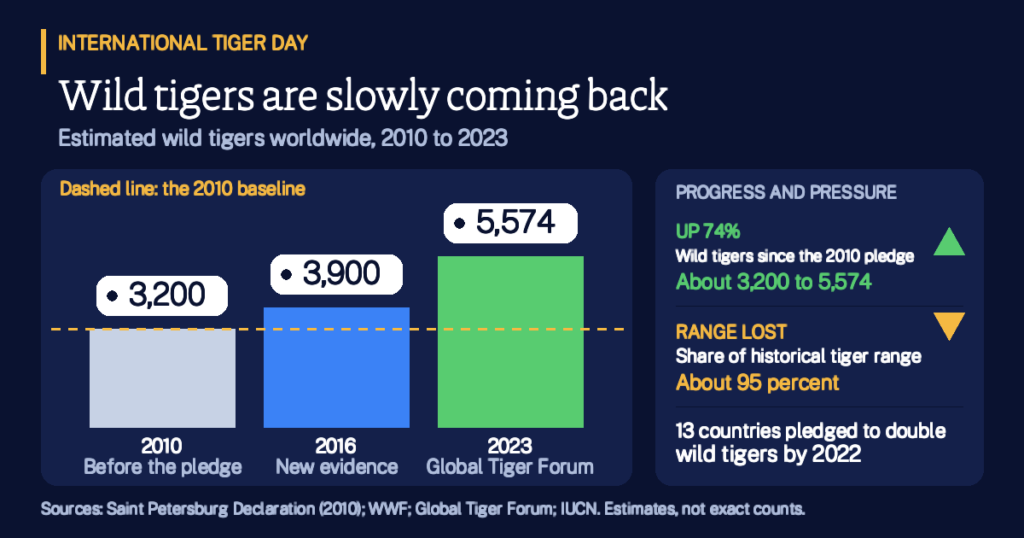
TX2 is shorthand for tigers times two. The starting point was an estimate of about 3,200 wild tigers in 2010. Doubling that would mean roughly 6,400. The goal was a range-wide population target, not a promise about any single reserve, and every figure involved is an estimate that changes as survey methods improve. That is why a good reader treats tiger numbers as a trend line rather than a headcount.
Example 1: the doubling arithmetic. Take the reported figures at face value. Doubling 3,200 gives 6,400. The 2023 estimate of about 5,574 is roughly 87 percent of that target, which is a 74 percent increase over 3,200. Progress is substantial, though the goal was not fully met by 2022 on these numbers. This is simple arithmetic on reported estimates, not a new measurement.
The numbers behind the day
WWF’s timeline records an estimate of 3,200 wild tigers in 2010 and new evidence in 2016 of around 3,900, described as the first sign of recovery after a century of declining numbers. By 2023 the Global Tiger Forum reported approximately 5,574 wild tigers, according to WWF. WWF says populations are stable or increasing in India, Nepal, Bhutan, Russia and China.
- 13tiger range countries that signed the 2010 declaration
- 95%of historical range lost, by WWF’s estimate
- 5,574approximate wild tigers reported by the Global Tiger Forum, 2023
- 8,000+tigers held in more than 200 centers in East and Southeast Asia, per WWF
National counts tell the same story in sharper detail. India’s estimates rose from 1,706 in 2010 to 2,226 in 2014. Nepal is the clearest case. Its censuses found 121 tigers in 2009, 198 in 2013 and 235 in 2018. On Global Tiger Day 2022, Nepal declared that its population had reached 355, well past the target of 250 it had set for 2022, according to IUCN.
Example 2: how fast is that? From 121 in 2009 to 355 in 2022, Nepal’s count grew by 234 tigers, nearly tripling in 13 years. A simple average is about 18 additional tigers per year. Real growth was uneven between censuses, so this is an average, not a forecast.
Why one animal matters so much
Conservation groups often describe the tiger as an umbrella species: protect a landscape large enough for tigers and you shelter the forests, prey animals and rivers that share it. The reverse is also true. When tigers vanish, it usually means the habitat around them is already failing. Cambodia’s tigers were declared functionally extinct in 2016, a warning of what the wider decline looks like up close.
WWF names poaching as the most immediate threat to wild tigers, followed by habitat loss and human-wildlife conflict, including retaliatory killings. Coastal tigers face a further risk. WWF notes that sea-level rise of about a foot by 2070 could destroy nearly the entire Sundarbans tiger habitat, a mangrove landscape that readers will recognize from Mangrove Ecosystem Day.
Where the recovery is fragile
The good news is uneven. WWF describes Southeast Asia as still in crisis and declining, even as South Asia, Russia and China hold steady or grow. In 2019, WWF’s timeline estimated that Malaysia’s wild tigers numbered fewer than 200 and could be at risk of extinction, with poaching the largest threat.
Success also brings new tension. IUCN points to growing human-tiger conflict in Nepal as numbers rise, which means that more tigers need more space, and more space means more contact with the villages at the forest edge.
Example 3: why space is the real limit. Imagine a reserve of 1,000 square kilometers that supports 10 tigers, or one tiger per 100 square kilometers. To support 20 tigers at that density, planners would need about 2,000 square kilometers of connected habitat, or a way to share land safely with neighbors. The numbers are round and illustrative, but the logic is why tiger recovery is as much about land and people as about animals.
How the day is marked, and what comes next
The Saint Petersburg goal had a formal conclusion. In September 2022, the second Global Tiger Summit in Vladivostok, Russia, marked the official culmination of the TX2 initiative, according to WWF’s timeline. The day itself is observed on the ground. In 2024, IUCN and its country offices ran events across Asia: in India, pre-event celebrations in ten villages and a main event on recovery efforts in Manas; in Thailand, a three-day event from July 25 to 27; and in Nepal, a national conservation forum whose results fed into Global Tiger Day celebrations. IUCN also noted that its Integrated Tiger Habitat Conservation Programme, begun in 2014 with German funding, contributes to the Global Tiger Recovery Programme.
Key Takeaways
- The day was made by tiger countries. The 13 range countries committed to Global Tiger Day in the Saint Petersburg Declaration of November 23, 2010.
- The decline was steep. Tigers fell from 100,000 to below 3,500 in about a century, and have lost roughly 95 percent of their historical range.
- Recovery is real. Estimates rose from about 3,200 in 2010 to about 5,574 in 2023, a 74 percent increase.
- Nepal shows what works. Its count grew from 121 in 2009 to 355 in 2022, beating its own target of 250.
- Threats persist. Poaching, habitat loss and human-wildlife conflict remain, and Southeast Asia is still declining.
- Space and coexistence decide the future. More tigers need connected habitat and safe ways for people to live beside them.
How solid is this? Tiger figures are estimates from surveys and models and are revised as methods improve, so the 2010, 2016 and 2023 totals should be read as trends, not exact counts. The 5,574 figure is reported by WWF as a Global Tiger Forum estimate. The 6,400 doubling figure and the three worked examples are simple arithmetic or round, made-up numbers. See also the International Days hub and the International Days Calendar.
More in Nature
- Global Tiger Forum, Saint Petersburg Declaration on Tiger Conservation (November 23, 2010)
- WWF, Tiger Timeline: Progress Toward Doubling Wild Tigers (2022)
- WWF, Tiger (species page, citing the Global Tiger Forum)
- IUCN, Nepal achieves a global commitment to double the tiger (July 29, 2022)
- IUCN, Uniting for tigers: Global Tiger Day events across Asia (July 29, 2024)