Glaciers are slow, quiet and far away from most of us, which is why their disappearance is easy to miss. Yet they are rivers of ice that feed real rivers, hold most of the planet’s fresh water in frozen form and raise the sea as they shrink. World Day for Glaciers, observed every March 21, was created so that this slow story gets noticed while there is still time to change its ending. It sits beside World Water Day on the calendar for good reason: when a glacier fails, a river and the people downstream feel it.
How the day came about
The day was born from a UN decision to give glaciers a year of attention. The General Assembly proclaimed 2025 the International Year of Glaciers’ Preservation and set March 21 as the annual World Day for Glaciers. UNESCO and the World Meteorological Organization (WMO) lead the effort, and at the launch they reported more than 200 contributing organizations and 35 countries. The first observance took place on March 21, 2025.
The WMO opened that first day with a blunt message: the world was watching a record-setting run of ice loss. Its Secretary-General described 2022 to 2024 as the largest three-year loss of glacier mass on record. Naming a day is not a cure, but it gives scientists, governments and communities a shared date to compare notes and to ask what should be measured and protected.
What a glacier is, and why it matters
A glacier is a large body of ice on land that forms where more snow falls than melts, and that slowly flows downhill under its own weight. More than 275,000 glaciers worldwide cover roughly 700,000 square kilometers. Together with the great ice sheets, glaciers store about 70 percent of the world’s fresh water. That is the point many people miss: this is not scenery, it is a savings account of water.
Glaciers act like seasonal reservoirs. They hold snow through winter and release meltwater in warm, dry months, when rivers, farms and cities need it most. The WMO warns that their decline threatens the water supplies of hundreds of millions of people who live downstream.
The numbers behind the day
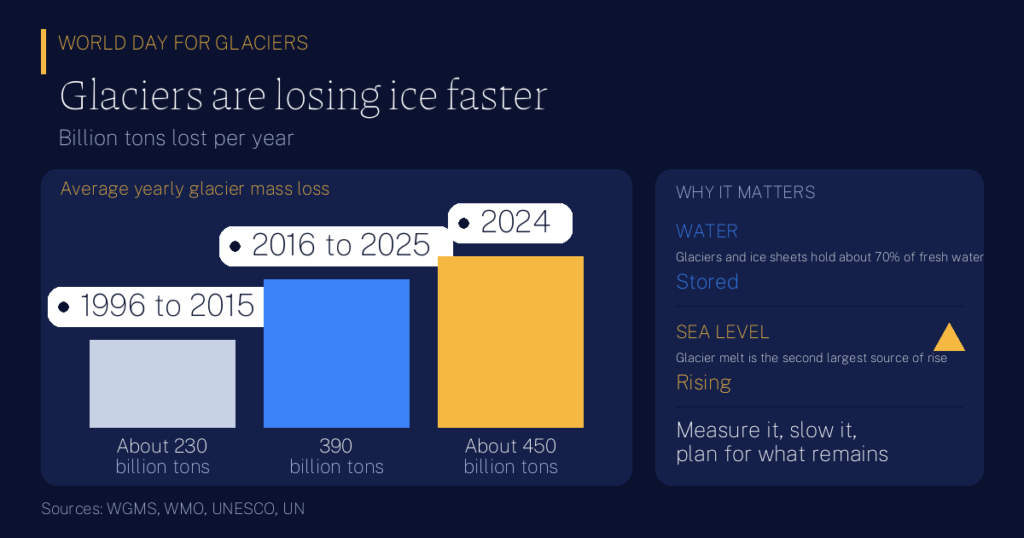
The World Glacier Monitoring Service (WGMS) tracks glacier mass change worldwide. Its record shows loss that is not only continuing but speeding up. From 1976 to 1995, glaciers lost less than 100 billion tons a year. From 1996 to 2015 the figure was around 230 billion tons a year, and from 2016 to 2025 it reached 390 billion tons a year.
Zoom out and the totals are large. From 2000 to 2023 glaciers lost 6,542 billion tons of ice, an average of 273 billion tons a year, which the WMO reports as a loss of 5 percent of the ice they held. Since 1975 the WGMS counts a cumulative loss of 9,583 billion tons, with an uncertainty of about 1,200, enough to raise the sea by roughly 26 millimeters. Six of the highest mass-loss years on record fall in the past seven years.
The single-year figures show how far the trend has run ahead of the average. In the 2024 hydrological year glaciers lost about 450 billion tons, and in 2025 they lost 408 billion tons, the sixth-most negative year on record. In the words of the lead scientist at the WGMS, the 2025 loss would have filled five Olympic swimming pools every second of that year.
Example 1: the water bank. Imagine a mountain glacier that holds 1,000 units of ice and loses 5 units a year to melt. Snowfall refills 4 of them. The glacier still feeds the river each summer, but its balance falls by 1 unit a year. The numbers are round and illustrative, yet this is the pattern: small yearly deficits add up until the account runs low.
Why the loss reaches everyone
Glacier melt is the second largest contributor to sea level rise, after the warming of the ocean itself. From 2000 to 2023 it added about 18 millimeters. That sounds small, but the WMO notes that every millimeter of sea level rise exposes an additional 200,000 to 300,000 people to annual flooding.
Example 2: counting a millimeter. Take the 2025 loss, about 1.1 millimeters of sea level rise by the WGMS estimate. Using the WMO’s range, one year of melt alone would add roughly 220,000 to 330,000 people to those exposed to yearly flooding. This is a back-of-the-envelope calculation that combines two published figures, not a forecast.
The effects also arrive in the mountains. In the short term, melting ice raises the risk of natural hazards such as floods. Over the longer term the rivers themselves can weaken: when meltwater first increases and then declines as a glacier shrinks, communities that planned around the early surge are left with less than they counted on.
Where the ice is going fastest
Loss is not even. In 2025 the largest regional contributions came from High Mountain Asia, Alaska and the Russian Arctic. Between 2000 and 2023 the share of remaining ice lost ranged from about 2 percent in the Antarctic and Subantarctic Islands to almost 40 percent in Central Europe. The WMO also cautions that at present melt rates many glaciers in Western Canada and the United States, Scandinavia, Central Europe, the Caucasus, New Zealand and the tropics will not survive the 21st century.
Who feels it, and who is left to adapt
The communities closest to the ice often have the fewest resources to respond. Farmers who irrigate from glacier-fed rivers, towns that draw drinking water from them and mountain residents all depend on predictions that science is still improving. That is why monitoring matters as much as headlines: a glacier that is not measured cannot be managed. For 2025 the WMO named South Cascade Glacier in Washington State as its Glacier of the Year, a site that scientists have observed for decades.
Example 3: a mountain valley. Picture a valley of 20,000 people whose river runs at 100 units in a hot summer, 30 of them from melting ice. If the glacier shrinks until it supplies only 10, the river drops to 80 units. The change looks modest on paper, but it lands in the driest weeks, when crops and towns need water most. The numbers are illustrative, not measured.
How the day is marked and what helps
Each March 21, UNESCO, the WMO and partners hold events, share data and invite schools, scientists and local groups to take part. Because the campaign theme changes each year, the pages of UNESCO and the WMO for the day are the best place to find the current one rather than relying on a remembered slogan.
What helps is no mystery. Cutting greenhouse gas emissions slows the warming that drives melt. Better monitoring, early warning and planning for water supply reduce the harm that can no longer be avoided. Individuals can follow the data, support local adaptation and treat water from mountains as the shared resource it is.
Key Takeaways
- The day is new and the problem is old. The first World Day for Glaciers took place on March 21, 2025, under UNESCO and WMO leadership.
- Glaciers are water stores. With ice sheets, they hold about 70 percent of the world’s fresh water.
- Loss is accelerating. Yearly ice loss rose from under 100 billion tons in 1976 to 1995 to 390 billion tons in 2016 to 2025.
- Recent years are extreme. 2024 lost about 450 billion tons and 2025 lost 408 billion tons, well above the 273 billion yearly average of 2000 to 2023.
- The sea feels it. Glacier melt is the second largest source of sea level rise, and each millimeter exposes 200,000 to 300,000 more people to yearly flooding.
- Some regions are close to the edge. Central Europe lost almost 40 percent of its ice from 2000 to 2023.
- Measurement and action both count. Monitoring, early warning and cutting emissions are the tools that protect people downstream.
How solid is this? Glacier mass figures are scientific estimates with stated uncertainty, and the WGMS revises them as data arrive. The sea level and flood exposure numbers are WMO estimates, and the two figures in Example 2 are combined by the author. The three worked examples use round, made-up numbers to show an idea. See also World Water Day, the International Days hub and the International Days Calendar.
More in Nature
- WMO, Glacier melt will unleash avalanche of cascading impacts (March 2025)
- World Glacier Monitoring Service, Global glacier mass change in 2025
- UNESCO, World Day for Glaciers
- United Nations, World Day for Glaciers
- UN News, Climate emergency: 2025 declared international year of glaciers
- WMO and UNESCO, Launch of the International Year of Glaciers’ Preservation 2025