Swimming is a sport in which athletes race through water using set strokes over fixed distances in a pool or open water. It is governed worldwide by World Aquatics, which had 210 national federations in January 2026, and it has been part of every modern Olympic Games.
History of swimming
Swimming is an ancient practice, since people had to learn to cross rivers and lakes long before sport existed. As a sport, however, it probably was not widely practiced until the early 19th century. The National Swimming Society of Great Britain was formed in 1837 and began to hold competitions, and most early swimmers used the breaststroke or a variation of it.
Faster strokes arrived through travelers. In the 1870s a British swimming instructor named J. Arthur Trudgeon saw people in South America using an alternating overarm stroke and brought it to England, where it became the trudgen, a crawl with a scissors kick. In the late 1880s Frederick Cavill saw a crawl with a flutter kick in the South Seas, settled in Australia and taught what became the Australian crawl.
The butterfly came later. In the 1940s breaststrokers found that they could go faster by bringing both arms forward over the water together. That technique was banned in breaststroke soon afterward, but it developed into the butterfly, now the fourth competitive stroke.
Swimming was on the programme at Athens in 1896, and women’s swimming was first held at the Stockholm Games in 1912.
Rules and strokes in swimming
In freestyle, swimmers may use any stroke, except in the medley races, where backstroke, breaststroke and butterfly are excluded from the freestyle leg. A body part must touch the wall at each turn and at the finish. Swimmers may be fully submerged for up to 15 meters after the start and each turn, and the head must break the surface by that mark.
In backstroke, athletes start in the water holding the grips and swim on their backs, with rolls of less than 90 degrees from horizontal. In breaststroke, the arm and leg movements must be simultaneous and the feet must turn outward during the kick. In butterfly, both arms move together, forward over the water and back under it, and the legs move simultaneously with no breaststroke kick. Breaststroke and butterfly both require a simultaneous two-hand touch at turns and at the finish.
The individual medley is swum in the order butterfly, backstroke, breaststroke and freestyle, each for one quarter of the distance. In the medley relay the order is backstroke, breaststroke, butterfly and freestyle.
An athlete who starts before the signal may be disqualified, and the referee does so only when both the starter and the referee observe and confirm the false start. Automatic officiating equipment records times to one hundredth of a second, and it takes precedence over the times and placings given by human officials.
Equipment and venues for swimming
Competition pools are either 50 meters or 25 meters long. In a 50-meter pool, touch panels must give a distance of 50.000 meters between them, with a tolerance of plus 0.010 and minus 0.000 meters.
Lane width is also set by the rules. For the Olympic Games, the rules specify eight lanes, each 2.5 meters wide. At world championships in a temporary pool they specify ten lanes of the same width, with a gap of at least 0.5 meters at the outer edges.
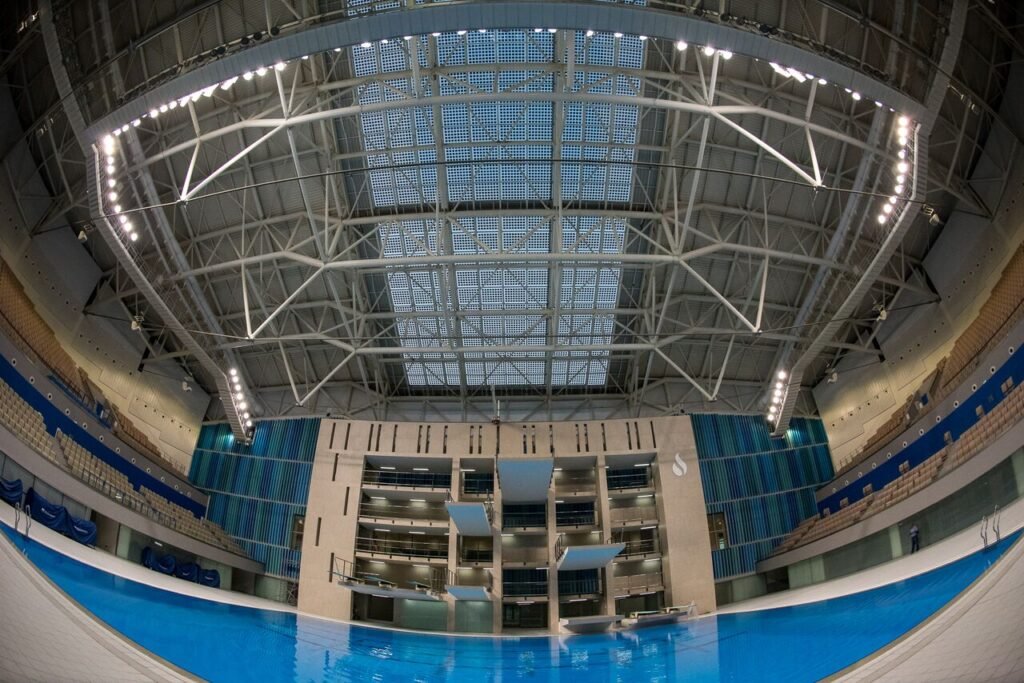
The touch panels are part of the automatic timing system, which is why the rules treat their placement so precisely. The photograph on this page shows the Baku Aquatic Palace, an indoor Olympic-size pool in Azerbaijan.
Governing bodies and major competitions
World Aquatics was founded as the Fédération Internationale de Natation, or FINA, on 19 July 1908 in London, during the Olympic Games. Its eight founding federations were Belgium, Denmark, Finland, France, Germany, Great Britain, Hungary and Sweden. It was renamed World Aquatics in 2022.
The founders aimed to create unified rules for swimming, diving and water polo, to verify world records and to run swimming at the Olympics. World Aquatics now governs six sports: swimming, water polo, diving, artistic swimming, open water swimming and high diving.
The current Olympic programme gives men and women freestyle races over 50, 100, 200, 400, 800 and 1,500 meters. Backstroke, breaststroke and butterfly are swum over 100 and 200 meters, the individual medley over 200 and 400 meters, and three relays complete the pool programme. Los Angeles 2028 will bring the first Olympic 50-meter races in backstroke, breaststroke and butterfly.
Since Beijing 2008, men and women have also raced 10 kilometers in open water at each Games.
Records and notable moments in swimming
The United States has dominated Olympic swimming, with 266 golds and 614 medals as of 2024. Australia is second with 74 golds, and East Germany’s women won 38 golds before the country dissolved.
Michael Phelps of the United States has 23 golds and 28 medals, the most Olympic medals and golds won by any athlete in any sport. Katie Ledecky has nine golds and 14 medals, and Mark Spitz and Caeleb Dressel each have nine golds.
Emma McKeon of Australia is the only non-American in the top ten for both overall medals and golds. She has 14 medals and six golds, including seven medals at Tokyo 2020, a women’s record for any sport.
Global participation in swimming
World Aquatics reported 209 national federations across five continents in its IOC profile. Its last general survey, in 2019, counted 35 million registered athletes across its sports, along with 36,000 swim clubs and nearly 290,000 coaches.
More than 20 nations have won over ten Olympic swimming medals. They include Australia, Japan with 84 medals, Hungary with 77 and Great Britain with 86, and the sport has been part of the Youth Summer Olympics since 2010 for boys, girls and mixed events.
More in Sports Coaching and Performance
Key facts
- FINA, now World Aquatics, was founded in London on 19 July 1908 by eight national federations.12
- Swimming has been held at every modern Olympic Games, and women first competed in 1912.2
- Competition pools are 50 or 25 meters long, with touch panels giving exactly 50.000 meters in a 50-meter pool.3
- The four competitive strokes are freestyle, backstroke, breaststroke and butterfly.32
- Michael Phelps has 23 Olympic golds and 28 medals, the most by any athlete in any sport.2
Related concepts
In the news
Quick checkWhat are the four competitive swimming strokes?Show answer
The four strokes are freestyle, backstroke, breaststroke and butterfly. The individual medley combines all four, and the medley relay gives each stroke to a different swimmer.
Sources
- International Olympic Committee, Creation of FINA, olympics.com, https://www.olympics.com/ioc/news/creation-of-fina
- Olympedia, Swimming (discipline overview, with World Aquatics history and Olympic medal data), olympedia.org, https://www.olympedia.org/sports/SWM
- World Aquatics, Swimming Rules (as published by Special Olympics), media.specialolympics.org, https://media.specialolympics.org/resources/sports-essentials/swimming/m-e-r-c/World-Aquatics-Swimming-Rules-EN.pdf
Editorially reviewed by Specialty Digest Editorial TeamLast reviewed November 4, 2026Researched and drafted with AI assistanceReport an issue