Most international days celebrate an idea. This one remembers people. Every March 25, the United Nations pauses to think about colleagues who have been detained or who have disappeared while doing their jobs. They may be drivers, nurses, interpreters, human rights officers or logistics clerks. The day asks for something simple and old: that no colleague be forgotten, and that those who hold them let them go.
A day that began with one abduction
The date is not random. According to the UN, the day marks the anniversary of the abduction of Alec Collett, a former journalist who was working for the UN Relief and Works Agency for Palestine Refugees (UNRWA) when armed gunmen took him in 1985. His body was finally found in Lebanon’s Bekaa Valley in 2009, after more than two decades of uncertainty for his family and his colleagues. The UN says the day has been observed since 1986.
That long wait explains the shape of the observance. It is not a celebration, and it is not a statement about any single country. It is a yearly act of solidarity inside the UN family, and a public reminder to governments and armed groups that international staff serve in places where help is most needed and risks are highest. Each year the Secretary-General issues a message for the day, and that message is the clearest place to find the latest count.
What the words mean
The title names two situations. A detained staff member is held by an authority, such as a government or a de facto authority that controls territory. A missing staff member is someone whose whereabouts are unknown. In both cases the concern is the same: a person doing official work has lost their freedom or been cut off from their family and employer.
The UN also stresses that staff in these roles work under privileges and immunities that protect them in doing their duties. Its Secretary-General has repeatedly described arbitrary detention of UN personnel as unacceptable and has asked for prompt, unconditional release. The day gives that message a fixed place on the calendar.
Example 1: a quiet absence. Imagine a field office with a team of twelve. One morning a driver does not arrive, and by evening the office knows he has been taken into custody without a stated reason. His team keeps his chair empty, his family waits for news, and his employer asks the authorities to confirm where he is. The numbers are round and illustrative, but the sequence of absence, uncertainty and appeals is what the day is about.
The numbers behind the day
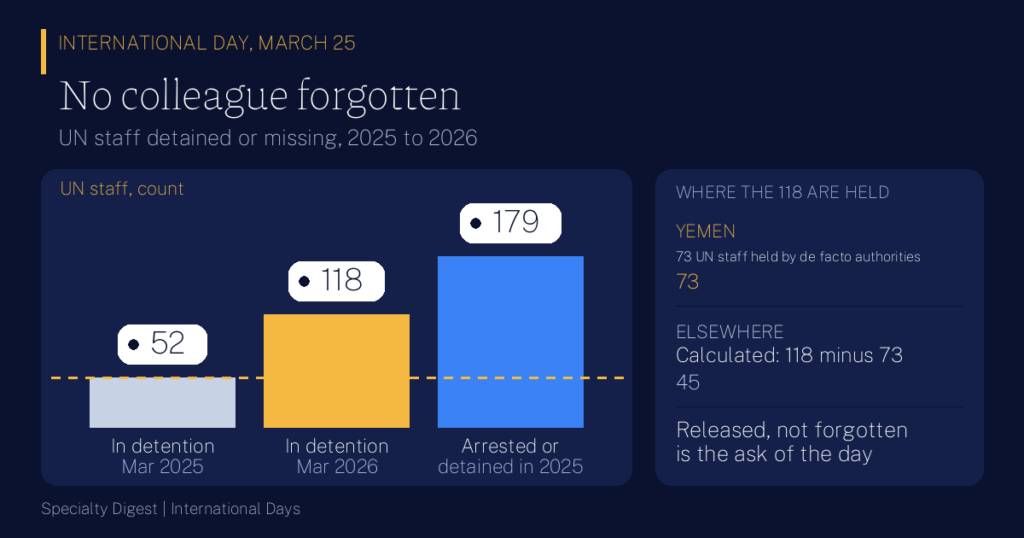
The Secretary-General’s 2026 message says that 179 UN personnel were arrested or detained in 2025, and that 118 UN colleagues remain in detention. UN News reported that this is a significant increase from the 52 UN staff in detention at the same time in 2025. The two figures measure different things. One counts arrests or detentions over a whole year, and the other counts people still held on one day.
Example 2: why two numbers can both be true. Suppose an organization has 100 people detained on January 1. During the year 150 more are detained and 120 are released. By December 31, it counts 130 still held, even though 150 new detentions happened during the year. These figures are made up and rounded, but they show why a yearly total and a single-day count can look so different and still be consistent.
Yemen at the center of the count
The UN News report on the 2026 observance singled out one country for the largest share. In Yemen, 73 UN staff remain detained by the de facto Houthi authorities, including eight from the UN human rights office. UN High Commissioner for Human Rights Volker Turk has said that under no circumstances can UN personnel be detained for doing their work, and that some colleagues have been deprived of their liberty for five years. This article reports what the UN says. It does not describe the circumstances of any individual case.
The legal shield
International law gives UN staff real protection on paper. The Convention on the Safety of United Nations and Associated Personnel was adopted by the General Assembly on December 9, 1994, in resolution 49/59. It builds on earlier steps, including Security Council resolution 868 of 1993. A 2005 Optional Protocol, adopted on December 8, 2005 in resolution 60/42, widened the scope to operations that deliver humanitarian, political or development assistance in peacebuilding, and operations that deliver emergency humanitarian assistance.
The gap is in the follow-through. The UN itself noted that, as of 2013, the Convention had been ratified by fewer than half of UN member states, and more than four out of five had yet to ratify its Optional Protocol. In 2024 the Security Council added resolution 2730, which addresses the safety and security of humanitarian and UN personnel. Rules matter only when they are accepted, applied and enforced, which is why the UN keeps asking governments to ratify, to respect them, and to release those held.
Why it matters beyond the UN
It is tempting to see this as an internal staff matter. It is not. UN personnel carry vaccines, food, shelter and monitoring missions into places most organizations cannot reach. When staff are detained, aid can slow, programs can be suspended, and local communities can lose services they depend on. The principle also connects to the wider protection of civilians and to rights such as liberty and fair treatment that appear in the Universal Declaration of Human Rights, the subject of Human Rights Day.
Example 3: the ripple effect. Imagine a program that vaccinates 2,000 children a month, run by a team of ten. If two of them are detained and others are reassigned for safety, the program might serve only about 1,500 children for a time. The numbers are round and illustrative, yet they show how one detention reaches far beyond one person.
How the day is marked
The day is observed mainly through the Secretary-General’s message and through calls from UN leaders and staff representatives for release and for accountability. The 2026 message ended on a promise: no colleague is forgotten. Readers can mark it simply by learning the facts, by sharing accurate information, and by supporting organizations that press for the safety of those who serve in difficult places.
Key Takeaways
- The day honors people, not an idea. It marks the 1985 abduction of former journalist Alec Collett and has been observed since 1986.
- Two words, one concern. Detained means held by an authority, and missing means whereabouts unknown.
- The count has risen sharply. The UN reported 118 staff in detention in March 2026, up from 52 a year earlier.
- The year total is larger. A reported 179 personnel were arrested or detained during 2025.
- One country holds the largest share. UN News reported 73 staff detained in Yemen by de facto authorities.
- Law exists, but ratification lags. The 1994 Convention and its 2005 Optional Protocol are only as strong as the states that accept them.
- The ask is simple. Release those held, account for those missing, and let no colleague be forgotten.
How solid is this? The detention figures come from the Secretary-General’s 2026 message and UN News and may change as cases are resolved or added. The 45 other detainees is a calculation from two reported figures. Ratification information comes from a UN page dated 2013 and may be out of date. The three worked examples use round, made-up numbers. See also the International Days hub and the International Days Calendar.
More in Society
- United Nations, International Day of Solidarity with Detained and Missing Staff Members
- Secretary-General message for the Day, 2026
- UN News, UN chief calls for immediate release of 118 detained UN staff, March 25, 2026
- UN Memorial, Protecting UN Staff
- UN Audiovisual Library of International Law, Convention on the Safety of United Nations and Associated Personnel
- UN Department of Safety and Security, Security Council resolution on safety and security of humanitarian and UN personnel