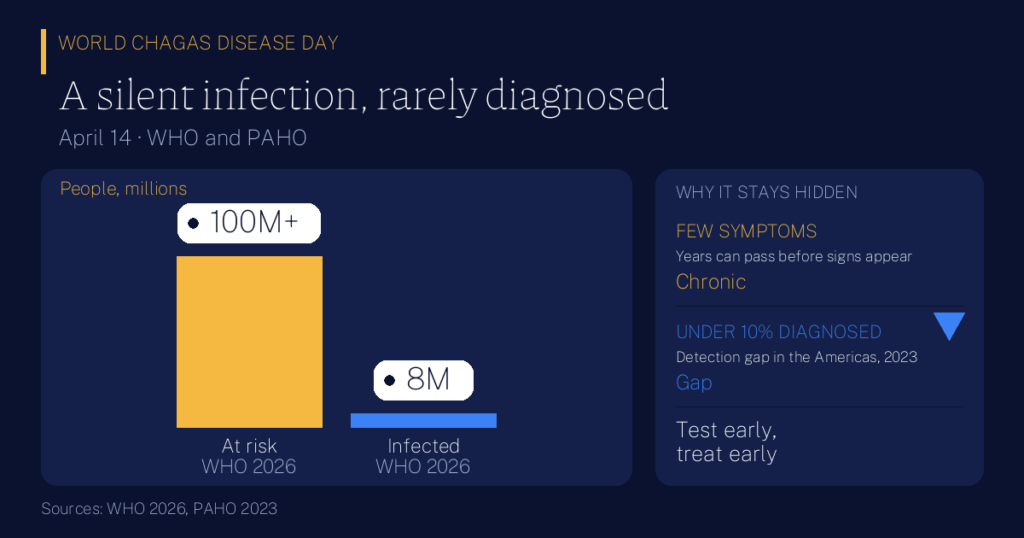
Some of the world’s most serious diseases make little noise. Chagas disease can live in the body for decades without a single symptom, and then, in some people, damage the heart or the gut. WHO’s latest fact sheet estimates that about 8 million people carry the infection, yet very few know it. World Chagas Disease Day, observed every year on April 14, exists to change that. It asks the world to find, test and treat people who have gone unseen, and it belongs to the wider family of neglected tropical diseases.
A discovery in a child
The date points back to 1909. On April 14 of that year, the Brazilian physician Carlos Chagas diagnosed the disease in a patient for the first time. WHO records that the first patient was a girl named Berenice Soares de Moura. Chagas had traced the illness to a parasite and to the insects that carry it, which is an unusual achievement: he described the disease, its cause and its means of spread in a single body of work.
The day itself is much newer. The proposal to create it was initiated by the International Federation of Associations of People Affected by Chagas Disease, a group led by patients. In May 2019, the 72nd World Health Assembly approved the designation of World Chagas Disease Day, to be celebrated annually on April 14. WHO had already recognized Chagas disease as a neglected tropical disease in 2005. Note that a 2023 PAHO article dates the Assembly’s decision to 2020, while WHO’s own 2019 and 2026 pages say 2019, which is the date used here.
What Chagas disease is
Chagas disease, also called American trypanosomiasis, is caused by a parasite. It is carried by triatomine bugs, often called kissing bugs, which hide in cracks of mud and thatch homes and feed at night. The bug does not inject the parasite. It leaves feces or urine near the bite, and the parasite enters through the wound, the eyes or the mouth. That is only one route.
The route that matters most has shifted. Vector control, meaning spraying homes and improving housing, has been the most effective prevention in Latin America. WHO says domestic transmission by the insect has been verified as interrupted in all of Chile, Paraguay and Uruguay, and in parts of Argentina, Brazil, Colombia, Peru and Bolivia. As that front closed, mother-to-child transmission became the main route worldwide, with over 10,000 new cases a year according to WHO. Because the infection can pass from mother to baby, one untreated woman can leave a lasting link in a family tree.
The numbers behind the day
Estimates differ by source and year. WHO’s 2019 news item and PAHO’s 2023 article both cite 6 to 7 million infected people, while WHO’s 2026 fact sheet says about 8 million. More than 100 million people are considered at risk of infection, according to WHO in 2026, and more than 10,000 people die of the disease each year. The disease is endemic in 21 continental Latin American countries, but it has been detected in 44 countries, including Canada, the United States and many in Europe.
- About 8 millionpeople estimated infected worldwide, WHO 2026
- 100 million+people considered at risk of infection, WHO 2026
- 10,000+deaths every year, WHO 2026
- Under 10%of people with Chagas receive a diagnosis, PAHO 2023
That last figure is the heart of the problem. PAHO reported in 2023 that the detection rate for Chagas in the Americas was below 10 percent. A disease that is not found cannot be treated, and treatment works best early.
Why a quiet infection becomes a serious illness
Chagas disease has two phases. The acute phase appears soon after infection and is often mild or without symptoms. The chronic phase can last for life. WHO says up to a third of chronically infected people develop heart disorders, and about 1 in 10 develop digestive, neurological or mixed problems. PAHO gives the same ranges as up to 30 percent and up to 10 percent.
Example 1: a village screening. Suppose a clinic tests 1,000 adults in an endemic district and 30 test positive. Using WHO’s ranges, about 10 of those 30 might develop heart problems over their lifetimes, and about 3 might develop digestive or neurological ones. The numbers are round and illustrative, but they show why a positive test is a reason for regular check-ups, not alarm.
Who is left behind
Chagas disease follows poverty. Triatomine bugs thrive in poorly built homes, so the people most at risk are those with the fewest choices about where they live. In Latin America, PAHO estimates that about 1.1 million women of childbearing age are infected, and that 9,000 children a year are infected before or at birth. Because symptoms are rare early on, many people meet the disease only when a heart rhythm test or a blood donation reveals it. Health systems often lack tests, trained staff or reporting. WHO notes that national information systems exist in only 6 of the 44 countries that have reported cases.
Treatment is available. Two medicines, benznidazole and nifurtimox, are described by WHO as fully effective in curing the disease if given early, in the acute phase. PAHO describes the infection as almost 100 percent curable when found and treated early. They are not simple drugs: adverse reactions occur in up to 40 percent of adults, and they are not for pregnant women or people with kidney or liver failure. WHO notes that nifurtimox for all ages and benznidazole for children under 19 are free donations. For children, early treatment can end an infection before it becomes a lifelong one.
Example 2: a newborn’s chance. Imagine a clinic that finds 50 infected mothers in one year and tests all of their babies. Any infant carrying the parasite can start treatment in the first months of life, when the medicine works best. A parent who learned of the infection only at age 50, after heart symptoms, would not have the same chance. The numbers are illustrative; the contrast between early and late discovery is what the agencies describe.
The case for acting early
Prevention is also cheaper than the cure. WHO calculates that the medical care of patients with chronic forms of the disease costs more than 80 percent more than spraying residual insecticide. Screening is a cost-effective intervention, WHO says, and the 2021 to 2030 roadmap for neglected tropical diseases sets a target of 75 percent antiparasitic treatment coverage among eligible people.
Example 3: spray or treat? Imagine a region that spends $1 million to spray homes and improve walls. By WHO’s comparison, caring for chronic patients in the same area could cost over $1.8 million. The figures are round and illustrative, but the logic holds: stopping bugs at the door costs less than treating a damaged heart years later.
How the day is marked
Each year WHO, PAHO, ministries of health and patient groups use April 14 to push for tests, trained doctors and care close to home. The themes show the progression. The 2022 campaign focused on finding and reporting every case, the 2023 theme was integrating Chagas disease into primary health care, the 2024 campaign urged early diagnosis and care for life, and in 2025 the theme was “Prevent, control, care: everyone’s role in Chagas disease.” If you live in or have lived in an endemic area, or your mother did, ask a health worker about a simple blood test.
Key Takeaways
- Chagas is silent. Many infected people have no symptoms for years, so the disease hides in plain sight.
- The numbers are large and uncertain. WHO’s 2026 estimate is about 8 million infected and more than 100 million at risk.
- Diagnosis is the gap. PAHO reported in 2023 that fewer than 1 in 10 people with Chagas receive a diagnosis.
- Early treatment can cure. Benznidazole and nifurtimox work best in the acute phase, and children can receive free medicine.
- Complications are serious. Up to a third of chronic patients develop heart disorders and about 1 in 10 develop digestive or nerve problems.
- Prevention pays. Chronic care costs more than 80 percent more than spraying, according to WHO.
- Ask for the test. If you have lived in an endemic area, or your mother did, a blood test is the first step.
How solid is this? Case counts are modeled estimates and differ between WHO’s 2019 and 2026 publications and PAHO’s 2023 figures for the Americas, so each number is tied to its source and year. Congenital and diagnosis figures come from PAHO and WHO. The three worked examples use round, made-up numbers to show an idea. See also World Neglected Tropical Diseases Day, the International Days hub and the International Days Calendar.
More in Health
- WHO, Chagas disease (American trypanosomiasis) fact sheet, April 2026
- WHO, World Chagas Disease Day: raising awareness of neglected tropical diseases, May 2019
- PAHO/WHO, Less than 10% of people with Chagas receive a diagnosis, April 2023
- WHO, World Chagas Disease Day 2024: urging early diagnosis and care for life
- WHO, World Chagas Disease Day 2025: Prevent, control, care
- WHO, World Chagas Disease Day 2022: finding and reporting every case