Most international days honor a problem to solve or a group to protect. Chinese Language Day honors something different: a way of speaking, writing and thinking shared by a very large part of humanity. Observed every year on April 20, it is one of six language days kept by the United Nations, one for each official language. The date comes from an old story about the invention of writing, and the day belongs to a modern effort to treat every official language as an equal. It is a close cousin of International Mother Language Day, which looks at linguistic diversity across the world.
A legend, a rain and a date
The choice of April 20 is not random. According to the UN’s Chinese Language Day page, the date was selected from Guyu, which can be translated as “Rain of Millet.” Guyu is the sixth of the 24 solar terms in the traditional East Asian calendars, and in the Gregorian calendar it usually begins around April 20. The day was chosen to pay tribute to Cangjie.
Cangjie, the page explains, is claimed to be an official historian of the Yellow Emperor and the inventor of Chinese characters. Legend has it that he had four eyes and four pupils, and that when he invented the characters, the deities and ghosts cried and the sky rained millet. From then on, Chinese people celebrate Guyu in honor of Cangjie. Notice the careful wording: this is a legend, and the UN presents it as one. What matters is the idea behind it, that writing was a marvel powerful enough to move the heavens.
Why the United Nations keeps language days
Chinese Language Day belongs to a family of six. The UN explains that its language days are the result of a 2010 initiative by the Department of Global Communications, which set out to establish a day for each of the Organization’s six official languages. Their purpose, in the UN’s words, is to celebrate multilingualism and cultural diversity and to promote equal use of all six official languages throughout the Organization. Under the initiative, UN duty stations around the world celebrate six separate days. The 2026 event is titled the 17th UN Chinese Language Day, which matches a program that began in 2010.
The principle behind the days is older. On December 6, 1999, the General Assembly adopted resolution 54/64, which invited the appointment of a coordinator on multilingualism.
How Chinese earned its place at the UN
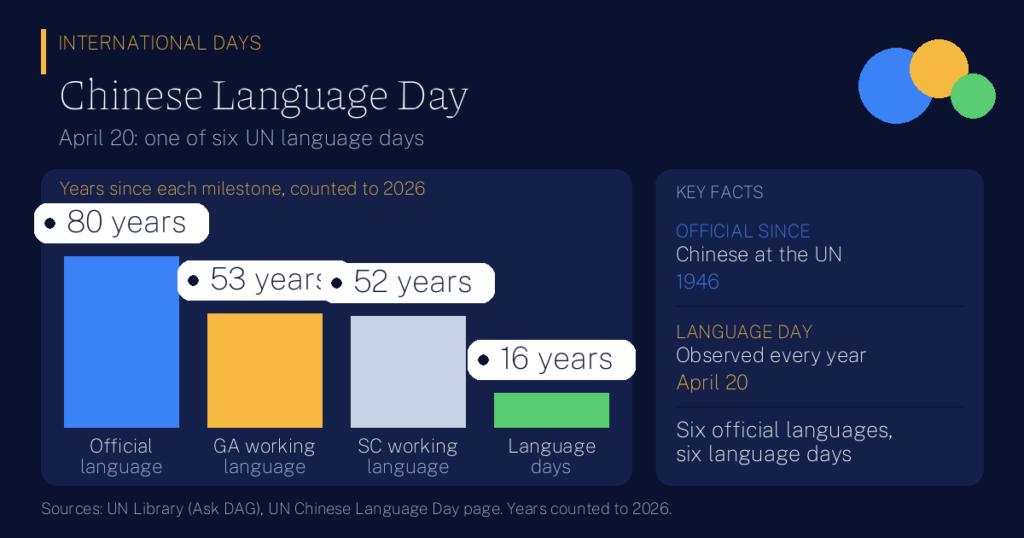
Chinese has been part of the Organization from the start. On February 1, 1946, General Assembly resolution 2 (I) established Chinese, French, English, Russian and Spanish as official languages, and English and French as working languages. Chinese also became an official language of the Security Council on June 24, 1946. Arabic joined the list later, which brought the total to six.
The UN has long distinguished between official languages and a smaller set of working languages, and Chinese joined the second group later. It became a working language of the General Assembly on December 18, 1973, through resolution 3189 (XXVIII), and of the Security Council on January 17, 1974, through resolution 345 (1974). That is a gap of 27 years after 1946 for the Assembly, a reminder that formal equality among languages can take time to become practical equality.
- 6official languages of the United Nations
- 1946year Chinese became an official UN language
- 27years from 1946 to a General Assembly working language role in 1973
- 17thUN Chinese Language Day, as titled for 2026
Example 1: one speech, six audiences. Imagine a 10-minute statement delivered in Chinese at a UN meeting. For the room to follow it fairly, it must be interpreted into the five other official languages, so one speech becomes six listening experiences. If the written text runs 12 pages, translating it into the other five languages creates 60 pages of new text. The numbers are round and illustrative, but they show why equal use of six languages is real work, not a slogan.
What “Chinese” really means
The word “Chinese” covers more than most people expect. Ethnologue describes Chinese as a grouping of thirteen languages under the Chinese macrolanguage. Among them, Mandarin Chinese is, in Ethnologue’s words, the largest language in the world when counting only first language (native) speakers. At the same time, Ethnologue notes that English is spoken in 146 countries, a stark difference to Mandarin’s 38. Size by native speakers and reach across borders are two separate measures.
Written Chinese adds another layer. Its characters, the ones Cangjie is said to have invented, are symbols that carry meaning rather than letters that stand for sounds.
Six languages, six days
French Language Day falls on March 20, Chinese on April 20, English and Spanish both on April 23, Russian on June 6 and Arabic on December 18. Two share a date, and four of the six fall in March or April. Together they give the Organization a rolling reminder that its work is done in many tongues.
Example 2: a year of language days. Suppose a UN duty station hosts one three-hour event for each language day. Across six days that is 18 hours a year devoted to the Organization’s languages, and if 40 staff members attend each event, the total is 240 attendances. The figures are round and illustrative, but they show how small, regular events add up to steady contact with languages people may not use at their desks.
Why a language day matters
A language is a tool and a home at once. It carries history, law, science, humor and memory, and when an institution treats one language as the default, speakers of the others must work harder to be heard. By setting aside a day for each official language, the UN signals that every one of them is a full means of participation. For learners, the day is an invitation to look past vocabulary lists and meet a living culture.
Example 3: a community class. Imagine a class of 30 adults studying a new language for 2 hours a week over a 40-week year. Each learner puts in 80 hours, and the class as a whole puts in 2,400 learner-hours. The numbers are round and illustrative, but they show how steady effort, not a single big event, turns curiosity into a skill.
How the day is marked
Each year the UN hosts a themed ceremony. The 2026 event was called “Chinese Language, Shining Civilizations: Thematic Ceremony for the 2026 UN Chinese Language Day,” with an opening ceremony listed for Monday, April 13. UN Web TV also lists celebrations at the UN Office at Nairobi for 2024, 2025 and 2026, so the day is not confined to headquarters. You can join in on your own scale: read about Cangjie, learn ten characters, or ask a Chinese-speaking friend to teach you a favorite phrase.
Key Takeaways
- The date comes from a legend. April 20 is tied to Guyu, “Rain of Millet,” and to Cangjie, the claimed inventor of Chinese characters.
- It is one of six. The UN’s 2010 language days initiative gave each official language its own day.
- The purpose is equality. The days celebrate multilingualism and promote equal use of all six official languages.
- Chinese has been official since 1946. It became a working language of the General Assembly in 1973 and of the Security Council in 1974.
- “Chinese” is a family. Ethnologue describes a grouping of thirteen languages, with Mandarin the largest by native speakers.
- Join in simply. Learn a few characters, read a translated poem or ask a speaker to share a phrase.
How solid is this? The date, the Cangjie legend, the language-day purpose and the UN language milestones come from UN pages. The Ethnologue country counts are undated on the page cited, so treat them as a comparison, not a current census. The three worked examples use round, made-up numbers to show an idea. See also the International Days hub and the International Days Calendar.
More in Education
- United Nations. Chinese Language Day, UN observances.
- United Nations. Chinese Language Day (English version), including the 2026 event.
- United Nations. Multilingualism and the UN.
- UN Library. What are the official languages of the United Nations? (updated January 2026).
- Ethnologue. What is the most spoken language?