Most trees are valued for wood, shade or fruit. The argan tree is valued for a whole way of life. It grows in the southwest of Morocco, where the land is dry and poor soils make farming hard, and it has fed families, fed livestock and held the ground together for generations. Every year on May 10 the United Nations marks the International Day of Argania to draw attention to this tree, to the people who live from it and to the fragile landscape it protects. It sits comfortably beside the International Day of Forests, because it shows in miniature why a single species can matter to an entire region.
How a regional tree reached the United Nations
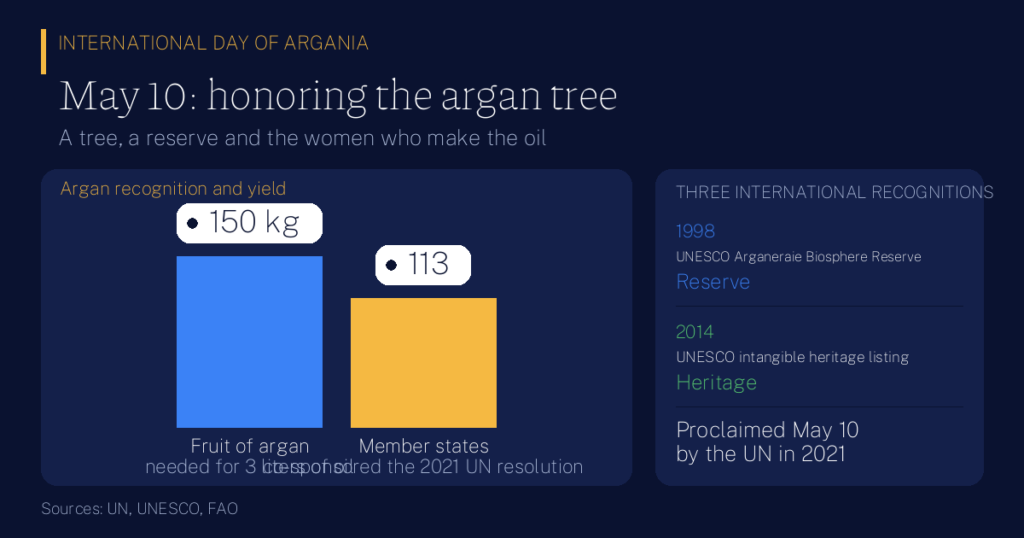
The argan tree is described by the UN as a native species of the southwest of Morocco. Morocco brought the idea of a global day to the General Assembly, and the Assembly proclaimed May 10 the International Day of Argania. The resolution, A/RES/75/262, was adopted by consensus, and the UN observance page records that 113 member states co-sponsored it. The UN Chronicle gives the adoption date as March 3, 2021. The first observance followed on May 10, 2021, with a virtual high-level event from Agadir that included a senior FAO official among its speakers.
The day did not appear from nowhere. Argan had already earned three separate forms of international recognition, each looking at the tree from a different angle: as an ecosystem, as living knowledge and as a farming system.
Three ways to see one tree
UNESCO’s Arganeraie Biosphere Reserve, nominated in 1998, covers 2,499,970 hectares and lists a total population of 3,121,116 people. A biosphere reserve is a place where conservation and everyday life are meant to work together, and this one is large enough to hold farms, villages, grazing land and argan woodland at once. In 2014 UNESCO inscribed “Argan, practices and know-how concerning the argan tree” on its intangible heritage list, with Morocco as the only state named. The point of that listing is that the tree is more than a plant. It is also a body of skills passed from mother to daughter.
The third recognition came from FAO. In December 2018 it designated an argan-based agro-sylvo-pastoral system in the area of Ait Souab-Ait Mansour as a Globally Important Agricultural Heritage System. FAO describes a landscape with more than 50 cultivated plant species, represented by 102 endemic landraces, and 16 livestock breeds, where farmers draw the larger part of their income from the argan trees. The system is noted for its resilience to water scarcity, erosion and poor soils.
Example 1: what a cooperative’s season looks like. The UN says it takes about 150 kg of fruit to produce 3 liters of oil, which is about 50 kg of fruit per liter. Suppose a small cooperative gathers 1,500 kg of fruit. At that ratio it could expect about 30 liters. The cooperative is made up, and the totals are round and illustrative, but the ratio is the UN’s, and it explains why the oil is precious and slow to make.
The women behind the oil
The UN observance page states that rural women lead the entire extraction process. UNESCO’s heritage entry says rural women, and to a lesser extent men, practice the traditional methods, and that “argan women” teach them to their daughters. FAO describes the producers as many rural women working in cooperatives. Cooperatives matter because a single household can gather only so much fruit, and shared work and shared sales give women a steadier income and a voice in decisions. No source we checked gives a verified count of cooperatives or of women workers, so this article does not offer one.
Livelihood claims should be read with the same care. Morocco’s ambassador to the UN said in 2020 that approximately three million Moroccans base their livelihoods on argan production. That is an official statement rather than a survey result, and it helps explain why the country pressed for a UN day.
Example 2: a household budget. Imagine a family that earns part of its income from selling oil through a cooperative, part from livestock that graze in the woodland and part from barley on small plots. If a drought cuts the fruit harvest by a third, the family still has two other income streams. These numbers are invented and round, but they show the logic that FAO honors in its heritage designation: a mixed system spreads risk.
A landscape under pressure
The same dry climate that makes argan useful also makes it vulnerable. UNESCO notes that climate change has brought long periods of drought followed by heavy rain and floods in the reserve. FAO wrote in 2025 that climate change, soil degradation and water scarcity now threaten this iconic species, even as demand for argan oil in cosmetics keeps growing worldwide. Rising demand can help families, but it also adds pressure on trees that grow slowly and are already stressed.
One response comes from the SALAM-MED project, funded through the EU and PRIMA, which runs a Living Lab in the Essaouira part of the reserve. FAO reported preliminary results after 12 months: the project’s SWRT technique raised soil moisture by up to 486 percent and seedling survival by up to 13 percent. Seedlings in protected areas did best, followed by those in traditionally managed agdal land, then those in heavily grazed areas. The agdal tradition is a set of community rules for resting land so it can recover.
Example 3: planting math. Suppose a village plants 1,000 seedlings and 40 percent survive in its first year. If a better technique lifts survival by 10 percentage points, 100 more trees make it, which is a 25 percent gain on the original 400. The figures are made up and round, and they show why small survival gains matter when trees are slow to grow.
How the day is marked
Observances include forums, events at the UN and in Morocco, and school and community activities. A 2023 observance carried the theme “Local Socioeconomic Development and Sustainability of the Argan Ecosystem,” which captures the two sides of the day: protecting the tree and protecting the people who depend on it. If you want to take part, buy oil from cooperatives that name their producers, learn how the tree is grown and read the UNESCO and FAO pages listed below.
Key Takeaways
- The day is official. The UN proclaimed May 10 through resolution A/RES/75/262, adopted by consensus with 113 co-sponsors.
- Argan is recognized three ways. UNESCO honors the reserve (1998) and the know-how (2014), and FAO honors a farming system (2018).
- The oil is hard-won. About 150 kg of fruit makes 3 liters, or roughly 50 kg per liter.
- Women lead extraction. Rural women, often in cooperatives, carry the skills and much of the work.
- The forest faces strain. Drought, floods, poor soils and water scarcity threaten the tree, according to UNESCO and FAO.
- Restoration shows promise. Early trial results report gains in soil moisture and seedling survival, but they are preliminary.
How solid is this? The resolution symbol, co-sponsor count and yield figure come from the UN. The reserve area and population come from UNESCO’s listing, which does not state a data year here. The three million livelihoods figure is a 2020 official statement, and the restoration results are preliminary and use “up to” wording. We found no verified tonnage or export value for argan oil, so none is given. The three worked examples use round, made-up numbers. See also the International Days hub and the International Days Calendar.
More in Nature
- United Nations. International Day of Argania.
- UN Chronicle. Cultivation of the Argan Tree Can Help Combat Climate Change and Support Sustainable Development (2023).
- UNESCO. Arganeraie, Man and the Biosphere Programme.
- UNESCO. Argan, practices and know-how concerning the argan tree (2014).
- FAO. Argan-based system, Globally Important Agricultural Heritage Systems.
- FAO Near East. From roots to resilience: Empowering Morocco’s argan landscapes (2025).
- FAO New York. FAO hails argan as SDGs champion (2020).