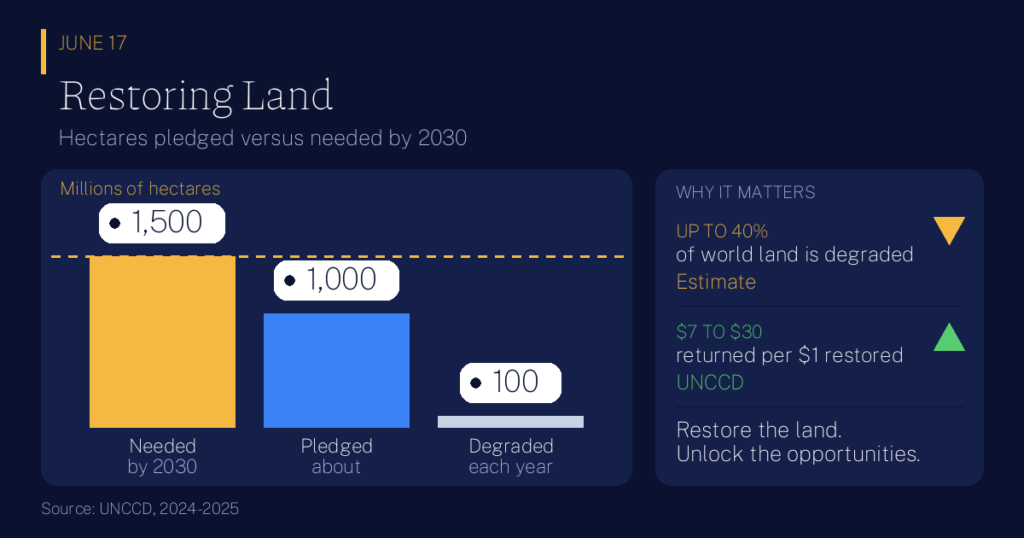
Land is easy to take for granted. It grows the food on our plates, filters the water in our rivers and holds the ground beneath our feet. Yet UN estimates say that up to 40 percent of the world’s land is already degraded, affecting more than 3 billion people. World Day to Combat Desertification and Drought, observed every year on June 17, asks everyone to notice the slow, quiet loss of healthy land before it becomes a crisis. It is a close relative of World Soil Day and World Water Day, because soil, water and land work as one system.
A treaty first, then a day
In 1994, the UN General Assembly declared June 17 the World Day to Combat Desertification and Drought in resolution A/RES/49/115. That same year, as UN News recalls, 196 countries and the European Union signed up to the UN Convention to Combat Desertification, the global treaty that the day supports. The UN observances page counts 197 parties today, 169 of them affected by desertification. Each year brings a new theme. The 2024 theme was “United for Land: Our Legacy. Our Future,” and the 2025 theme was “Restore the land. Unlock the opportunities.”
What the words mean
Desertification does not mean that deserts are marching across the map. The Convention uses the term for land degradation in dry areas, driven by factors that include climate variation and human activity. Land degradation is the broader loss of soil’s ability to grow crops, hold water and support life. Drought is different again: a spell of unusually low rainfall that leaves people, crops and nature short of water. The two feed each other. Degraded soil absorbs less rain and holds less moisture, so a dry spell bites harder, and repeated drought leaves land more exposed to erosion.
Example 1: one farm, one dry year. Imagine a field that normally yields 2 tons of grain per hectare. After years of erosion, it yields 1.5 tons, and a drought year cuts it again to 1 ton. The family harvests half of what it used to, from the same land and the same labor. The numbers are round and illustrative, but they show how degradation quietly lowers the floor that every drought then falls through.
The numbers behind the day
The UNCCD fact sheet for the 2025 observance gives a sobering baseline. Up to 40 percent of the world’s land is degraded, affecting more than 3 billion people. About 1 million square kilometers of healthy, productive land becomes degraded every year, which the UNCCD describes as 100 million hectares annually, or four football fields every second. Drought, land degradation and desertification together cost the global community an estimated $878 billion every year (UNCCD, 2024). Drought itself is growing: UN News reported in December 2024 that droughts have been increasing by 29 percent since 2000, due to climate change and unsustainable land management.
- 40%of the world’s land is degraded, at most (UNCCD, 2024)
- 3 billion+people affected by land degradation
- 100 million haof healthy land degraded every year (UNCCD, 2024)
- $878 billionestimated yearly cost of drought, degradation and desertification (UNCCD, 2024)
Why it matters to people far from the desert
The UN observances page notes that some two billion people depend on ecosystems in dry land areas, and that 90 percent of them live in developing countries. The UNCCD also reports that one billion people under the age of 25 live in regions directly dependent on land (UNCCD, 2022). When land fails, the first losses are harvests, grazing and water, and they fall hardest on people with the fewest alternatives. The effects travel, too, through food prices, jobs and the pressure on communities to move. For the 2025 observance, the UN Secretary-General’s message stressed the need to reverse degradation and to boost finance for restoration.
Example 2: a day measured in land. If 100 million hectares degrade in a year, that is roughly 275,000 hectares per day, or about 3 hectares every second. In round, illustrative terms, a county of 1 million hectares could vanish from productive use in about ten days of this global pace. The point is not the exact comparison, but the scale of a loss that rarely makes headlines.
Restoration: the gap between pledges and need
The good news is that degraded land can often be brought back. The UNCCD says restoring 1.5 billion hectares by 2030 will be necessary for a land-degradation-neutral world. Existing commitments add up to about 1 billion hectares: roughly 600 million hectares under national land degradation neutrality targets, 200 million under the Bonn Challenge and 290 million in national climate plans (IUCN and UNCCD, 2024).
The money question
Restoration pays. The UNCCD says every dollar invested in restoring degraded land generates between $7 and $30 in economic returns, and that restoring over one billion hectares is projected to generate up to $1.8 trillion annually. Yet money lags. The fact sheet says at least $2.1 trillion in cumulative investment is needed by 2030, notes an annual funding gap of $355 billion, and reports that the private sector contributes only 6 percent of global investment in land restoration. Other UN coverage, such as UN News from COP16, quotes a higher total of $2.6 trillion by 2030, so estimates differ by source and method.
Example 3: a village project. Suppose a community invests $10,000 to restore grazing land and rebuild soil. At the UNCCD range of $7 to $30 per dollar, the economic return would be about $70,000 to $300,000 over time. These numbers are round and illustrative, and real projects differ widely, but they show why restoration is described as an opportunity and not only as a cost.
How the day is marked, and what you can do
The convention’s governing body held its sixteenth session, COP16, in Riyadh, Saudi Arabia, from December 2 to 13, 2024, and UN News reported a call for global action on land and drought. Each June 17, the UNCCD and its partners focus attention on one theme, and communities are invited to join. The day needs no special equipment. Learning where your food comes from, supporting land restoration, using water carefully and asking how local land is managed are all ways to take part.
- 2024United for Land: Our Legacy. Our Future
- 2025Restore the land. Unlock the opportunities
Key Takeaways
- Desertification means dryland degradation. It is about losing land’s productive capacity, not deserts spreading on a map.
- The scale is vast. Up to 40 percent of the world’s land is degraded, affecting more than 3 billion people.
- The loss is continuous. About 100 million hectares of healthy land degrade every year.
- Drought is rising. UN News reports a 29 percent increase in droughts since 2000.
- Restoration has a measurable gap. About 1 billion hectares are pledged against 1.5 billion needed by 2030.
- Restoring land pays. The UNCCD cites $7 to $30 of returns for every $1 invested, yet funding falls short.
How solid is this? Figures come from the UNCCD fact sheet for 2025, UN News and the UN observances page. Land degradation and cost totals are estimates, and the pledged hectares are rounded, so the components exceed the 1 billion total shown by the source. Investment needs differ between UN sources. The worked examples use round, made-up numbers to show an idea. See also World Water Day, the International Days hub and the International Days Calendar.
More in Nature
- United Nations, World Day to Combat Desertification and Drought, background
- UNCCD, Desertification and Drought Day 2025 fact sheet
- UN News, Three billion people globally impacted by land degradation (December 2, 2024)
- UNCCD, Desertification and Drought Day 2025: Restore the land. Unlock the opportunities
- United Nations, Desertification and Drought Day 2024
- UN Digital Library, Observance of World Day to Combat Desertification and Drought