High on the rocky slopes of Central and South Asia lives a wild goat whose spiraling horns look like corkscrews. The markhor is the national animal of Pakistan, and it has become a quiet symbol of what careful conservation can achieve. Its story is not a simple one. The species is still counted in the thousands, not millions, and its numbers are falling in some places while rising in others. The International Day of the Markhor, observed every May 24, asks the world to look at that uneven picture and to ask what is working. It sits naturally beside the International Day for Biological Diversity, which is observed just two days earlier.
How a mountain goat got a UN day
The day is young. According to the UN office in Pakistan, the General Assembly adopted a resolution on May 2, 2024, sponsored by Pakistan and eight other countries. The text, numbered A/RES/78/278, proclaims May 24 as the International Day of the Markhor. It invites member states, UN bodies including the UN Environment Programme (UNEP), other organizations, civil society and individuals to observe the day as appropriate. It also asks those involved to consider international and regional cooperation to conserve the markhor, given its role in the ecosystem. The first observance took place on May 24, 2024.
Meet the markhor
The markhor (Capra falconeri) lives in mountainous terrain at roughly 600 to 3,600 meters, in open woodland, scrubland and light forest, according to the UN. Its range spans Central and South Asia, including Afghanistan, India, Pakistan, Tajikistan, Turkmenistan and Uzbekistan. The UN observance page describes three subspecies, each with its own range.
The numbers behind the day
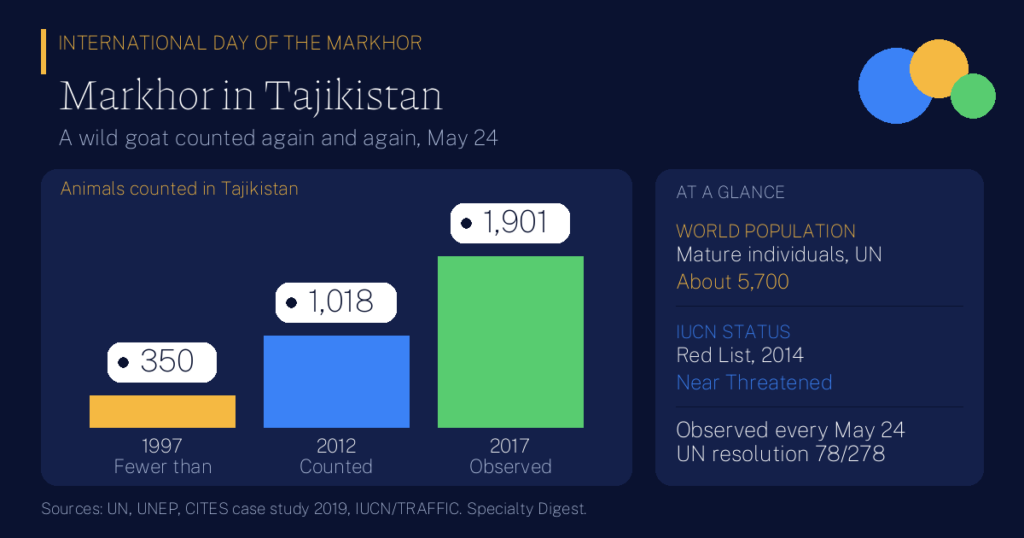
The UN’s observance page puts the world population at approximately 5,700 mature individuals. The UN office in Pakistan, writing in May 2024, said fewer than 6,000 mature individuals remain across the planet, and that numbers worldwide are declining. Yet Pakistan’s own population has kept increasing for the past ten years, reaching between 3,500 and 5,000, which that office credits to proactive conservation programs and community engagement.
The species is rated Near Threatened on the IUCN Red List, a category it was given in 2014 according to the UN. Since 1992 it has been listed in Appendix I of CITES, the convention that controls trade in wildlife, which is its strictest level of protection.
- 5,700mature markhor worldwide, per the UN observance page
- 6countries named in the range
- 2014year of the Near Threatened rating, per the UN
- 1992year the species entered CITES Appendix I
One of the clearest recoveries is in Tajikistan. A 2019 CITES case study reports fewer than 350 animals there in 1997. Surveys then counted just over 1,000 in 2012, and an IUCN specialist group survey recorded 1,901 in 2017, with 85 percent of them inside community conservancies. An IUCN analysis prepared for a CITES meeting adds a caution that the later survey figures are not all fully published, so trends should be read with care. A more recent IUCN specialist group report describes a preliminary 2022 survey suggesting more than 5,000 animals in Tajikistan, and stresses that its analysis was still ongoing.
Example 1: reading a recovery. Suppose a valley counted 40 animals one decade and 200 the next. That is a fivefold rise, which sounds dramatic, yet 200 animals is still a small herd that one bad winter or one outbreak could harm. The numbers are round and illustrative, but they show why conservationists celebrate gains and keep watching.
Why the markhor is still at risk
The UN, UNEP and the Pakistan release agree on the main threats: habitat loss, illegal hunting including poaching, and climate change. Mountain animals have few places to go. As pastures shrink or shift upslope, they compete with livestock and move into areas that are harder to protect. A species that lives in remote terrain across several countries also needs cooperation across borders, which is exactly what the resolution encourages.
Healthy mountain wildlife also signals healthy mountains. Pakistan’s “Living Indus” initiative, which UNEP designated a World Restoration Flagship in February 2024, is cited by the UN office in Pakistan alongside the markhor’s recovery, as part of a wider effort to restore the landscapes the animal depends on.
Conservancies and the hunting question
One of the most debated tools is regulated trophy hunting. In Tajikistan, according to the 2019 CITES case study, community conservancies earn money from a small number of permitted hunts, and the rules cap hunting at about 1 percent of a conservancy’s markhor population. The study reports that a hunter pays USD 135,000 to 190,000 per hunt, with a net benefit to the conservancy of USD 68,000 to 88,000. Of that net, USD 20,000 to 30,000 pays rangers and USD 10,000 to 25,000 goes to community development. The study counts roughly 300 jobs and about 20,000 people who benefit indirectly.
The approach is contested. The IUCN/TRAFFIC analysis prepared for a CITES meeting raised questions about whether the safeguards for loosening trade controls had been met, including concerns about the sustainability and legality of hunts. The IUCN specialist group, for its part, notes that rangers are drawn from local communities and that benefits have funded water catchments, education and health facilities. The honest summary is that the model depends on strict quotas, regular surveys and transparent benefit sharing.
Example 2: a conservancy cap. Imagine a conservancy with 400 markhor and a cap of 1 percent. That allows at most 4 animals to be taken in a year, and fewer if surveys show a decline. The numbers are made up, but the logic is real: the cap protects the herd, and the money pays the people who guard it.
How the day is marked and what progress needs
Because the day is new, there is no long list of annual themes yet, and no single lead agency is named on the UN pages. Observance is left to governments, communities, schools and conservation groups. Typical activities include wildlife surveys, ranger recognition, school talks and exhibitions about mountain habitats. What progress needs is fairly plain: protect habitat, stop poaching, keep counting, and share the benefits of conservation with the people who live beside the animals.
Example 3: why local pay matters. If a village earns nothing from wildlife, a poacher’s offer of cash looks attractive. If that same village receives, say, ten salaried ranger jobs and a new school from protecting the herd, guarding the animals becomes a shared interest. The figures are illustrative, but the incentive effect is what the community conservancy model aims to create.
Key Takeaways
- The day is new. The General Assembly proclaimed it on May 2, 2024, and the first observance was May 24, 2024.
- The markhor is rare. The UN counts about 5,700 mature individuals worldwide.
- The picture is mixed. Global numbers are reported to be declining, yet Pakistan’s population has risen for a decade.
- Threats are clear. Habitat loss, poaching and climate change top the UN’s list.
- Protection is strong on paper. The species is Near Threatened and sits in CITES Appendix I.
- Communities are central. Tajikistan’s conservancies show how local benefits can support recovery, though the hunting model is debated.
- Cooperation is the ask. The resolution invites countries to work together across borders.
How solid is this? The UN gives the world population without a survey year, and Tajikistan survey methods differ across years, so the trend is more reliable than any single count. The 2022 Tajikistan figure is described by IUCN as preliminary. Hunting figures come from a 2019 case study and may have changed. The three worked examples use round, made-up numbers. See also the International Days hub and the International Days Calendar.
More in Nature
- United Nations, International Day of the Markhor
- UN Environment Programme, International Day of the Markhor
- United Nations in Pakistan, Pakistan celebrates first International Day of the Markhor (May 2024)
- CITES, Livelihoods Case Study: Community-based trophy hunting of ibex and markhor in Tajikistan (2019)
- CITES CoP18 Inf. 12, IUCN/TRAFFIC analyses of proposals
- IUCN SSC Caprinae Specialist Group, Markhor success story