Biodiversity can sound abstract, yet it is the quiet system behind every meal, every breath and every glass of water. The word describes the variety of life on Earth: the species, the genes inside them and the ecosystems they build together. Each year on May 22, the United Nations marks the International Day for Biological Diversity to remind people that this web of life is fraying, and that it can still be repaired. It is a close companion of World Water Day, because healthy rivers, wetlands and forests are living water infrastructure.
From a treaty to a day
The day grew out of a treaty. On May 22, 1992, countries adopted the agreed text of the Convention on Biological Diversity through the Nairobi Final Act. The Convention commits its members to conserve biodiversity, use its components sustainably and share the benefits of genetic resources fairly.
When the UN General Assembly’s Second Committee first created the observance in late 1993, it picked December 29, the date the Convention entered into force. That choice did not work well in practice. In December 2000 the General Assembly moved the day to May 22, partly because many countries found it hard to plan celebrations in a period crowded with holidays. The new date commemorates the adoption of the Convention’s text. Each year the Convention’s secretariat proposes a theme and coordinates the campaign.
What biodiversity means
Biological diversity is not just a count of species. It has three layers. Genetic diversity is the variety within a species, such as the many types of rice or cattle. Species diversity is the range of plants, animals, fungi and microbes in a place. Ecosystem diversity is the variety of habitats, from coral reefs to wetlands and grasslands. Losing any layer weakens the others, much as removing threads weakens a woven cloth.
Example 1: the single-crop farm. Imagine a 100-hectare farm that plants one crop variety everywhere. A new disease that attacks that variety could threaten the entire harvest. A neighboring farm plants five varieties on 20 hectares each. The same disease might hit only one of them, putting about 20 percent of the harvest at risk instead of all of it. The numbers are round and illustrative, but the logic is why genetic diversity works like insurance.
The numbers behind the day
The best-known assessment comes from the Intergovernmental Science-Policy Platform on Biodiversity and Ecosystem Services (IPBES), whose 2019 Global Assessment found that around 1 million animal and plant species are now threatened with extinction, many within decades. The same report estimated about 8 million species on Earth, including 5.5 million insect species.
- 1 millionof about 8 million species threatened with extinction (IPBES, 2019)
- 75%of the land-based environment significantly altered by human actions
- 66%of the marine environment significantly altered
- 85%+of wetlands present in 1700 had been lost by 2000
The assessment also ranked the direct causes of change, in descending order of impact. Changes in land and sea use come first, such as clearing forests or converting wetlands. Direct exploitation of organisms, through fishing, hunting and harvesting, is second. Climate change, pollution and invasive alien species follow.
Why it matters at the dinner table
Biodiversity can feel remote until you look at your plate. According to the UN, over 80 percent of the human diet comes from plants, and fish provide 20 percent of animal protein for about 3 billion people. The same source notes that one million of the world’s estimated 8 million species are threatened. IPBES also reported that more than 9 percent of domesticated mammal breeds used for food and farming had gone extinct by 2016, with at least 1,000 more threatened.
Healthy ecosystems also do work that no budget line shows. Wetlands filter and store water, forests hold soil in place, insects pollinate crops, and coastal habitats soften storms. When these systems shrink, communities pay for what nature once provided free, and those with the least income are usually hurt first.
The global plan and the gap
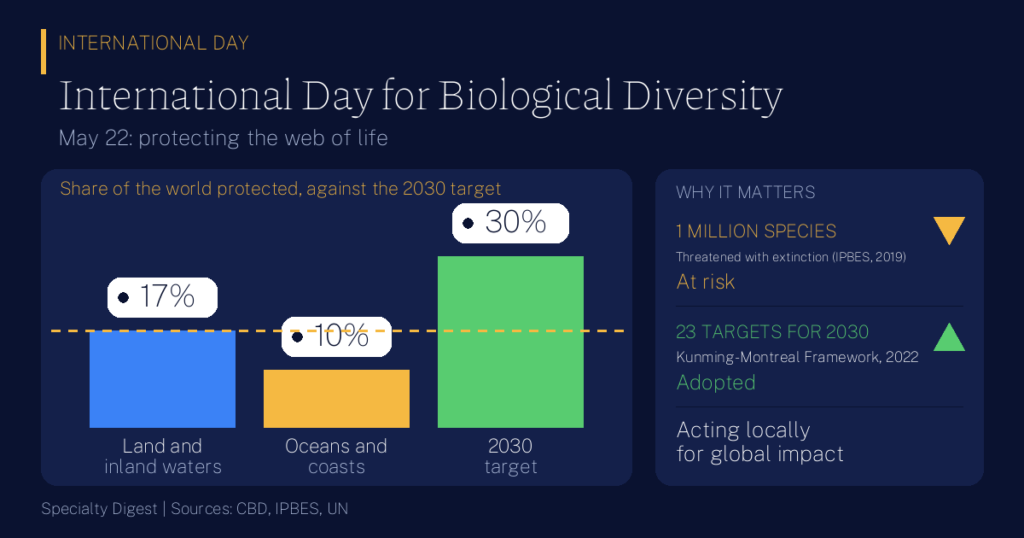
In December 2022, at the 15th Conference of the Parties (COP15) in Montreal, governments adopted the Kunming-Montreal Global Biodiversity Framework, with four goals for 2050 and 23 targets for 2030. Its best-known target, often called 30 by 30, calls for effective conservation and management of at least 30 percent of the world’s lands, inland waters, coastal areas and oceans by 2030. When it was adopted, the CBD reported that 17 percent of land and 10 percent of the oceans were under protection.
Example 2: a 30 percent target in one country. Suppose a country covers 1,000,000 square kilometers and has 170,000 under protection, or 17 percent. Reaching 30 percent means 300,000, so it must add 130,000 square kilometers by 2030, an area close to the size of a fifth of the country. The figures are round and illustrative, but they show how a percentage target becomes a map.
Money is part of the plan. The CBD’s summary lists a target to mobilize at least $200 billion per year for biodiversity by 2030, and to reduce harmful subsidies by at least $500 billion per year by 2030. International finance flowing to developing countries is meant to reach at least $20 billion per year by 2025 and $30 billion per year by 2030. The framework also refers to progressively closing a biodiversity finance gap of $700 billion per year.
Example 3: shifting a subsidy. Picture a government that spends $10 billion a year on payments that encourage harmful practices, such as overfishing. If it redirects $1 billion, or 10 percent, to support sustainable fishing and habitat restoration, it keeps its support for livelihoods but changes what the money rewards. The numbers are made up for illustration only.
Acting locally for global impact
The 2026 theme, “Acting locally for global impact,” connects the large framework to everyday places. The CBD says the 2026 campaign will help link local initiatives with the 23 global targets and stresses a whole-of-society approach, which it describes as a two-way street. Governments should create enabling conditions, and others should contribute to planning and implementation. The campaign is organized around three pillars: Look and Learn, Connect and Act, and Share.
The Food and Agriculture Organization (FAO) marked the 2026 day by highlighting local action for biodiversity in food and agriculture, including pastoralists who safeguard locally adapted livestock breeds. The UN also notes that by 2026 only four years remain to meet the near-term targets, so local action is no longer optional extra credit.
What does that look like? Planting native species, protecting a local wetland, choosing sustainably sourced food, joining a community survey of birds or insects, or asking a city council how it protects green space. None of these steps solves the problem alone. Together, many of them make the national and global targets reachable.
Key Takeaways
- Biodiversity has three layers. Genes, species and ecosystems all matter, and losing one weakens the others.
- The day marks a treaty. May 22 commemorates the 1992 adoption of the Convention on Biological Diversity text, and the date was set by the UN in December 2000.
- The risk is large. IPBES estimated in 2019 that about 1 million of roughly 8 million species face extinction.
- Land and sea use come first. The assessment ranked changes in land and sea use as the leading direct driver of change.
- There is a plan. The 2022 Kunming-Montreal Framework sets 23 targets for 2030, including protecting at least 30 percent of land and sea.
- The gap is real. Protection stood at 17 percent of land and 10 percent of oceans at adoption, so progress must speed up.
- Local action counts. The 2026 theme invites everyone to connect their own neighborhood to the global targets.
How solid is this? The species figures are scientific estimates from IPBES in 2019 and rest on modeling and expert judgment, so they carry real uncertainty and are updated over time. Protected-area shares are those reported at the Framework’s adoption in 2022 and have likely changed since. The three worked examples use round, made-up numbers to show an idea. See also World Water Day, the International Days hub and the International Days Calendar.
More in Nature
- Convention on Biological Diversity, International Day for Biological Diversity
- CBD, Theme of the International Day for Biological Diversity 2026
- CBD, IDB 2026 campaign page
- CBD, COP15 press release, December 19, 2022
- United Nations, International Day for Biological Diversity
- IPBES, Global Assessment media release, May 2019
- FAO, Celebrating International Day for Biodiversity 2026