Every country has laws that say children belong in classrooms and playgrounds, not on farms, building sites and factory floors. Yet nearly 138 million children are still in child labour. World Day Against Child Labour, observed every June 12 and led by the ILO, exists to keep that number in public view and to ask what it will take to bring it to zero. It is a natural companion to World Children’s Day, which celebrates what childhood should look like.
A promise made in law, still unfinished
The day rests on a set of agreements that nearly every nation has accepted. ILO Convention 182 on the Worst Forms of Child Labour, adopted in 1999, became the first Convention in ILO history to reach universal ratification when all 187 member States had signed on, a milestone completed on August 4, 2020 after Tonga’s ratification. It is described as the fastest-ratified Convention the ILO has ever had. A companion treaty, Convention 138 on Minimum Age, sets the age below which work should not begin, and the ILO continues to call for its full ratification.
The wider goal sits in the Sustainable Development Goals. Target 8.7 called for ending child labour in all its forms by 2025. In July 2019 the UN General Assembly unanimously declared 2021 the International Year for the Elimination of Child Labour, with the ILO in the lead. The 2025 deadline has now passed, and the ILO says plainly that the world missed it. The day is therefore less a celebration than a progress check.
The numbers behind the day
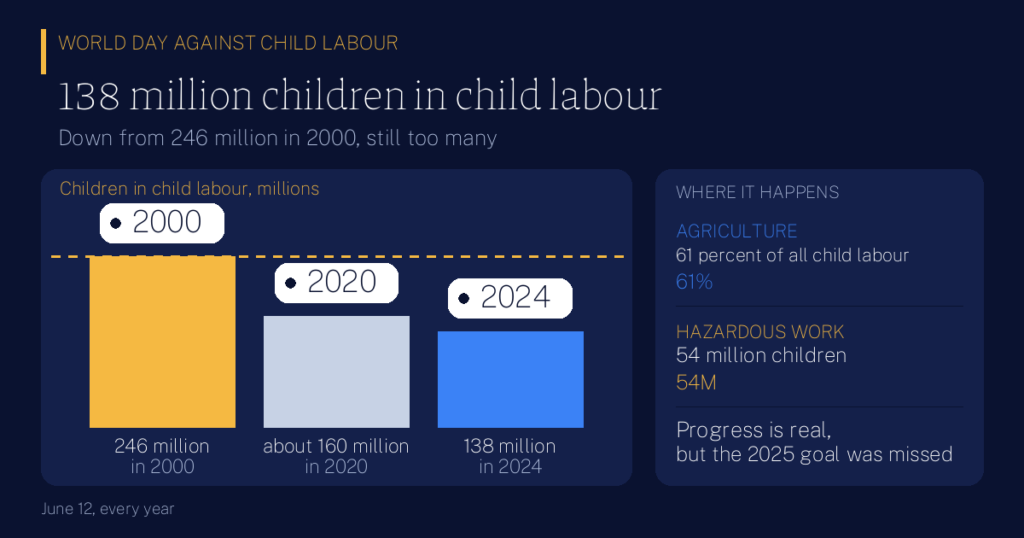
The latest joint estimates from the ILO and UNICEF, published in June 2025 and covering 2024, put the total at nearly 138 million children, almost 8 percent of all children worldwide. That is 78 million boys and 59 million girls. Of the total, 54 million are in hazardous work, meaning work likely to harm a child’s health, safety or development.
The long view is encouraging. Since 2000 the total has almost halved, from 246 million to 138 million, a drop of more than 100 million. Since 2020 alone, child labour has fallen by more than 22 million, and hazardous work by 25 million. But the line did rise between 2016 and 2020 before turning down, which is a reminder that progress can reverse.
- 138 millionchildren in child labour, 2024
- 54 millionof them in hazardous work
- 22 millionfewer children than in 2020
- 11 timesfaster progress needed to end it within five years
Example 1: what the pace means. Imagine a district where 1,000 children work. If the count falls by 10 children a year, it would take a century to reach zero. If it falls by 110 a year, the problem ends in under ten years. The numbers are round and illustrative, but this is the logic behind the ILO’s call for progress eleven times faster than today’s.
Where children work, and where the problem is concentrated
Child labour is mostly a rural story. Agriculture accounts for 61 percent of the total, and much of that is on family subsistence and smallholder farms. Services come next at 27 percent, including domestic work and small-scale trade, followed by industry at 13 percent, which covers construction, manufacturing and mining.
Geography is just as uneven. Sub-Saharan Africa has about 87 million children in child labour, close to two thirds of the world total. Prevalence there has slipped from 23.9 to 21.5 percent, yet the number of children has not fallen because the population keeps growing. Asia and the Pacific shows what steady progress looks like: prevalence dropped from 5.6 to 3.1 percent, and the count from 49 million to 28 million.
Example 2: a farm family. Picture a smallholder who cannot hire help at harvest. A 10-year-old skips school for several weeks to work the fields, and a bad season keeps the family from ever catching up. Nobody in the story is a villain, which is exactly why child labour is so persistent. The numbers are illustrative, but the pattern matches the ILO’s finding that most of it is family-based farm work.
Why it persists, and who is affected
Poverty is the engine. When a household loses income, a child’s labor can look like the only buffer. The ILO and UNICEF warn that cuts to education, social protection and livelihoods push families in this direction. They also warn that shrinking investment in data collection makes the problem harder to see, and what is not measured is rarely fixed.
Boys are more exposed at every age: 9 percent of boys aged 5 to 17 are in child labour, compared with 7 percent of girls. Younger children are mostly in agriculture, and as they grow, boys tend to move toward industry and girls toward services. The picture changes if long hours of unpaid household chores are counted. At 21 or more hours a week, the ILO notes, the gender gap reverses.
What progress needs
The ILO and UNICEF point to five levers: social protection systems, including universal child benefits; stronger child protection; universal access to quality education; decent work for adults and young people; and enforcement of laws and business accountability. They add that sustained and increased funding, global and domestic, is needed.
Example 3: a cash benefit that keeps a child in school. Suppose a regular benefit adds $15 a month to a household that earns $120. That is a 12 percent boost, which could cover school costs and make a child’s wages less urgent. The figures are round and made up, but they show why the 2022 theme of the day was universal social protection.
How the day is marked
Each year the ILO and its partners choose a theme and urge governments, employers, unions and citizens to act. Events range from national forums to school activities and media campaigns.
- 2022Universal social protection to end child labour
- 2025Progress is clear, but there’s more to do: let’s speed up efforts
- 2026Red card to child labour: Fair play for children, decent work for adults
Key Takeaways
- Progress is real. Child labour has almost halved since 2000, from 246 million to 138 million children.
- The goal was missed. The 2025 target for ending child labour in all its forms was not met.
- Farms are the center. Agriculture accounts for 61 percent of child labour, mostly on family farms.
- Africa carries the weight. Sub-Saharan Africa has about 87 million children in child labour, close to two thirds of the total.
- Hazard is the urgent core. 54 million children do work that can harm their health, safety or development.
- Families need support. Social protection, schooling and decent adult jobs are the proven levers.
- Pace decides the outcome. The ILO says progress must be 11 times faster to end child labour within five years.
How solid is this? Figures are ILO and UNICEF global estimates for 2024, published in June 2025, and are modeled from surveys, so they carry margins of error and are revised over time. The 2020 value is implied by the reported fall of over 22 million. The three worked examples use round, made-up numbers to show an idea. If a child may be in danger, contact your local child protection authority, labor inspectorate or national child helpline. See also the International Days hub and the International Days Calendar.
More in Society
- ILO and UNICEF, Despite progress, child labour still affects 138 million children globally (June 2025)
- ILO, 2024 Global Estimates of Child Labour in figures
- ILO, World Day Against Child Labour
- ILO, World Day Against Child Labour 2025
- ILO, Child Labour Convention achieves universal ratification (2020)
- United Nations, World Day Against Child Labour