Look closely at a village school fee, a clinic bill or a new tin roof in many parts of the world, and you may find that the money came from far away. It was earned by a relative who works abroad and sent home in small, regular amounts. These payments, called remittances, are among the largest financial flows touching poor and middle-income countries, yet they rarely make headlines. The International Day of Family Remittances, observed every year on June 16, exists to change that. It honors the people who send the money, the families who depend on it, and the question of how to make every transfer cheaper and safer. It sits naturally beside the International Day of Families, because the story of remittances is a story of families stretched across borders.
A day for money that crosses borders
The General Assembly designated June 16 as the International Day of Family Remittances in resolution 72/281. According to the United Nations, the day recognizes the contribution of over 200 million migrants to improving the lives of their 800 million family members back home. The idea is simple but easy to overlook: this is not charity and not government aid. It is private money, earned by individuals and sent to people they know, often in modest sums that add up to something very large.
The observance also gives governments, banks, mobile operators and community groups a yearly reason to ask hard questions. Who can send money easily? Who pays too much? Who is still outside the financial system altogether? Past themes reflect that focus, from digital and financial inclusion to rural resilience, as shown below.
What a remittance really is
A remittance is money that a person who has migrated sends to family or friends in their home country. A family remittance is distinct from a business payment or a development loan, because it moves from one household to another. The sums are usually small, often a few hundred dollars at a time, but they arrive month after month.
Example 1: the monthly transfer. Imagine a worker abroad who earns $1,500 a month and sends $300 home. Over a year, that is $3,600. The numbers are round and illustrative, but they show the pattern: a modest monthly sacrifice for the sender becomes a steady income stream for a household that may have few other sources.
The numbers behind the day
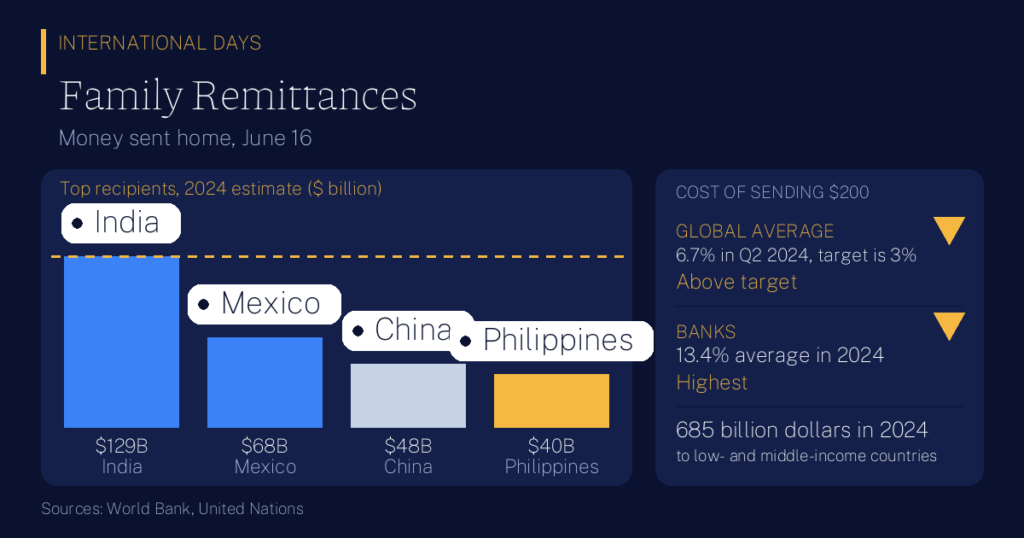
The scale is hard to overstate. The United Nations notes that over the past decade, migrants have sent US$5 trillion in remittances to low- and middle-income countries. The World Bank estimated that remittance flows to those countries would reach $685 billion in 2024, with growth of 5.8 percent that year, up from 1.2 percent in 2023. The Bank also notes that the true total, including money moved through informal channels, is believed to be even larger.
- 200 millionmigrants supporting families back home
- 800 millionfamily members who benefit
- $5 trillionsent to low- and middle-income countries over the past decade
- 1 in 3+More than one-third of these funds reached rural areas
Volume is only half the picture. Measured against the size of the economy, the dependence can be striking. The World Bank estimated that remittances equaled about 45 percent of GDP in Tajikistan, 38 percent in Tonga, 27 percent in Nicaragua, 27 percent in Lebanon and 26 percent in Samoa in 2024. For these countries, money from abroad is not a bonus. It is a pillar of the economy.
The comparison with other flows is also telling. Over the past decade, the World Bank reports, remittances increased by 57 percent while foreign direct investment declined by 41 percent. In 2024 the Bank described remittances to low- and middle-income countries as larger than foreign direct investment and official development assistance combined.
Where the money goes
The United Nations estimates that 75 percent of remittance flows go to meet immediate needs, while the other 25 percent, over $100 billion a year, is available for other purposes. That second slice matters. It is the portion that can pay for schooling, build a small business or serve as savings, and it is where policy attention often focuses.
Example 2: one household’s split. Take the $300 sent each month in Example 1. If it followed the 75 and 25 percent pattern, about $225 would cover immediate needs and about $75 would be left for other purposes. Over a year, that $75 becomes $900, enough to make a difference for school costs or a small business. The figures are illustrative and real households vary widely.
The cost of sending money home
Every transfer has a price, and for people sending small sums, fees bite hard. Sustainable Development Goal target 10.c commits countries to reduce to less than 3 percent the transaction costs of migrant remittances by 2030 and to eliminate corridors with costs higher than 5 percent. The United Nations reports that the global average cost of sending $200 was 6.7 percent in the second quarter of 2024, more than double the target and up from 6.2 percent a year earlier.
The range is wide. Banks averaged 13.4 percent in 2024, up from 12.1 percent in 2023. Mobile operators, at 3.9 percent, came closest to the target, and digital channels as a group averaged 5.3 percent against 7.2 percent for non-digital ones. That gap is why digital access has been a recurring theme of the day.
Example 3: what fees take. Suppose a worker sends $200 every month. At the 6.7 percent global average, the fee is $13.40 each time, so $186.60 arrives. At the 3 percent target, the fee is $6 and $194 arrives. Across twelve months the difference is about $89 per year, kept by one family. The numbers are rounded and illustrative, but multiplied across hundreds of millions of transfers, small percentages become very large sums.
Who is left out, and how the day is marked
Not everyone can use the cheapest channel. People without bank accounts, ID documents, a smartphone or a nearby agent often rely on slower or costlier options. Families in remote rural areas may live far from any place to collect money. That is why financial inclusion has become so central to the conversation, and why the United Nations highlights that over one-third of remittance funds reach rural areas.
On June 16, governments, international bodies and community groups hold events, publish research and share the stories of senders and recipients. Each year brings a theme, and the official materials show how the focus has evolved.
- 2022Recovery and resilience through digital and financial inclusion
- 2024Digital remittances towards financial inclusion
- 2026Remittances for rural resilience and entrepreneurship
The day is also a prompt for ordinary people. If you send money abroad, you can compare providers and fees. If you work in finance, policy or technology, you can ask who still pays too much and why.
Key Takeaways
- Remittances are private family money. They are earned by migrants and sent person to person, not delivered as aid.
- The scale is enormous. The World Bank estimated $685 billion to low- and middle-income countries in 2024.
- Some economies lean on them heavily. In Tajikistan, the estimate for 2024 was about 45 percent of GDP.
- Most of the money meets daily needs. The UN estimates 75 percent goes to immediate needs and over $100 billion a year is available for other purposes.
- Fees remain too high. The global average of 6.7 percent in 2024 is more than double the 3 percent goal.
- Channel choice matters. Banks averaged 13.4 percent while mobile operators averaged 3.9 percent.
- Inclusion is the next step. Cheaper, digital and rural-friendly options help more of each dollar reach its destination.
How solid is this? The 2024 flow figure is a World Bank estimate and the true total, including informal channels, is believed to be larger. The 75 and 25 percent split is a UN estimate with no year given on its source page. Cost figures are for the second quarter of 2024. The three worked examples use round, made-up numbers to show an idea. See also the International Days hub and the International Days Calendar.
More in Society
- United Nations, International Day of Family Remittances: Background
- World Bank, Remittance flows to low- and middle-income countries in 2024 (December 2024)
- United Nations, Sustainable Development Goals Report 2025, Goal 10
- United Nations, International Day of Family Remittances 2024 brochure
- United Nations, International Day of Family Remittances 2026 brochure