Most observances ask us to remember something. Olympic Day asks us to do something. Every June 23, the International Olympic Committee (IOC) invites people everywhere to move, to try a sport, and to learn what the Olympic values look like in ordinary life. You do not need to be an athlete or own special equipment. A brisk walk with a friend counts.
The invitation has a serious purpose. The World Health Organization (WHO) reports that nearly a third of the world’s adults do not get enough physical activity, and the trend is moving the wrong way. Unlike World Toilet Day, which the UN General Assembly created, Olympic Day was created by the sports movement itself. That origin shapes how it works: it is less a ceremony than a worldwide invitation to join in.
Why June 23
The date points back to 1894. On June 23 of that year, at the Sorbonne in Paris, the International Olympic Committee was founded. The IOC describes Olympic Day as a celebration of that founding.
The day itself came later. At the 41st IOC Session in Stockholm in 1947, an IOC member from Czechoslovakia, Dr. Gruss, presented a report on a World Olympic Day. The idea was adopted at the 42nd Session in St. Moritz in January 1948, and the first Olympic Day was celebrated on June 23, 1948. According to the IOC, countries that took part that first year included Portugal, Greece, Austria, Canada, Switzerland, Great Britain, Uruguay, Venezuela and Belgium, and the IOC President of the time sent a message to young people.
What the day actually is
Olympic Day is not a day off, and it is not tied to the Games. It is a flexible, open invitation. The IOC says its National Olympic Committees (NOCs) were invited to pick a date between June 17 and 24 to celebrate, which is why local events can land a few days either side of June 23. The 1978 edition of the Olympic Charter was the first to recommend that every NOC celebrate it. It should not be confused with the International Day of Sport for Development and Peace, which the UN General Assembly proclaimed for April 6.
The best-known tradition is the Olympic Day Run, first launched in 1987. The IOC says it grew from 45 participating NOCs in its first edition to more than 150 today. The IOC’s recent campaigns carry a simple name, “Let’s Move,” launched in 2023 in collaboration with WHO. The 2025 edition, “Let’s Move?”, encouraged everyone to invite a “+1” to get moving, and the 2026 edition carries the message “You Can Do This!”
The numbers behind the day
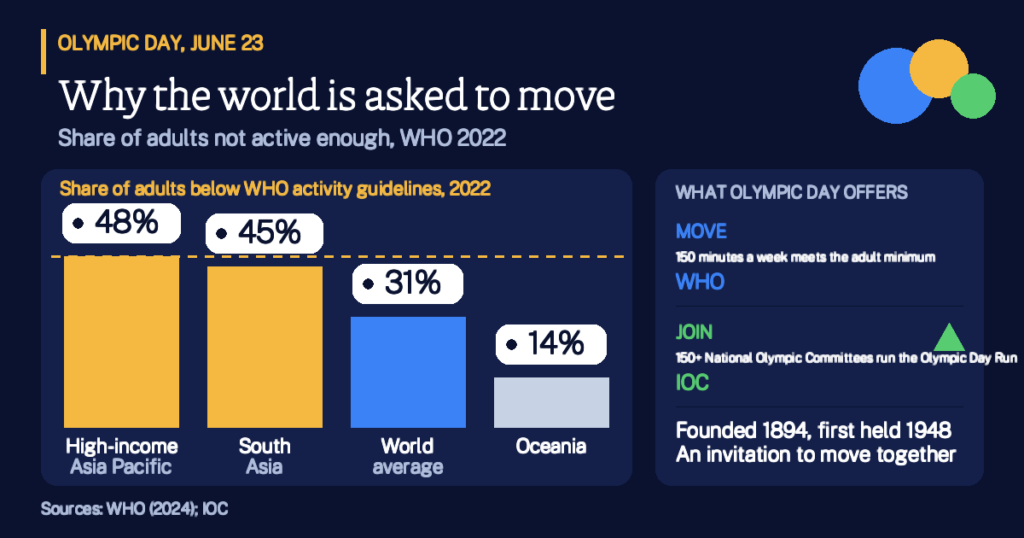
The reason a sports body and a health agency work together is easy to see in WHO’s data. In 2022, nearly one third of adults worldwide, 31 percent or about 1.8 billion people, did not meet the recommended levels of physical activity. That share rose by about 5 percentage points between 2010 and 2022. If the trend continues, WHO projects it will reach 35 percent by 2030, far from the global target of a 15 percent relative reduction in inactivity by 2030 compared with 2010 levels.
The standard is modest. WHO advises adults to do at least 150 minutes of moderate-intensity activity a week, or 75 minutes of vigorous activity, or an equivalent mix. For children and adolescents, WHO defines an active day as at least 60 minutes of moderate to vigorous activity.
- 31%of adults did not meet activity guidelines, 2022 (WHO)
- 1.8 billionadults affected in 2022
- 35%projected inactivity rate by 2030 if trends continue
- 20 to 30%higher risk of death for insufficiently active people (WHO)
Example 1: the 150-minute week. Suppose an adult walks briskly for 30 minutes on five days. That adds up to 150 minutes, enough to meet WHO’s minimum. These numbers are round and illustrative, but they show how small the daily commitment is compared with the benefit.
Why it matters
Inactivity is not just a personal habit. WHO describes it as one of the leading risk factors for death from noncommunicable diseases, and says people who are insufficiently active face a 20 to 30 percent higher risk of death than those who are active. WHO also projects that inactivity will add nearly US$300 billion in health costs between 2020 and 2030, about US$27 billion a year.
This is where a day built around fun does real work. Campaigns that make activity social, free and easy to start, such as inviting a “+1,” lower the barrier that stops many people at the front door. Olympic Day cannot build a sidewalk or a park, but it can nudge a school, a workplace or a neighborhood to try.
Who is left behind
Inactivity is not spread evenly. WHO’s 2022 data show that 34 percent of women were insufficiently active compared with 29 percent of men. Regional gaps are wide: 48 percent in high-income Asia Pacific and 45 percent in South Asia, against 28 percent in high-income Western countries and 14 percent in Oceania.
Young people face a similar challenge. WHO’s fact sheet reports that one in four adolescents aged 11 to 17 reported no active days, about 240 million, with 28 percent of girls against 22 percent of boys. It also reports that 86 percent had fewer than seven active days. Habits formed in these years tend to shape adult life, which is why schools sit at the heart of Olympic Day programs.
Example 2: one school. Imagine a school of 400 students. If the WHO adolescent figure of 86 percent applied exactly, about 344 of them would fall short of a full week of active days. The figures are round and illustrative, but they show why an event that gets a whole school moving on one day can matter.
How the day is marked
Because the IOC leaves the format open, celebrations vary widely. In 2025, the IOC reported that over 150 NOCs, international sports federations, Games organizing committees and Worldwide Olympic Partners joined in, with more than 35,000 social media posts about the day. A walking challenge run with a Worldwide Olympic Partner drew over 350,000 people, and the Los Angeles 2028 organizers engaged 3,200 young athletes at nearly 70 sites in Los Angeles County. These are the IOC’s own figures, reported by the organizers.
Ideas for your own day are easy. Join a local run or school event, try a sport you have never played, invite a friend, a parent or a coworker, or simply add a 20-minute walk to your calendar. Learning counts too: the Olympic values include respect, friendship and excellence, and many events pair play with a short lesson on them.
Example 3: a town sets a goal. Picture a town of 100,000 adults where 31 percent are inactive, or 31,000 people. If the town cut that rate by 15 percent in relative terms, about 4,650 fewer adults would be inactive, leaving roughly 26,350. These numbers are made up for illustration, and the real WHO target is measured against 2010 levels, but the arithmetic shows what a 15 percent cut means in practice.
Key Takeaways
- June 23 marks a founding. It honors the creation of the IOC at the Sorbonne in Paris in 1894.
- The day is young but sturdy. It was adopted in January 1948 and first celebrated that June.
- It is an invitation, not a ceremony. NOCs choose their own dates and formats, and more than 150 now join the Olympic Day Run.
- The health case is strong. About 31 percent of adults, 1.8 billion people, were not active enough in 2022.
- The bar is low. Adults need 150 minutes of moderate activity a week, such as 30 minutes of brisk walking on five days.
- Gaps are real. Women, adolescents and several regions are less likely to meet the guidelines.
- Start small. Invite one person, move for 20 minutes and let the habit grow from there.
How solid is this? Inactivity figures are modeled WHO estimates for 2022 and may be revised, and the adolescent figures come from WHO’s 2026 fact sheet. Participation counts for 2025 are the IOC’s own reports. The three worked examples use round, made-up numbers. See also the International Days hub and the International Days Calendar.
More in Health
- IOC, Olympic Day
- IOC, Olympic Day 2025 unites millions in global celebration of sport and community (July 3, 2025)
- WHO, Nearly 1.8 billion adults at risk of disease from not doing enough physical activity (June 26, 2024)
- WHO, Physical activity fact sheet
- United Nations, General Assembly proclaims 6 April International Day of Sport for Development and Peace (2013)