Torture is one of the few acts the world has agreed to ban without exception. It is also one of the hardest to see, because it usually happens behind closed doors, far from cameras, and survivors often carry the damage in silence for years. The United Nations International Day in Support of Victims of Torture, observed every June 26, exists to turn attention toward those survivors and their families, and to remind governments of a promise they have already made. This article is a plain guide to what the day marks, what the law says, and what helps. It is written with care, and it avoids graphic detail.
From a 1984 treaty to a 1997 day
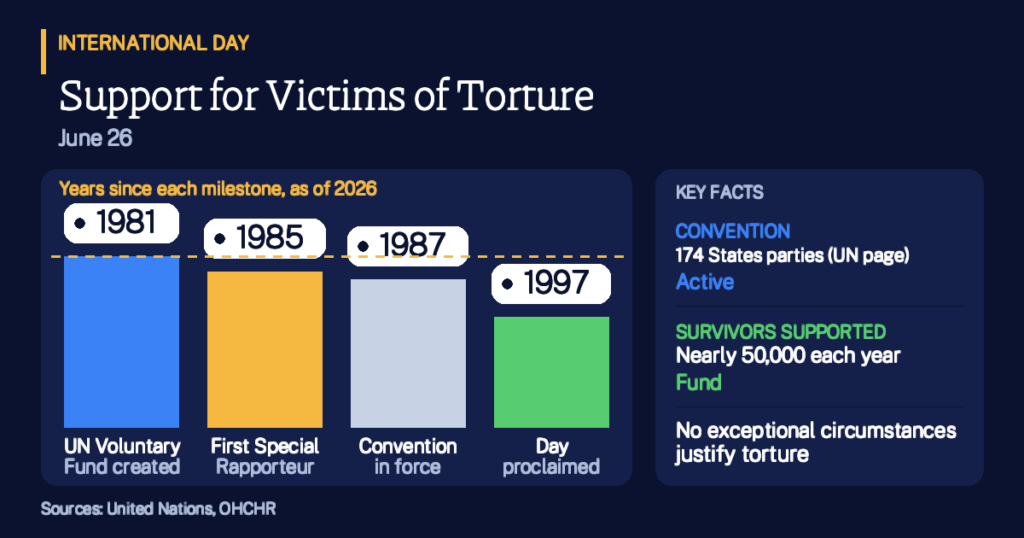
The day rests on a treaty. The Convention against Torture and Other Cruel, Inhuman or Degrading Treatment or Punishment was adopted by the General Assembly in 1984 and came into force in 1987. On December 12, 1997, the General Assembly adopted resolution 52/149 and proclaimed June 26 as the United Nations International Day in Support of Victims of Torture. The date was chosen deliberately: according to the UN, it marks the moment in 1987 when the Convention took effect.
Other pieces of the system are older still. The UN Voluntary Fund for Victims of Torture was established by the General Assembly in 1981 to fund organizations that assist victims and their families. In 1985 the Commission on Human Rights appointed the first Special Rapporteur on torture, an independent expert who reports on the situation of torture in the world. The day therefore stands on more than four decades of work.
What the Convention means by torture
The word is often used loosely, but the Convention defines it with care. In Article 1, torture means an act that causes severe pain or suffering, physical or mental, and that meets several conditions at once. It must be intentional. It must serve a purpose, such as obtaining information or a confession, punishing, intimidating or coercing a person, or discriminating against them. And it must be carried out by a public official or with that official’s consent or acquiescence. Pain that arises only from lawful sanctions is not covered by the definition.
That last condition explains why torture is treated as a special wrong. It is not an ordinary crime between private persons. It is the misuse of state power over someone who cannot defend themselves, most often a person in detention. Acts that fall short of the definition but are still cruel, inhuman or degrading are covered by separate obligations in the same treaty.
Example 1: why the definition matters. Imagine, for illustration only, that a detainee is questioned for days to force a signed statement. Every element is present: severe suffering, intent, a purpose, and an official behind it. Now imagine a fight between two private individuals. It may be a crime, but it is handled by ordinary criminal law, not by the Convention. The definition tells investigators and courts which framework applies.
No exceptions, and no use of the results
The Convention is unusually firm. Article 2 says that no exceptional circumstances whatsoever, whether a state of war, a threat of war, internal political instability or any other public emergency, may be invoked as a justification for torture. Orders from a superior are no defense either. The treaty also bars sending a person to a country where there are substantial grounds for believing they would be in danger of torture, and it says a statement obtained through torture may not be used as evidence in any proceeding, except against the person accused of the torture.
These rules matter because the temptation to make exceptions is strongest in moments of fear. The Convention was written to close that door in advance.
The numbers we can verify
Torture is hidden by nature, so no one can give a reliable worldwide count of how many people suffer it. What can be verified is how the system responds. The UN observance page reports that 174 states are parties to the Convention, a date-stamped count that changes as countries join. It also reports that the Voluntary Fund supports nearly 50,000 torture survivors each year, through hundreds of grants to civil society organizations worldwide.
- 174States parties to the Convention, per the UN observance page
- Nearly 50,000survivors supported each year through the Voluntary Fund
- 1981year the Voluntary Fund was established
- 1997year the General Assembly proclaimed the Day
Preventing torture and documenting it
A ban on paper is not enough, so the system adds ways to look and to record. The Committee against Torture reviews how countries are keeping their promises. An Optional Protocol to the Convention, adopted in 2002, created a Subcommittee on Prevention of Torture and asks states to set up national bodies that can visit places of detention before abuse occurs. The idea is simple: open doors protect people.
Documentation matters just as much. The Istanbul Protocol, a manual for the investigation and documentation of torture, was revised in 2022. It guides doctors, lawyers and judges in recording evidence so that survivors are believed and cases can be proven.
Example 2: why a good record protects a survivor. Picture a doctor who, following a recognized protocol, carefully notes a patient’s injuries, the patient’s account and how the two fit together. Years later that record may be the difference between a claim being dismissed and a case moving forward. The scenario is illustrative, but it shows why training health workers is a form of prevention.
Healing and how the day is marked
Survivors may live with physical injuries, lasting fear, sleep problems, and difficulty trusting others. Families are affected too. The Convention recognizes a right to redress, including the means for as full a rehabilitation as possible, and that is why the Voluntary Fund exists. It pays for services such as medical care, psychological support, legal aid and social help, delivered by organizations close to the people who need them.
Example 3: what a small grant can do. Suppose, with round illustrative numbers, a local center receives $100,000 for a year and uses it to support 200 survivors. That is about $500 per person for counseling, medical visits and legal advice. Real costs vary widely by country and by need, but the arithmetic shows why many modest grants, spread across communities, can reach tens of thousands of people.
On June 26, UN offices, human rights bodies, civil society groups and survivor-led organizations hold events, publish statements and call on governments to join the Convention and its Optional Protocol. If you or someone you know has survived torture, trusted health services, specialized rehabilitation centers and local human rights organizations can help, and many offer confidential support.
Key Takeaways
- The day marks a treaty. June 26 recalls the 1987 entry into force of the Convention against Torture, and the General Assembly proclaimed the day in 1997.
- Torture has a precise definition. Severe suffering, intent, a purpose and an official link must all be present.
- There are no exceptions. War, emergency or orders from a superior cannot justify it under the Convention.
- Evidence from torture cannot be used. Statements obtained this way are barred from proceedings, except against the person accused.
- Open doors protect people. Independent visits to places of detention and careful documentation help prevent abuse.
- Healing is a right. The Voluntary Fund, founded in 1981, supports nearly 50,000 survivors each year.
- Silence helps abusers. Speaking up for survivors, and asking your government to uphold the Convention, keeps the promise alive.
How solid is this? Dates and the count of 174 States parties come from the UN observance page, and the count changes whenever a state joins. The figure of nearly 50,000 survivors supported each year is the UN’s own description of the Voluntary Fund. Legal points summarize the text of the Convention and the Optional Protocol. No reliable global count of torture cases exists, so none is given here. The three worked examples use round, made-up numbers to show an idea. See also the International Days hub and the International Days Calendar, and compare World Toilet Day for another observance rooted in human dignity.
More in Society
- United Nations, International Day in Support of Victims of Torture
- OHCHR, Convention against Torture and Other Cruel, Inhuman or Degrading Treatment or Punishment
- OHCHR, UN Voluntary Fund for Victims of Torture, International Day
- OHCHR, Special Rapporteur on torture
- United Nations Treaty Collection, Optional Protocol to the Convention against Torture
- OHCHR, Istanbul Protocol (revised edition, 2022)