Most anniversaries look back at something that ended. This one looks back at something that shaped the modern world and still echoes in it. Every August 23, the International Day for the Remembrance of the Slave Trade and its Abolition asks people everywhere to remember the millions who were enslaved, to honor the people who resisted, and to understand how that history connects to the present. It is a day for learning as much as for mourning, and it invites a simple question: what do we owe to the truth?
A night in Saint-Domingue
The date was chosen for a specific event. On the night of August 22 to 23, 1791, men and women who had been torn from Africa and sold into slavery revolted against the slave system in Saint-Domingue, the colony that is today Haiti. UNESCO describes that uprising as the beginning of a movement that played a crucial role in the abolition of the transatlantic slave trade. The Haitian Revolution that followed, the UN notes, produced the world’s first Black freedom state.
Remembrance became an official observance in the 1990s. UNESCO’s General Conference adopted resolution 29 C/40 at its 29th session in 1997, naming August 23 as the International Day for the Remembrance of the Slave Trade and its Abolition. The day was first celebrated in a number of countries, in particular in Haiti on August 23, 1998, and on Gorée Island in Senegal on August 23, 1999.
A project to recover the story
The day grew from a larger effort. UNESCO launched the Slave Route Project in August 1994 in Ouidah, in present-day Benin, which was once the Kingdom of Dahomey. UNESCO today presents the work under the name Routes of Enslaved Peoples, and it has marked three decades of research, education and the preservation of sites of memory. The aim is not only to count the past but to explain how it formed the societies, economies and cultures that people live in now.
The scale of the trade
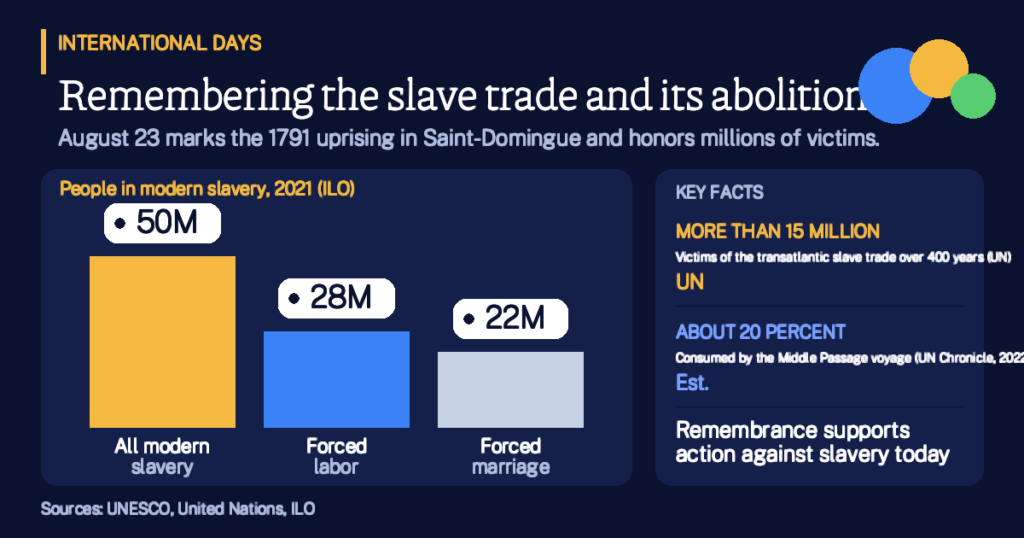
The numbers are hard to hold in the mind, and historians give ranges because records are incomplete. The United Nations says that for over 400 years, more than 15 million men, women and children were the victims of the transatlantic slave trade. A UN Chronicle article from 2022 puts the number enslaved in the western hemisphere after an Atlantic voyage at some 12 to 20 million. That voyage, known as the Middle Passage, lasted 6 to 10 weeks, and the same article reports that it consumed some 20 percent of its human cargo. About 40 percent of enslaved Africans, it adds, were shipped to the Caribbean islands.
Example 1: reading a ratio. Suppose a ship carried 500 people. If about 20 percent did not survive the crossing, that would be about 100 people lost on one voyage alone. The numbers are round and illustrative, but they show why the percentage matters: small shares, repeated across centuries of voyages, add up to a human toll that no single figure can express.
Two days, one memory
August 23 is not the only day of remembrance. In resolution 62/122 of December 17, 2007, the UN General Assembly declared March 25 the International Day of Remembrance of the Victims of Slavery and the Transatlantic Slave Trade. At United Nations Headquarters in New York, a permanent memorial called the Ark of Return honors those victims. The two days complement each other: March 25 centers on the victims, while August 23 centers on remembrance of the trade and the long struggle to end it. Another observance, covered in our article on the International Day for the Abolition of Slavery, looks at the fight against slavery in its present forms.
Why the past is not finished
Abolition did not erase forced exploitation. The International Labour Organization estimated that 50 million people were living in modern slavery in 2021. Of these, 28 million were in forced labor and 22 million were trapped in forced marriage. That was 10 million more than in the 2016 estimates, and forced marriage alone rose by 6.6 million. These figures are modeled estimates, and the ILO notes they describe a situation on any given day. The legal tool most associated with this fight is the ILO Forced Labour Convention of 1930, known as No. 29.
Example 2: the split. Take the ILO’s 50 million as 100 for ease of thinking. About 56 of every 100 people were in forced labor and about 44 were in forced marriage. The shares are simple arithmetic on the reported totals, and they show that the problem is not one thing but several, each needing its own response.
Anyone who believes a person is being held or exploited against their will can contact local authorities or a national anti-trafficking hotline. Our piece on the World Day against Trafficking in Persons explains the wider picture.
Memory in the Caribbean and beyond
The Caribbean holds a special place in this story. The UN Chronicle recalls that the region received about 40 percent of enslaved Africans, that colonial laws such as the Barbados Slave Code, passed in 1661, wrote slavery into law, and that the same region gave rise to the Haitian Revolution. Memory work today includes archives, museums, sites of memory and school lessons that trace how slavery shaped trade, language, food, music and law on several continents. UNESCO also points to the Second International Decade for People of African Descent, which runs from 2025 to 2034, as a framework for recognition, justice and development.
Example 3: a classroom project. Imagine a class of 30 students split into three groups of 10. One group maps a trade route, one researches a local site or archive, and one reads a firsthand account. When each group shares its findings, the class has covered the geography, the evidence and the human voices in a single lesson. The class and numbers are illustrative, but the approach mirrors how remembrance turns into understanding.
How the day is marked
Observance takes many forms: ceremonies at sites of memory, lectures, exhibitions, film screenings, school lessons and public statements from UNESCO and governments. The tone is usually solemn, and the emphasis is on dignity, resistance and learning. For individuals, the most useful gesture may be modest: read one reliable account, visit a local museum, or ask how your own community’s history connects to the story.
Key Takeaways
- The date marks a revolt. The night of August 22 to 23, 1791 in Saint-Domingue began an uprising that UNESCO says played a crucial role in abolition.
- It is a UNESCO day. Resolution 29 C/40 of 1997 created it, and Haiti and Gorée Island hosted the first observances in 1998 and 1999.
- The scale is vast. The UN speaks of more than 15 million victims over 400 years, and historians use ranges because records are incomplete.
- The crossing itself was deadly. The Middle Passage lasted 6 to 10 weeks and consumed some 20 percent of its human cargo, according to the UN Chronicle.
- There are two remembrance days. March 25 honors the victims, and August 23 remembers the trade and its abolition.
- Exploitation persists. The ILO estimated 50 million people in modern slavery in 2021, so remembering the past supports action today.
How solid is this? The scale of the trade is given as ranges because historical records are incomplete, and the Middle Passage share is a UN Chronicle estimate. The modern slavery figures are modeled ILO estimates for 2021. The three worked examples use round, made-up numbers to show an idea. See also the International Days hub and the International Days Calendar.
More in History
- UNESCO. International Day for the Remembrance of the Slave Trade and its Abolition.
- United Nations. Slave Trade, Decade for People of African Descent.
- UN Digital Library. Note transmitting UNESCO resolution 29 C/40, International Day for the Remembrance of the Slave Trade and its Abolition.
- UN Chronicle. The Legacy of Slavery in the Caribbean and the Journey Towards Justice (2022).
- UNESCO. The Routes of Enslaved Peoples: 30 Years of Dedicated Work for Peace.
- International Labour Organization. 50 million people worldwide in modern slavery (2022).
- UN General Assembly. Resolution 62/122 (December 17, 2007).