Most observances ask people to learn something. International Overdose Awareness Day, held every August 31, asks for something older and simpler: to remember. It is a day to mourn people who died from an overdose, to support the families who carry that loss, and to say plainly that many of these deaths can be prevented. It is a community campaign rather than a day created by a United Nations resolution, which is why this guide files it under awareness days. Its message still lines up with the work of health agencies worldwide, and it sits close to the wider conversation covered in the International Day against Drug Abuse and Illicit Trafficking.
From a barbecue in Melbourne
The day began small. According to the campaign’s own history, the first International Overdose Awareness Day, in 2001, was a remembrance barbecue at The Salvation Army needle exchange in Melbourne, Australia. The date was chosen with care. The campaign explains that August 31 is the last day of winter in Australia, a moment for remembrance and reflection, and that it signals the beginning of spring, a season that stands for hope and new beginnings.
The idea spread from there. Penington Institute, an Australian non-profit committed to freedom from serious drug harms, has led the campaign since 2012. The campaign says that more than 1,000 events in over 40 countries now join in every year. In 2026 it reaches its 25th anniversary under the theme “25 Years On. Still Needed.” The theme carries a quiet admission: a day built to remember would ideally become unnecessary, and it has not. The organizers also state, as one of their principles, that criminalizing drug use has not worked and that compassionate alternatives must be pursued. That is the campaign’s position, and governments take a range of approaches.
What an overdose is, and what can be done in minutes
An overdose happens when a person takes more of a substance than the body can handle. Opioids are the group most often linked to fatal cases. WHO says an opioid overdose can be identified by a combination of three signs: pinpoint pupils, unconsciousness and difficulties with breathing. The breathing problem is the danger, which is why WHO tells first responders to focus on airway management, assisting ventilation and administering naloxone.
Naloxone is an antidote that reverses the effects of an opioid overdose if given in time, and WHO notes it has virtually no effect in people who have not taken opioids. WHO says death after an opioid overdose is preventable if the person receives basic life support and timely naloxone. It recommends that naloxone be made available to people likely to witness an overdose, along with training. Access is still often limited to health professionals, though WHO names Australia, Canada, Italy, the United Kingdom and Ukraine as countries that have made it available over the counter.
Example 1: the first five minutes. Imagine a person is found unresponsive at a gathering, with slow breathing and tiny pupils. A friend who has taken a short training course calls emergency services, tilts the person’s head to open the airway and gives naloxone from a kit kept at home. The numbers here are not data, only a picture: a few minutes decide the outcome, and the people nearby are the first responders. That is exactly why WHO links naloxone access to training.
The numbers behind the day
WHO estimated in 2026 that 316 million people worldwide used drugs in 2023, including around 61 million who used opioids non-medically. About 64 million people live with drug use disorders. Deaths are harder to count across the world. WHO’s fact sheet estimates that about 600,000 deaths were attributable to drug use in 2019, close to 80 percent of them related to opioids, and that approximately 125,000 people died of opioid overdose that year. These are modeled estimates, so read them as a sense of scale rather than an exact count.
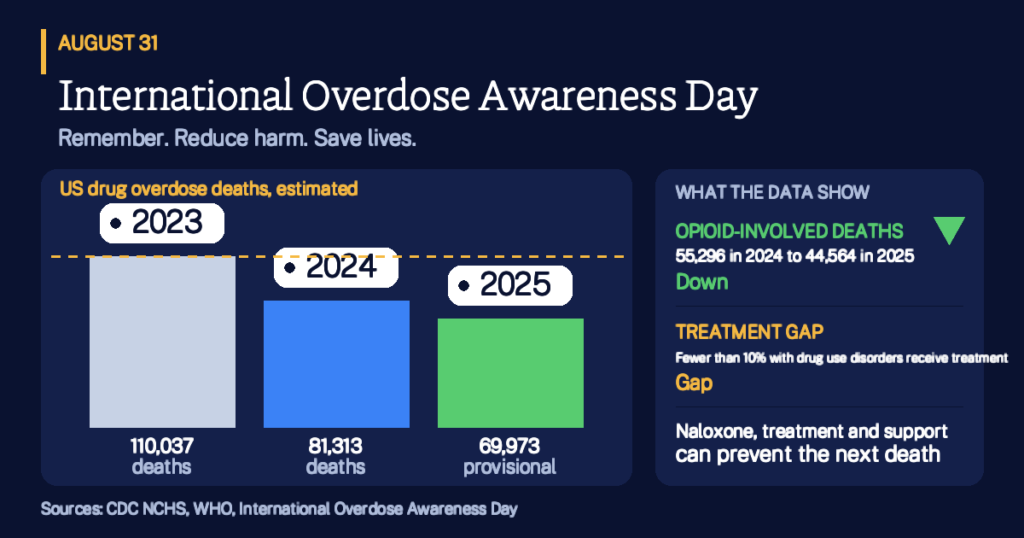
The United States offers the most closely watched recent trend. CDC estimates put drug overdose deaths at 110,037 in 2023, 81,313 in 2024 and 69,973 in 2025, the last still provisional. The 2025 figure is a decrease of almost 14 percent from 2024. Opioid-involved deaths fell from an estimated 55,296 in 2024 to 44,564 in 2025. The CDC cautions that the 2025 numbers are incomplete and subject to change. Even after three years of decline, each of those counts is a set of individual lives and a set of grieving families.
- 316 millionpeople used drugs worldwide in 2023
- 64 millionpeople live with drug use disorders
- Under 10%of those with disorders get treatment
- 69,973US overdose deaths in 2025, provisional
The treatment gap
Remembering is only part of the purpose. WHO says fewer than 10 percent of people living with drug use disorders currently receive treatment. In April 2026 it reaffirmed its recommendation for opioid agonist maintenance treatment with methadone and oral buprenorphine, and extended its guidance to include new long-acting injectable buprenorphine formulations as a conditional recommendation. It said the full guidelines are expected later in 2026 or in early 2027.
Example 2: the waiting line. Picture a town where 1,000 people live with a drug use disorder. If fewer than 10 percent receive treatment, fewer than 100 are in care and more than 900 are not. The numbers are round and illustrative, but they show how large the gap can be when the share is so low, and why expanding access is as urgent as the awareness itself.
Who is affected, and what protects them
Overdose is not confined to one group. The campaign says it continues to affect every community. The loss also reaches far beyond one person, to parents, partners, children, friends and coworkers, which is why the day gives equal weight to those left behind. Prevention works at several points at once: treatment that people can reach, naloxone in the hands of people who witness overdoses, and training so that bystanders know what to do.
WHO cites a 2019 to 2020 study in Kazakhstan, Kyrgyzstan, Tajikistan and Ukraine in which about 40,000 naloxone kits were distributed and more than 14,000 people were trained. Around 90 percent of participants who witnessed an overdose reported using naloxone. It is a small program, but it shows that ordinary people can act when they are given the tools.
Example 3: a community kit program. Suppose a city hands out 2,000 naloxone kits and trains 500 residents. If just 5 percent of the kits are ever used, that is 100 emergencies in which someone was ready. The numbers are made up to show the logic: kits that sit unused are still a sign of preparation, and a single use can mean a life saved.
How the day is marked
The campaign invites communities to hold remembrance events and to light landmarks purple, its signature color. Its event listings include gatherings in places as varied as St Kilda, Cincinnati and Port Angeles. Many people simply spend the day telling a name aloud, sharing a memory, or learning how to use naloxone.
If you are with someone you think is overdosing, call your local emergency number right away, stay with them and follow the dispatcher’s instructions. If you or someone you know needs support with substance use, a local health service, doctor or national helpline can connect you with care.
Key Takeaways
- The day began with remembrance. A 2001 barbecue at a Melbourne needle exchange grew into a campaign in more than 40 countries.
- The date carries meaning. August 31 marks the end of winter in Australia and the start of spring, a symbol of hope.
- Overdose deaths are preventable. WHO says basic life support and timely naloxone can prevent death after an opioid overdose.
- Know the three signs. Pinpoint pupils, unconsciousness and difficulty breathing call for emergency help.
- The scale is vast. WHO estimates 316 million people used drugs in 2023, and 64 million live with drug use disorders.
- Treatment is out of reach for most. Fewer than 10 percent of people with drug use disorders currently receive it.
- Declines are real but fragile. US estimates fell from 110,037 deaths in 2023 to a provisional 69,973 in 2025, and every count is a person.
How solid is this? Global use and treatment figures are WHO estimates and the 2019 death figures are modeled. US counts are CDC provisional estimates, and the 2024 total was revised from 80,391 in the 2025 release to 81,313 in the 2026 release. The three worked examples use round, made-up numbers to show an idea. See also the International Days hub and the International Days Calendar.
More in Health
- International Overdose Awareness Day. About the campaign.
- International Overdose Awareness Day. Frequently asked questions.
- World Health Organization. Opioid overdose fact sheet (29 August 2025).
- World Health Organization. WHO updates guidelines on opioid dependence treatment and overdose prevention (2 April 2026).
- CDC National Center for Health Statistics. U.S. Overdose Deaths Decrease for Third Consecutive Year in 2025 (13 May 2026).
- CDC National Center for Health Statistics. U.S. Overdose Deaths Decrease Almost 27% in 2024 (14 May 2025).