Millions of people trace their roots to Africa while living in the Americas, Europe, Asia and elsewhere, often as the descendants of people carried across oceans against their will. For centuries their histories were left out of textbooks, their contributions went unpaid or uncredited, and their descendants met barriers that were built long before they were born. The International Day for People of African Descent, observed every August 31, asks the world to look at that record plainly and to act on it. It is a companion to the International Day of Remembrance of the Victims of Slavery and the Transatlantic Slave Trade, which looks backward, while this day looks at what is owed in the present.
How the day came to exist
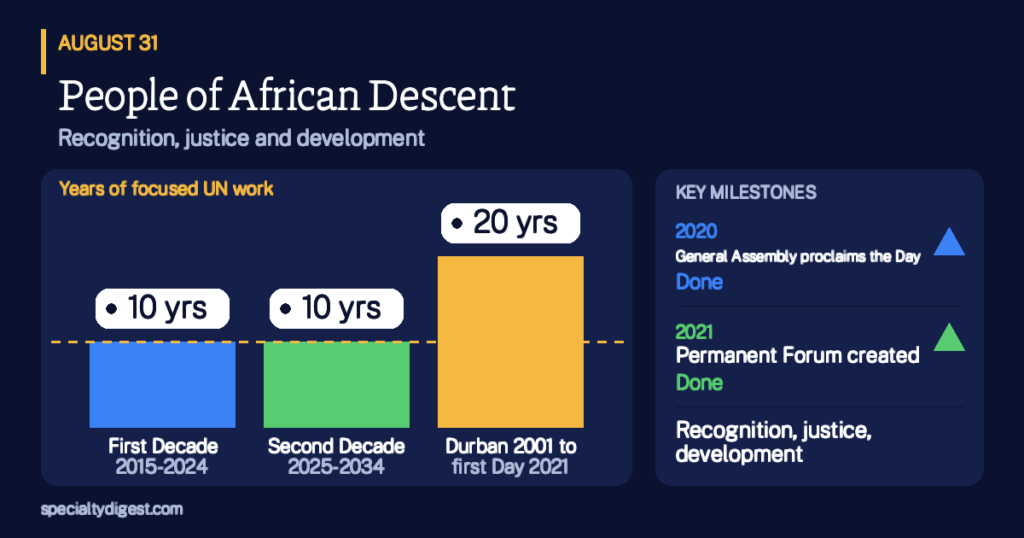
The day is the product of a long diplomatic road. In 2001, governments met in Durban, South Africa, for the UN World Conference against Racism, Racial Discrimination, Xenophobia and Related Intolerance. That meeting put the situation of people of African descent firmly on the international agenda. A UN expert body, the Working Group of Experts on People of African Descent, followed to study the problem and advise governments.
The next milestone was the International Decade for People of African Descent, which ran from 2015 to 2024 under the headline themes of recognition, justice and development. Then, in 2020, the General Assembly adopted a decision, reported in a UN press release on its Third Committee resolutions, to proclaim August 31 as the International Day for People of African Descent. The first observance came on August 31, 2021, and the Secretary-General marked it with a message calling for sustained, daily action at every level to redress historical wrongs.
Who counts as a person of African descent
The term is broad on purpose. It covers people whose ancestors came from Africa, whether they descend from those enslaved in the transatlantic trade or arrived more recently as migrants, students or refugees. In Latin America many use the word Afrodescendant, in the Caribbean and the United States other terms are common, and in Europe the language varies by country. The UN does not draw a narrow line. What unites the group, in the words of UN human rights bodies, is a shared experience of racial discrimination linked to a history of slavery, colonialism and exclusion, together with a rich cultural inheritance that has shaped music, food, language, science and politics around the world.
Example 1: the same city, two outcomes. Imagine a city of 100,000 people in which one in five residents is of African descent. If those residents hold only a few of every hundred senior jobs, hold fewer loans and live on streets with fewer clinics, the numbers show a pattern no single person chose. The figures here are round and illustrative, but this is the kind of gap that official statistics are meant to reveal, and it is why the UN keeps urging countries to collect data broken down by race and ethnicity.
The three words behind the Decade
The International Decade for People of African Descent was built on three ideas. Recognition means acknowledging the history and the present reality, including the role of people of African descent in building nations. Justice means equal protection under law and remedies for wrongs, including discrimination in policing, courts and public services. Development means a fair chance at education, health care, work and income. These three words continued into the Second International Decade for People of African Descent, which covers 2025 to 2034 and carries the same call for recognition, justice and development into a further ten years of work.
The bodies that carry the work
Several UN bodies keep the issue alive between each August 31. The General Assembly proclaims the day and the decades. The Working Group of Experts on People of African Descent studies conditions around the world and visits countries at their invitation. In 2021 the General Assembly also created the Permanent Forum on People of African Descent, a standing platform where people of African descent, governments and experts can meet. The President of the Human Rights Council appointed its members in 2022, and the Forum held its first session that year. The idea behind it is simple: decisions about a community work better when that community helps make them.
Example 2: why a seat at the table matters. Suppose a town plans a highway and holds one hearing, announced only in a newspaper few residents read. A neighborhood of 5,000 people, mostly of African descent, learns of the plan after the route is chosen. If a standing advisory council had existed, the route might have changed. The numbers are made up for illustration, but the point is real: standing voice prevents harm earlier and more cheaply than a remedy afterward.
Why the day still matters
Racism is not only a matter of history or of individual prejudice. UN human rights bodies speak of structural discrimination, meaning rules, habits and systems that produce unequal results even when no one intends harm. The Secretary-General’s messages on the day have called for action against it at every level, from schools and hospitals to courts and police forces, and have asked countries to confront the legacy of slavery and colonialism honestly. The day also invites celebration. People of African descent have shaped science, literature, sport, music and law in every region, and the UN presents their contributions as part of the common heritage of humanity, not as a footnote.
Example 3: counting what counts. A school district of 20,000 students finds that students of African descent are 20 percent of enrollment but 40 percent of suspensions. Without data by group, no one would notice. With it, the district can review its rules and training. These percentages are illustrative, not real, yet they show why recognition begins with honest data.
How the day is marked
Observances take many forms: UN meetings and statements, school lessons on African and diaspora history, museum exhibitions, concerts, community dialogues and book readings. Governments are encouraged to review their laws and policies against the goals of the Decade, and individuals can start closer to home by learning local history, supporting businesses and artists from the community, and speaking up when they see discrimination. Anyone who experiences racial discrimination can usually seek help from a national human rights institution, an equality body or a legal aid service in their country.
Key Takeaways
- The day was proclaimed in 2020. The General Assembly set August 31 as the International Day for People of African Descent, first observed in 2021.
- It builds on a decade of work. The International Decade ran from 2015 to 2024, and a Second Decade covers 2025 to 2034.
- Three words guide the effort. Recognition, justice and development describe what the UN asks of governments.
- The community has a standing voice. The Permanent Forum on People of African Descent was created in 2021 and began meeting in 2022.
- Data makes inequality visible. Figures broken down by race and ethnicity show gaps that would otherwise stay hidden.
- History and the present are linked. Slavery and colonialism left effects that structural discrimination can carry forward.
- The day is also a celebration. People of African descent have shaped cultures and knowledge in every region.
How solid is this? Dates and institutions in this article come from United Nations and OHCHR pages and press releases; it deliberately omits population and poverty statistics that could not be verified for this edition. The three worked examples use round, made-up numbers to show an idea. See also the International Days hub and the International Days Calendar.
More in Society
- United Nations. International Day for People of African Descent.
- UN General Assembly. General Assembly adopts 48 Third Committee resolutions, proclaims International Day for People of African Descent (2020).
- UN News. UN marks first International Day for People of African Descent (2021).
- United Nations. Secretary-General message on the International Day for People of African Descent (2021).
- UN News. General Assembly creates new Permanent Forum of People of African Descent (2021).
- OHCHR. International Decade for People of African Descent 2015-2024.
- OHCHR. Second International Decade for People of African Descent 2025-2034.