Every heart attack is, at its core, a plumbing emergency. An artery that feeds the heart muscle becomes blocked, and the clock starts. What happens in the next hours decides how much of the muscle survives. Over the past decades, a branch of medicine has learned to reach the blocked artery through a thin tube, often without open surgery. That field is interventional cardiology, and the International Day for Interventional Cardiology, observed every September 16, asks the world to understand it, and to understand the disease that makes it necessary.
How the day came to be
In September 2022, the United Nations General Assembly decided to proclaim September 16 as the International Day for Interventional Cardiology, in resolution A/RES/76/302. The text invites everyone concerned to observe the day every year in an appropriate manner and in line with national priorities. Its stated aim is to raise public awareness of cardiovascular diseases and procedures, of their complications, and of prevention and care, including through education and the mass media.
The date has a story. According to the UN, the first coronary angioplasty was performed by Dr. Andreas Grüntzig on September 16, 1977. That single procedure opened a new way of treating heart disease, and the day marks its anniversary. Note what the resolution does and does not do: it creates no new treaty or funding, only a yearly moment of public attention, which is how most UN days work.
What “interventional” means
Cardiology is the care of the heart. Interventional cardiology is the part that treats heart and blood vessel problems with catheter-based procedures: a long, thin tube is guided through a blood vessel to the heart, where doctors can look at the arteries and repair what they find. Angioplasty, the procedure behind the date, is the best-known example. The goal in a heart attack is simple to say and hard to achieve: get blood flowing again, quickly.
Example 1: the race against time. Imagine two patients with the same blockage. One lives ten minutes from a catheter team and the other three hours away. The round numbers are illustrative, but the principle is real: WHO says early recognition of symptoms and emergency care substantially improve survival. Distance, transport and awareness shape who gets care in time.
The numbers behind the day
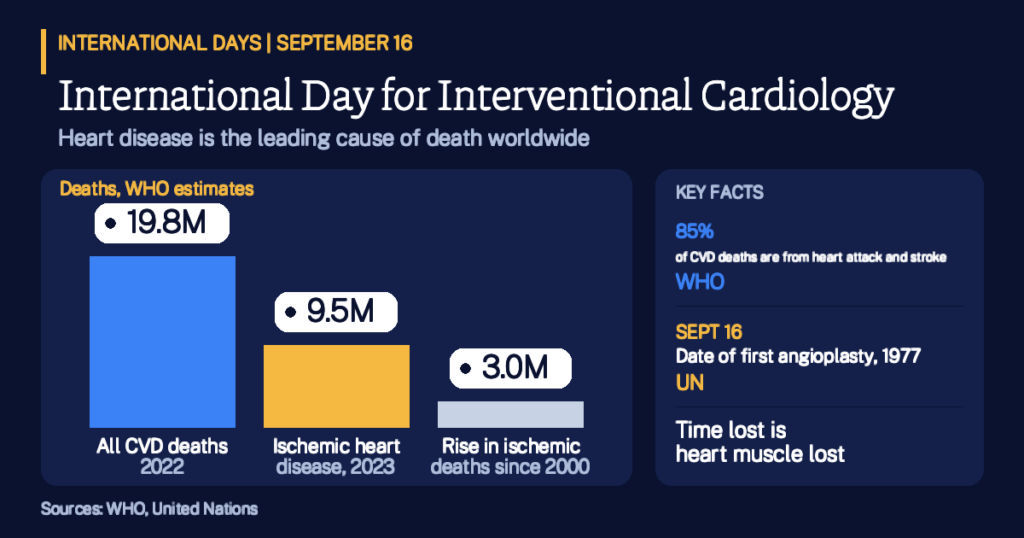
Cardiovascular diseases, or CVDs, are the leading cause of death worldwide. WHO estimates that 19.8 million people died from CVDs in 2022, about 32 percent of all global deaths. Of those deaths, 85 percent were due to heart attack and stroke. Ischemic heart disease, the condition behind most heart attacks, was the world’s biggest killer in WHO’s latest top 10 list: 9.5 million deaths in 2023, 16 percent of 61 million deaths worldwide, 3.0 million more than in 2000.
- 19.8 millionCVD deaths worldwide, 2022
- 9.5 milliondeaths from ischemic heart disease, 2023
- 16%of all deaths worldwide were ischemic heart disease, 2023
- 1977year of the first coronary angioplasty
Who is most affected
Heart disease is not only a rich-country problem. WHO reports that over three quarters of CVD deaths take place in low- and middle-income countries. It also reports that, of 18 million premature deaths from noncommunicable diseases in 2021 (deaths before age 70), at least 38 percent were caused by CVDs. These are lives cut short during working and family years, with costs that reach households, employers and health systems long after a single hospital stay.
Example 2: one town, one clinic. Picture a town of 10,000 adults where 2,000 have high blood pressure. If a clinic finds and treats 1,000 of them, half are covered and half are still at risk. The numbers are illustrative, but WHO’s target is of this kind: at least 50 percent of eligible people receiving drug therapy and counseling. Catheter procedures rescue people after a blockage, while this kind of prevention keeps many from reaching that point.
Prevention first, procedures when needed
Most heart attacks can be prevented, WHO says, by controlling behavioral and metabolic risks: tobacco use, unhealthy diet, physical inactivity, harmful alcohol use, overweight and obesity, raised blood pressure, raised blood glucose and raised blood lipids. Air pollution is the key environmental factor. The same fact sheet notes that age-standardized death rates from ischemic heart disease have fallen by roughly 15 percent since 2000, even as the total number of deaths rose with growing and ageing populations. Better care is working, and there is far more to do. For a closer look at one key risk, see World Hypertension Day.
WHO’s answer is to bring care close to people. It launched the Global HEARTS Initiative in 2016 to support countries through primary health care, and it says the key lies in including cardiovascular disease management in universal health coverage packages. Basic medicines such as aspirin, beta-blockers, ACE inhibitors and statins are the backbone, with surgery and devices where needed. The UN day adds the public side: knowing the warning signs, knowing that emergency help exists and knowing why a catheter team matters.
Example 3: a health awareness day. Suppose a hospital runs a free screening day and checks blood pressure for 500 visitors. If 100 are told their readings are high and 40 follow up with a doctor, that is 40 people who now have a plan. The figures are round and made up, but they show how a single day of attention can start a longer chain of care.
How the day is marked
The resolution leaves the details open. Hospitals, medical societies, patient groups and schools mark the day with talks, screenings, and public information on heart health and on procedures such as angioplasty. The UN page names no official theme. The common thread is awareness: of the disease, the warning signs, the care available and the need to reach it in time. Anyone can take part by learning the warning signs, checking their own blood pressure, and talking with family about heart health.
Key Takeaways
- The day is a UN observance. It was proclaimed in September 2022 through resolution A/RES/76/302 and falls on September 16.
- The date marks a first. The UN links it to the first coronary angioplasty, performed on September 16, 1977.
- Heart disease is the leading killer. WHO estimates 19.8 million CVD deaths in 2022, about 32 percent of all deaths.
- Heart attack and stroke dominate. They account for 85 percent of CVD deaths.
- The burden is unequal. Over three quarters of CVD deaths occur in low- and middle-income countries.
- Time matters. WHO says time lost is heart muscle lost, so quick recognition and emergency care save lives.
- Prevention is the first defense. Controlling blood pressure, tobacco use, diet and activity prevents most heart attacks.
How solid is this? Death figures are WHO estimates for different years (2021, 2022 and 2023) and are revised as data improve, so compare them with care. The three worked examples use round, made-up numbers to show an idea. This article is general information, not medical advice: anyone with chest pain or symptoms of a heart attack should call local emergency services. See also the International Days hub and the International Days Calendar.
More in Health