Rabies is one of the oldest diseases known to people, and one of the few that is almost always fatal once symptoms begin. It is also one of the most preventable. The vaccines work, the dogs that spread it can be vaccinated, and the treatment after a bite is well understood. World Rabies Day, observed every September 28, exists to close the gap between what science can do and what still happens in places where help is far away. It sits comfortably beside other efforts against neglected diseases, such as World Neglected Tropical Diseases Day, because rabies hits the same communities: poor, rural and easy to overlook.
Why September 28
The date marks the anniversary of the death of Louis Pasteur, the French chemist and microbiologist who developed the first rabies vaccine. Unlike many observances in this series, World Rabies Day is not tied to a United Nations resolution. It is an awareness day, organized each year by the Global Alliance for Rabies Control with support from the World Health Organization (WHO) and the World Organisation for Animal Health (WOAH). Its purpose, in WHO’s words, is to raise awareness about rabies prevention and to highlight progress in defeating the disease. The 2026 theme is “Stronger Together,” and the 2025 event was titled “You, Me, Community” by WOAH, both reminders that no single agency can do this alone.
How the disease works
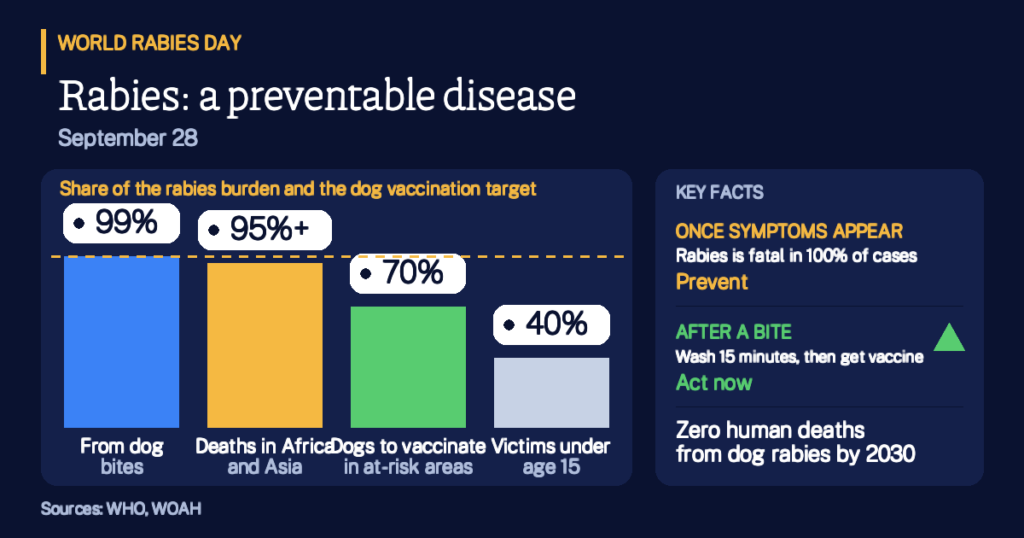
Rabies is a virus that spreads through the saliva of an infected animal, usually through a bite or scratch. It travels along nerves to the brain. The incubation period is typically two to three months, though it can range from one week to a year. That delay is the reason prevention works: there is a window after a bite when treatment can still stop the virus. Once the virus reaches the central nervous system and clinical symptoms appear, WHO states that rabies is fatal in 100 percent of cases.
The source of infection matters. Dogs cause 99 percent of human rabies cases, according to WHO. In the Americas the picture has changed: vampire bats, which feed on blood, are now the primary source of human cases there. This is why the strategy for most of the world is aimed at dogs, not at people alone.
The numbers behind the day
Counting rabies deaths is hard, because many occur at home in remote areas and go unrecorded. WHO’s fact sheet cites the 2021 Global Health Estimates model, which puts annual deaths at 44,203, and notes that the true toll is likely substantially higher. An earlier WHO and WOAH figure, widely quoted since 2018, is about 59,000 deaths a year. The two numbers come from different models and years, so treat them as a range that shows scale, not a precise count.
The burden is lopsided. More than 95 percent of rabies deaths occur in Africa and Asia, WOAH reports, and about 40 percent of victims are children under 15. Children between 5 and 14 are frequent victims, partly because they play with dogs and may not report a bite.
- 44,203annual deaths in the 2021 WHO estimate, likely higher
- 29 million+people receive human rabies vaccine each year
- $108average cost of treatment after a bite, as of 2018
- $8.6 billionestimated yearly global cost of rabies, per WHO
The cost of a bite
Treatment after a bite is effective, but it is not free. WHO puts the average cost of a course at US$108 as of 2018, before travel and lost income. For families who live on one to two dollars per person each day, that is a heavy burden, and clinics are often far away. Part of the answer is a technique called intradermal vaccination, which uses smaller doses injected into the skin and reduces costs by 60 to 80 percent compared with the standard method, without compromising safety or efficacy.
Example 1: a week of wages. Suppose a household earns $2 per person per day and a bitten child needs a $108 course. That equals 54 days of one person’s income, and 108 days at $1 per day. The figures are round and illustrative, but they show why a bite can push a family into debt or lead them to skip care.
Example 2: the intradermal saving. Imagine a clinic whose standard course costs $100. If an intradermal schedule cuts costs by 60 to 80 percent, the same course would cost between $20 and $40. Across 500 patients, the clinic would save $30,000 to $40,000. These numbers are made up to show the arithmetic.
Stopping rabies at its source
The most cost-effective way to protect people, according to WHO, is mass vaccination of dogs. WOAH states that vaccinating at least 70 percent of dogs in at-risk areas can reduce human cases to zero. When dogs are immune, the virus has no path into people, and the need for bite treatment shrinks over time.
Example 3: one village. Picture a village with about 1,000 dogs. Reaching 70 percent means vaccinating 700 of them, and teams usually have to return each year as puppies are born. This is an illustration, not a real program, but it shows why campaigns focus on coverage that is high enough and sustained.
Zero by 30
In 2015, a conference titled “Global elimination of dog-mediated human rabies: The Time Is Now” set the goal of zero human deaths from dog-mediated rabies by 2030. In 2018, WHO, WOAH, the Food and Agriculture Organization (FAO) and the Global Alliance for Rabies Control launched a joint plan called Zero by 30. It was the first time the four partners joined forces behind one strategy. The idea is simple: vaccinate dogs, make treatment available, and educate communities about bites.
Progress is visible. According to WHO’s fact sheet, as of September 17, 2026, Bhutan, Chile and Mexico have been validated as having eliminated dog-mediated human rabies as a public health problem, and 17 countries have declared themselves free of rabies virus to WOAH. WOAH reports that its Rabies Vaccine Bank, set up in 2012, has delivered 26.9 million dog vaccines to 37 countries. Dog-mediated rabies has long been eliminated in western Europe, Canada, the United States and Japan, which shows the goal is realistic.
What you can do
Individuals matter more than they might think. Wash any bite or scratch with soap and water for at least 15 minutes, then go to a health facility without delay, even if the animal looked healthy. Vaccinate pet dogs and cats where required. Teach children to avoid unfamiliar animals and to tell an adult about any bite. In places with bats, never handle them with bare hands. Communities can support dog vaccination days, and schools can use September 28 to teach bite safety.
Key Takeaways
- Rabies is almost always fatal once symptoms appear. Yet it is preventable if treatment starts after a bite.
- Dogs cause 99 percent of human cases. That is why protecting dogs protects people.
- The burden falls on the poor and the young. More than 95 percent of deaths are in Africa and Asia, and about 40 percent of victims are under 15.
- Wash first, then seek care. Soap and water for 15 minutes, followed by vaccine and, when indicated, antibodies.
- Treatment is costly for families. An average course cost $108 as of 2018, and intradermal dosing can cut that by 60 to 80 percent.
- Vaccinating 70 percent of dogs in at-risk areas can end human cases. This is WOAH’s stated threshold.
- The goal is zero by 2030. Bhutan, Chile and Mexico show it can be done.
How solid is this? Death counts are modeled estimates, and WHO notes they are likely underreported. The 44,203 figure comes from the 2021 Global Health Estimates and the 59,000 figure from an earlier WHO and WOAH estimate, so they should not be compared as a trend. The cost figures carry the years given. The three worked examples use round, made-up numbers to show an idea. See also the International Days hub and the International Days Calendar.
More in Health