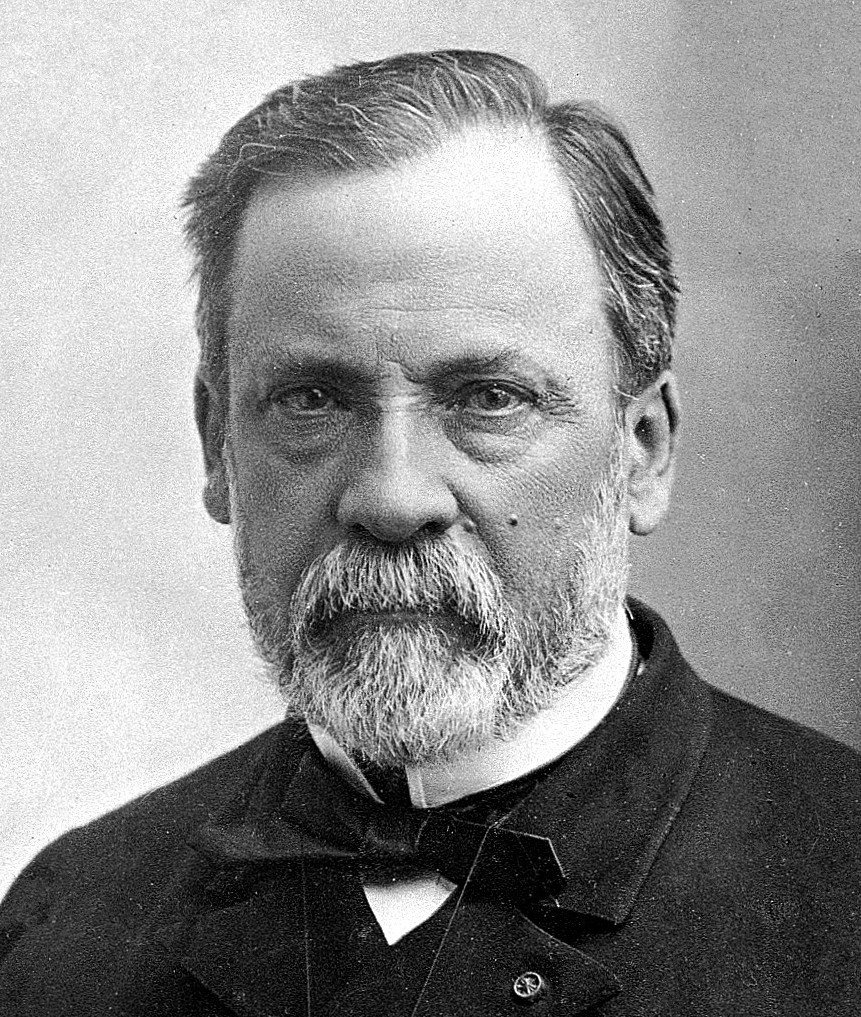
Louis Pasteur (1822 to 1895) was a French chemist and microbiologist whose experiments helped establish the germ theory of disease. He showed that microbes cause fermentation and spoilage, developed early vaccines against anthrax and rabies, and founded the research institute that bears his name. The heating process called pasteurization is named after him.
Early life of Louis Pasteur
Pasteur was born in Dole, France, on December 27, 1822, to Jean-Joseph Pasteur, a leather tanner, and Jeanne-Etienne Roqui. He spent his early school years in the town of Arbois and in Besancon, near the Swiss border. He earned a bachelor of arts degree from the Royal College of Besancon in 1840 and a bachelor of science degree in 1842.
In 1843 he passed the exams for the Ecole Normale in Paris, where his studies centered on chemistry and physics. He received a doctorate in 1847. His mother died suddenly in May 1848.
His early chemistry work included the study of crystals and tartaric acid, topics that appear in his surviving lecture notes. That training in careful laboratory method later shaped his work on microbes.
He became a professor of chemistry at the University of Strasbourg in January 1849. In 1854 he was promoted to dean of the faculty of science at the University of Lille. He then began the research on fermentation that made his name.
Career and major work of Louis Pasteur
Pasteur’s work on fermentation began in Lille. The German chemist Justus von Liebig had argued that fermentation was a chemical process in which a substance decomposes, and the two men corresponded and challenged each other through the 1850s and 1860s. Pasteur argued that living microorganisms were responsible. This view fits the modern picture of fermentation as a process driven by yeasts and bacteria.
In 1864 he found that heating wine to between 50 and 60 degrees Celsius, or 122 to 140 degrees Fahrenheit, killed the microorganisms that caused spoilage. The method was later applied to milk and other drinks and foods. Throughout the early 1860s he also carried out a series of experiments to test the idea that germs in the air, not spontaneous generation, explained why nutrient broths became cloudy.
Pasteur then turned to diseases. In a widely publicized experiment in 1881 he gave an experimental anthrax vaccine to livestock at Pouilly-le-Fort. By the mid-1800s scientists such as Pasteur were trying to produce vaccines for infectious diseases using weakened forms of the agents that cause them, building on Edward Jenner’s smallpox work in 1796.
In the spring of 1880 Pasteur began to study rabies, which he called an invisible dragon because it was so deadly. On July 6, 1885, he vaccinated Joseph Meister, a nine-year-old boy who had been bitten by an infected dog. The treatment was reported as successful, and patients began to arrive from around the world. Funding for a dedicated research center came from international donors, and the Science History Institute holds a receipt from 1887 showing that even France’s poorest peasants contributed.
Ideas and contributions of Louis Pasteur
Pasteur’s central idea was that microorganisms are active agents in the living world. In the mid-1800s many people accepted the miasma theory, which said that disease was caused by bad air, and others believed that living things could arise spontaneously from nonliving matter. One of the best-known supporters of spontaneous generation was the naturalist Felix Pouchet, who made his case in a book published in 1859.
Pasteur’s experiments on airborne germs helped to defeat that view. His wider work linked microbes to fermentation, spoilage and infection, which became the foundation of modern microbiology. It also helped to change practices in medicine, food production and public health.
His vaccine work showed that weakened pathogens could be used to protect against disease. A vaccine works by showing the immune system a harmless form of a germ so that it can respond quickly to the real one. Pasteurization, by contrast, uses controlled heat to reduce the microbes that spoil food and drink without cooking the product through. The Science History Institute notes that his contributions in fermentation, pasteurization and vaccination all depended on collaboration with colleagues as well as competition with rivals.
Disputes and criticism
Liebig and Pasteur each challenged the credibility of the other’s fermentation research, according to the Science History Institute, and the exchange lasted for years.
Pasteur had sharp scientific disagreements, notably with Liebig on fermentation and with Pouchet on spontaneous generation. The Science History Institute describes the science of his era as a mix of competition and collaboration, and it notes that his methods and claims were scrutinized then and since.
The rabies treatment of 1885 was a risky step. It was given to a boy who might otherwise have died, and it was reported at once as a success. A satirical cartoon in the magazine Puck in 1885 shows how widely the public followed the story.
Legacy of Louis Pasteur
After the rabies treatment, patients came from around the world, and the need for a dedicated institution became clear. A public appeal and a decree recognizing charitable status laid the foundations in 1887, and the Institut Pasteur officially opened on November 14, 1888. It has had ten Nobel laureates, including Ilya Mechnikov, Alphonse Laveran, Francois Jacob, Jacques Monod and Andre Lwoff.
Rabies is a zoonotic disease, meaning one that passes from animals to people, and Pasteur’s vaccine was an early answer to it. Vaccination programs today also rely on herd immunity, in which a high level of immunity in a population reduces the spread of an infection.
The institute describes its aim as to understand, protect and innovate in the interests of human health, and it has now worked on that mission for almost 140 years. Pasteur died in 1895. Pasteurization is now used worldwide, and the vaccines and microbiology that grew from his work are central to public health. Readers should treat this entry as history and not as medical advice.
More in Biology
Key facts
- Louis Pasteur was born in Dole, France, on December 27, 1822, and died in 1895.1
- In 1864 he found that heating wine to between 50 and 60 degrees Celsius killed the microorganisms that spoiled it.1
- He gave an experimental anthrax vaccine to livestock at Pouilly-le-Fort in 1881.1
- On July 6, 1885, he vaccinated nine-year-old Joseph Meister, who had been bitten by a dog with rabies.1
- The Institut Pasteur officially opened on November 14, 1888.2
Related concepts
Quick checkWhat is Louis Pasteur famous for?Show answer
Pasteur is famous for showing that microbes cause fermentation and spoilage, for the heating process now called pasteurization, and for developing vaccines against anthrax and rabies. He also founded the Institut Pasteur in Paris.
Sources
- Science History Institute, Scientific Biographies: Louis Pasteur, https://www.sciencehistory.org/education/scientific-biographies/louis-pasteur/
- Institut Pasteur, Our History, https://www.pasteur.fr/en/institut-pasteur/history
Editorially reviewed by Specialty Digest Editorial TeamLast reviewed November 4, 2026Researched and drafted with AI assistanceReport an issue